
Sign up to save your podcasts
Or



Based on Podcast App listening data
There have been far more lethal pandemics than Covid-19, but the scale of our response to Covid-19 is dramatically new. For the first time in human history, our civilization made a collective decision to shut much of the world economy down. Contemporary historian Adam Tooze helps us understand what happened, why it happened, and how we can learn from it.
Sign up for our new weekly newsletter, The Pitch: https://civicventures.substack.com/
Adam Tooze holds the Shelby Cullom Davis chair of History at Columbia University and serves as Director of the European Institute. In 2019, Foreign Policy Magazine named him one of the top Global Thinkers of the decade. His most recent book, Shutdown: How Covid Shook the World’s Economy, is out now.
Twitter: @adam_tooze
Shutdown: How Covid Shook the World’s Economy: https://bookshop.org/books/shutdown-how-covid-shook-the-world-s-economy/9780593297551
Check out the Unf*cking The Republic podcast at https://www.unftr.com
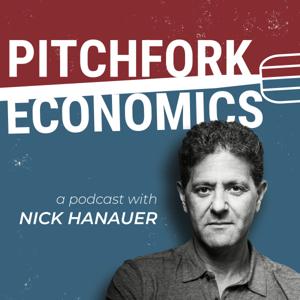
Website: http://pitchforkeconomics.com/
Twitter: @PitchforkEcon
Instagram: @pitchforkeconomics
Nick’s twitter: @NickHanauer
Roosevelt Institute President Felicia Wong and writer Hanna Brooks Olsen join Nick and Goldy to explore how the intense burdens of poverty make it nearly impossible to even think about climbing the economic ladder. This episode was originally recorded and released in 2019.
Sign up for our new weekly newsletter, The Pitch: https://civicventures.substack.com/
Felicia Wong is the President and CEO of the Roosevelt Institute.
Twitter: @FeliciaWongRI @rooseveltinst
Hanna Brooks Olsen is a writer and the co-host of Spotless, a podcast about cleaning.
Twitter: @mshannabrooks
Website: http://pitchforkeconomics.com/
Twitter: @PitchforkEcon
Instagram: @pitchforkeconomics
Nick’s twitter: @NickHanauer
Everything you need to know about what the expanded child tax credit actually is, why it’s good policy, and how it will impact people’s lives.
Wendy Bach is a Professor of Law at the University of Tennessee, Knoxville. She is a nationally recognized expert in poverty law.
Twitter: @wendyabach
Biden’s child tax credit is a step away from a discriminatory system: https://qz.com/2034199/how-does-the-us-child-tax-credit-work/
Two-thirds of people now receive monthly benefit checks: https://www.peoplespolicyproject.org/2021/07/19/two-thirds-of-people-now-receive-monthly-benefit-checks/
The time tax: https://www.theatlantic.com/politics/archive/2021/07/how-government-learned-waste-your-time-tax/619568/
Website: http://pitchforkeconomics.com/
Twitter: @PitchforkEcon
Instagram: @pitchforkeconomics
Nick’s twitter: @NickHanauer
What’s the next generation of access to credit? Why are home prices and rents so out-of-whack with each other? And how can we approach the discord between what liberals say they want for their community versus what housing and development policies they’ll actually support? Glenn Kelman, the CEO of real estate brokerage website Redfin, helps us examine the future of housing and the best ways that companies like his can contribute to solving the housing crisis.
And if you’re wondering why this episode sounds so good, or why nobody mentions the pandemic… it’s because this conversation is from our archives of interviews that we recorded in-studio, just before the pandemic hit. But don’t let that discourage you—this is still just as relevant today as the day it was recorded. Enjoy!
Glenn Kelman is the CEO of Redfin.
Twitter: @glennkelman
Website: http://pitchforkeconomics.com/
Twitter: @PitchforkEcon
Instagram: @pitchforkeconomics
Nick’s twitter: @NickHanauer
Is inflation bad? What’s the difference between a neoliberal and a conservative? If large corporations were held to higher labor standards than small employers, wouldn’t Walmart get all the talent? And more!
Thanks to Mark from Nashville, David from Japan, Mike from Dallas-Fort Worth, Mary from Pennsylvania, Steve from Austin, and Pete from Boston, who left the great voicemails included in this episode! If you have any questions for a future AMA episode, leave us a voicemail at 731-388-9334.
Website: http://pitchforkeconomics.com/
Twitter: @PitchforkEcon
Instagram: @pitchforkeconomics
Nick’s twitter: @NickHanauer
Workers at a Frito-Lay factory in Topeka, Kansas made national headlines when they went on strike to protest dismal labor conditions including forced overtime and 84-hour workweeks. (Frito-Lay's parent company, PepsiCo, made $10.5 billion in profit last year.) The strike ended after 19 days on July 26th, but it’s an important part of a national conversation about labor and corporate profits. Kansas state Representative Jason Probst joins the show to explain the details of the strike and how these insidious labor practices affect his state’s economy.
Jason Probst serves in the Kansas House of Representatives.
Twitter: @thatguyinhutch
Substack: https://thatguyinhutch.substack.com/
Kansas Frito-Lay workers end strike: https://www.washingtonpost.com/business/2021/07/26/frito-lay-strike-topeka/
Striking information - what PepsiCo’s annual report tells us about the Frito Lay strike: https://thatguyinhutch.substack.com/p/striking-information
The Backbreaking Work That Goes Into a Bag of Chips: https://nymag.com/intelligencer/2021/07/frito-lay-workers-on-their-strike.html
Website: http://pitchforkeconomics.com/
Twitter: @PitchforkEcon
Instagram: @pitchforkeconomics
Nick’s twitter: @NickHanauer
Nick and Goldy answer your questions! If we had progressive taxation, would we still need means testing? Can we send ultra-rich people away to their own economy? What are the best economic indicators for the progressive economy? And more!
Thanks to Lisa from Indianapolis, Rick from Baltimore, Jacob from Portland, Sean from Philadelphia, Linda from Seaside, and Frank from Georgia who left the great voicemails included in this episode! If you have any questions for a future AMA episode, leave us a voicemail at 731-388-9334.
Website: http://pitchforkeconomics.com/
Twitter: @PitchforkEcon
Instagram: @pitchforkeconomics
Nick’s twitter: @NickHanauer
Can we create transformative climate outcomes by adopting new regulatory strategies? Financial regulation expert Sarah Bloom Raskin helps us explore what levers exist to steer fiscal and monetary policy toward lasting sustainability.
Sarah Bloom Raskin is the former Deputy Secretary of the U.S. Department of the Treasury and a former Governor of the Federal Reserve Board. She served as the Commissioner of Financial Regulation for the State of Maryland from 2007 to 2010. She is currently a visiting professor and distinguished fellow at Duke Law School’s Global Financial Markets Center, and a member of President Biden’s Regenerative Crisis Response Committee, which recommends changes in fiscal, monetary, and financial regulatory policies that are likely to enable the U.S. to achieve net carbon neutrality before 2050.
Twitter: @SBloomRaskin
Learn more about the Regenerative Crisis Response Committee here: https://regenerativecrisisresponsecommittee.org/
Does environmental regulation kill or create jobs? https://policyintegrity.org/files/media/Jobs_and_Regulation_Factsheet.pdf
Do regulations really kill jobs? https://www.theatlantic.com/business/archive/2017/01/regulations-jobs/513563/
Website: http://pitchforkeconomics.com/
Twitter: @PitchforkEcon
Instagram: @pitchforkeconomics
Nick’s twitter: @NickHanauer
Our friends at the Center for American Progress put on a great virtual event last week with Senator Sherrod Brown, discussing how the U.S. tax codes favors the wealthy and the tools Congress plans to use to rebalance the tax system.
Twitter: @amprog
You can watch video of the event here: https://www.americanprogress.org/events/2021/06/21/500822/billionaires-paying-no-taxes/
The Secret IRS Files: Trove of Never-Before-Seen Records Reveal How the Wealthiest Avoid Income Tax: https://www.propublica.org/article/the-secret-irs-files-trove-of-never-before-seen-records-reveal-how-the-wealthiest-avoid-income-tax
Website: http://pitchforkeconomics.com/
Twitter: @PitchforkEcon
Instagram: @pitchforkeconomics
Nick’s twitter: @NickHanauer
Contrary to fears that economic inclusion must come at the expense of economic growth, global management consulting firm McKinsey & Company's research and empirical evidence supports the idea that economic growth is at its best when it is most inclusive – but that equity needs to be embedded in systems from the start in order to be effective. What does ‘inclusion’ mean in the context of an economy that works for everyone? McKinsey's JP Julien explains how policymakers and companies can ensure that economic growth goes hand-in-hand with – and is enhanced by – reducing inequality.
JP Julien is an Associate Partner at McKinsey & Company, where he serves US federal, state, and city governments on inclusive economic-development topics and supports private-, public-, and social-sector organizations in advancing racial equity. He is a leader of the McKinsey Institute for Black Economic Mobility, a global economic think tank focused on inclusive economic development and racial equity topics.
Twitter: @McKinsey
The case for inclusive growth: https://www.mckinsey.com/industries/public-and-social-sector/our-insights/the-case-for-inclusive-growth
Website: http://pitchforkeconomics.com/
Twitter: @PitchforkEcon
Instagram: @pitchforkeconomics
Nick’s twitter: @NickHanauer
From the publisher's feed
Ranked by our users in the last 21 days

9,188 Listeners

10,714 Listeners

3,472 Listeners

1,982 Listeners

431 Listeners

1,198 Listeners

6,273 Listeners

6,103 Listeners

32,248 Listeners
545 Listeners
9,300 Listeners
627 Listeners

2,074 Listeners

15,886 Listeners
562 Listeners