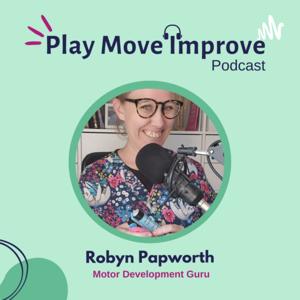
Play Move Improve

Play Move Improve

By Robyn PapworthEducation
Download on the App Store

Play Move Improve episodes

  • Why transitions can be challenging for neurodivergent children

    Play Move Improve Podcast: Understanding and Managing Transitions for Neurodivergent Children


    Episode Summary

    In this insightful episode, Robyn Packworth, an exercise physiologist and developmental educator, discusses the challenges that neurodivergent children face with transitions and offers practical strategies to help.

    • The cerebellum and prefrontal cortex play crucial roles in managing transitions
    • Neurodivergent children may struggle with sensory processing and predicting what happens next
    • Internal time management systems can be affected in neurodivergent individuals
    • Transitions can be particularly stressful for children who have masked their behaviors all day
      1. Provide warnings before transitions
      2. Use transition objects (e.g., favorite toys, fidgets)
      3. Implement visual schedules
      4. Offer comforting routines (e.g., favorite snacks, songs)
      5. Create a predictable after-school routine
        • Visual schedules for transitions
        • Comfort toy handout
        • Vagus nerve drop-off handout

        • Robyn Packworth is a mother of three, an exercise physiologist, developmental educator, and early learning speaker. She works with the Beautiful Parents Hub in Victoria, supporting children with developmental delays, autism, anxiety, ADHD, and dyspraxia.


          Join our free online community for more support and resources! Sign up here: Play Move Improve Online Community

          • Website: playmoveimprove.com.au
          • Leave a review on iTunes or Spotify

          • Remember, transitions can be challenging, but with understanding and the right strategies, we can make them easier for our children!

            10 min
          • Early childhood emotional development - eye contact before emotion cards

            Play Move Improve Podcast: Beyond Emotion Cards - The Foundations of Emotional Development


            Episode Summary

            In this insightful episode, Robyn Papworth, an exercise physiologist and developmental educator, discusses the importance of foundational emotional development in children, especially those born during the social pandemic of 2020-2021.


            She explains why emotion cards might not be the best first approach and offers practical strategies for supporting children's emotional growth.

            • The impact of the social pandemic on children's emotional development
            • The importance of joint attention and social connection in early emotional development
            • Why emotion cards may not be effective for young children without foundational skills
            • The role of play in developing emotional regulation and brain function
            • The significance of interoception in understanding and expressing emotions
              1. Provide opportunities for eye contact and joint attention
              2. Engage in shared activities (e.g., singing, playing games, household tasks)
              3. Encourage community involvement and social interactions
              4. Prioritize play with real 3D objects to stimulate brain development
              5. Create experiences that develop interoception (awareness of internal bodily sensations)

              6. Robyn Papworth is a mother of three, an exercise physiologist, developmental educator, and early learning speaker. She is passionate about empowering parents and educators to set up engaging play activities that improve children's development, health, and learning outcomes.


                Robyn mentions an upcoming program focused on foundational skills for emotional development. Stay tuned for more information!


                Join our free online community for more support and resources! Sign up here: Play Move Improve Online Community

                • Website: playmoveimprove.com.au
                • Leave a review on iTunes or Spotify

                • Remember, building strong foundations for emotional development through play, connection, and sensory experiences is crucial for our children's growth and well-being!

                  10 min
                • Hugh asks his mum Robyn Papworth questions about the brain, Exercise Physiology, and his favourite topic, basketball!

                  Play Move Improve Podcast: A Special Q&A with Robyn and Hugh Papworth


                  Episode Summary

                  In this delightful episode, Robyn Papworth is joined by her son Hugh for a fun and insightful Q&A session. They take turns asking each other questions about Robyn's career, Hugh's love for basketball, and their shared interests in the brain and sports.

                  1. Favorite part of the brain: Amygdala, for its role in personal growth through anxiety and fear
                  2. Career aspirations: Originally wanted to be a biomechanist for tennis, switched to rehab after a personal experience
                  3. Top tip for a successful business: Be yourself and embrace your quirks
                  4. Estimated number of children helped: Thousands, with a focus on making a difference one child at a time
                  5. Discovery of exercise physiology: Through university studies in exercise science

                  6. Bonus Basketball Question: Robyn named five Melbourne United players, showcasing her growing knowledge of the sport thanks to Hugh's influence

                    1. Motivation for starting a podcast: To share knowledge about basketball and compete with mom's podcast
                    2. Love for basketball: 10 out of 10
                    3. When basketball passion began: After a pickup game at school
                    4. Favorite NBA team and player: Split between Clippers and Memphis Grizzlies; favorite player is GG Jackson
                    5. Preference between NBA and NBL: Appreciates both for different reasons

                    6. Bonus Brain Question: Hugh named three parts of the brain: hippocampus, amygdala, and cerebellum

                      • Hugh's own podcast: "Hugh's NBA Highlights"
                      • Robyn's journey from biomechanics to exercise physiology
                      • The family's shared interest in Melbourne United (NBL team)
                      • Hugh's passion for basketball and its positive impact on his life
                      • The blend of sports and brain science in their family discussions

                      • Robyn Papworth is an exercise physiologist, developmental educator, speaker, and mother of three. Hugh is Robyn's son and an enthusiastic basketball fan with his own podcast.

                        • Check out Hugh's new podcast ⁠Hugh's NBA Highlights⁠ to share your support!
                        • Share your questions for Hugh for potential future episodes
                        • Join our free online community for more content and discussions: Play Move Improve Online Community
                          • Website: playmoveimprove.com.au
                          • Leave a review on iTunes or Spotify

                          • This episode showcases the fun and educational dynamics of the Papworth family, blending professional insights with personal passions!

                            10 min
                          • How screen time is impacting children's sensory development

                            Play Move Improve Podcast: Essential Sensory Skills for Children's Development


                            Episode Summary

                            In this informative episode, Robyn Papworth, an exercise physiologist and developmental educator, discusses the importance of sensory skills in children's development. She highlights eight essential sensations and provides practical activities to enhance these skills.

                            1. Many children today struggle with basic sensory skills that weren't a concern a decade ago.
                            2. Eight essential sensations: visual, auditory, taste, smell, touch, vestibular, proprioception, and interoception.
                            3. Modern lifestyle changes, including increased screen time and reduced outdoor play, are impacting children's sensory development.
                            4. Sensory integration is crucial for fine motor skills, self-regulation, and overall learning.
                              1. Visual: 3D objects, natural light, searching for hidden objects
                              2. Auditory: Various sounds, music, guessing games with different noises
                              3. Taste: Encourage trying different foods (consult professionals if concerned)
                              4. Smell: Use herbs, essential oils, and everyday scents to stimulate memory and calm
                              5. Touch: Provide various textures through sensory tubs, gardening, and cooking activities
                              6. Vestibular: Head movement activities like dancing, spinning, and looking up/down
                              7. Proprioception: Jumping, hopping, crawling, and other pressure-inducing movements
                              8. Interoception: Awareness of internal bodily sensations like hunger, thirst, and temperature
                                • Create sensory tubs with various materials (sand, water, corn flour, etc.)
                                • Use recycled shampoo bottles for smell activities
                                • Incorporate outdoor play to experience different temperatures and textures
                                • Discuss bodily sensations during meals and drinks
                                • Engage in gross motor activities to stimulate the vestibular system and proprioception

                                • Proper sensory development is crucial for:

                                  • Self-regulation and emotional control
                                  • Focus and attention in class
                                  • Fine motor skills development
                                  • Overall learning and development

                                  • Robyn Papworth is an exercise physiologist, developmental educator, speaker, author, and mother of three. She is passionate about empowering parents and educators to support children's development through engaging play activities.

                                    • Try one of the suggested activities and share your experience
                                    • Reach out to Robyn for more ideas or support
                                    • Join our free online community for more resources and discussions: Play Move Improve Online Community
                                      • Website: playmoveimprove.com.au
                                      • Leave a review on iTunes or Spotify

                                      • Remember, supporting your child's sensory development can be fun and easy with these simple, everyday activities!

                                        14 min

                                      About Play Move Improve

                                      From the publisher's feed

                                      Hey, I'm Robyn from Play Move Improve. I am an Exercise Physiologist, Developmental Educator and Trainer who is passionate about getting more children active and moving each day.