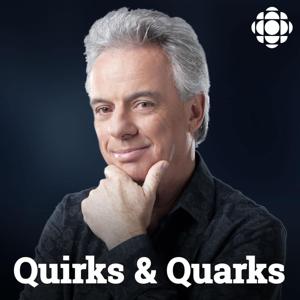
Quirks and Quarks

Quirks and Quarks

Download on the App Store
  • Ranking

    1st

    on Earth Sciences

  • Favorites

    930

    Followers

  • Typical duration

    54 min

    per episode

  • If it hooks

    69%

    finish an episode

Based on Podcast App listening data

Quirks and Quarks episodes

  • Quirks and Quarks Introduces: Tai Asks Why - Season 4
    Fifteen-year-old Tai Poole won’t rest until he’s uncovered the mysteries of the universe, one probing question at a time. In Season 4 of his Webby-winning podcast, Tai talks to everyone from NASA scientists to stand-up comedians to his equally curious little brother Kien. If you’ve ever wondered if we can keep eating meat without destroying the planet or if we’re alone in the universe, Tai has you covered. More episodes are available at hyperurl.co/taiaskswhy
    5 min
  • A sabretooth hypercarnivore, pack hunting spiders, urban trees and invasive insects, testing a baleen whale’s hearing, tire rubber pollution, clothes that listen to you and lithium mining in Ontario.
    Paleontologists identify the first sabre-toothed mammalian hypercarnivore; A rare social spider hunts in packs in order to kill large prey; The urban tree canopy is facing a worst-case scenario in the near future; How do you test how well a whale hears?; Rubber dust from car tires can poison freshwater fish; Your favourite shirt might soon be listening to your hearbeat; Canada has lithium in Northwestern, Ontario. What is being done to mine it?
    55 min
  • Russia and space cooperation, the UN plastic treaty, ancient 10-legged octopus, medical alarm sounds and the price of fear for prey animals.
    Will cooperation in space with Russia survive war in Ukraine?
    For more than half a century, through international conflict and political turmoil, the west has cooperated on a wide range of activities in space with the Soviets and then the Russians, culminating in the International Space Station. We speak with Mac Evans, former head of the Canadian Space Agency about why the war in the Ukraine runs the risk of ending that long collaboration.
    What will the new UN treaty to control plastic pollution need to achieve?
    On March 2, at a meeting of the United Nations Environmental Assembly in Nairobi the world’s nations agreed to negotiate a global agreement to control plastic pollution. We speak to Max Liboiron, a plastics pollution researcher at Memorial University of Newfoundland, about how the world created its plastics problem, and Tony Walker, who studies plastics pollution at Dalhousie University, on what he hopes the treaty will accomplish.
    The oldest octopus ancestor ever found had ten arms.
    Christopher Whalen, a palaeontologist from the American Museum of Natural History in New York has identified the oldest vampyropod, the group that includes ancestors of the octopus. The 328 million year old fossil from Montana is in extraordinary condition and is 82 million years older than the previous oldest find. But the big surprise is that this is that this animal had ten arms. His research was published in Nature Communications.
    Making medical alarms less awful – and maybe saving lives
    Hospitals can be pretty noisy places. Medical devices, in particular, make quite a racket. And while their alarms are essential, perhaps they don’t have to be so unpleasant. Michael Schutz, a professor of music cognition at McMaster University, believes that we can use what we know about music to improve the sonic environment in hospitals – and maybe save lives in the process.
    Fear of predation all by itself can reduce the survival rate of songbirds
    Liana Zannette, a biology professor from Western University in London, Ontario has found that just being aware of predators, even without actually being preyed upon, can reduce the reproductive rate of songbirds, and reduce the survival rate of those offspring they do have by as much as 53 percent. The most obvious impact is that birds living in fear do not eat. Her research was published in Proceedings of the National Academy of Sciences.
    Are people who get blood transfusions from vaccinated donors protected from COVID?
    For the answer to this Quirks listener question, we hear from Dr. Jacob Pendergrast, a director of the blood transfusion service at the University Health Network in Toronto.

    55 min
  • Climate change and health, the biggest bacteria, rare earth metal recycling, tracking a giant Antarctic iceberg and are we living in a simulation?
    IPCC report gives bleak warning about the future, but ideas on how we should prepare; Scientists discover the world’s biggest bacteria; Rare earth elements can be extracted from mining and electronic waste; Researchers watch a wandering Antarctic iceberg the size of PEI melt down; Could we be living in a computer simulation? And if we were, would there be any way to tell?
    55 min
  • A Quirks & Quarks special: Feeding The Future - How we can feed 10 billion people without killing the planet
    By many estimates we’re going to have 10 billion people on the planet by the year 2050. That’s a lot of mouths to feed. As it is, we have a hard time feeding the world’s current population. Many experts say that our food systems are at a breaking point, and that the way we eat - and what we eat - has to change. But there are solutions.
    This week, on a special edition of Quirks & Quarks, we’ll unpack the latest science showing what the future of food should look like.
    First we look at how farmers across the country are turning their fields into science experiments to help them survive climate change. Plus, we’ll look at the technologies that could help Canada grow fresh produce all year long.
    Then we look at sustainable food systems that curb waste, and how people are growing food where it was never thought possible - in concrete jungles and remote northern villages.
    Finally, we’re looking at the future of protein, from lab-made meat, to milk from a microbrewery, which can all be made without ever touching an animal.
    55 min
  • Roman porta-potty, rogue waves, why dogs can be tiny and titanic, half billion year old fossil nerves, a history of timekeeping and sleep and light.
    Researchers reveal an ancient Roman porta-potty; A rare ‘rogue wave’ is captured by marine scientists; Dogs range in size from tiny to enormous – and the gene behind the variation comes from wolves; A 500 million year old fossil preserves the nervous system of an ancient sea creature; Marking the science and history of timekeeping, tick by tick; Quirks Listener Question. Do we sense light from other places in our body other than our eyes?
    55 min

About Quirks and Quarks

From the publisher's feed

CBC Radio's Quirks and Quarks covers the quirks of the expanding universe to the quarks within a single atom... and everything in between.

Best of Quirks and Quarks

Ranked by our users in the last 21 days

More shows like Quirks and Quarks

As It Happens by CBC

As It Happens

421 Listeners

White Coat, Black Art by CBC

White Coat, Black Art

111 Listeners

Ideas by CBC

Ideas

394 Listeners

Laugh Out Loud by CBC

Laugh Out Loud

154 Listeners

Day 6 by CBC

Day 6

45 Listeners

Because News by CBC

Because News

178 Listeners

The Current by CBC

The Current

205 Listeners

The Sunday Magazine by CBC

The Sunday Magazine

59 Listeners

Under the Influence with Terry O'Reilly by Apostrophe Podcast Network

Under the Influence with Terry O'Reilly

734 Listeners

The House by CBC

The House

74 Listeners

Cross Country Checkup by CBC

Cross Country Checkup

18 Listeners

Fault Lines by CBC

Fault Lines

27 Listeners

2050: Degrees of Change by CBC

2050: Degrees of Change

21 Listeners

The Fridge Light by CBC

The Fridge Light

166 Listeners

The Debaters by CBC

The Debaters

190 Listeners

The Secret Life of Canada by CBC

The Secret Life of Canada

244 Listeners

Front Burner by CBC

Front Burner

427 Listeners

Killers: J pod on the brink by CBC Radio

Killers: J pod on the brink

16 Listeners

Cost of Living by CBC

Cost of Living

27 Listeners

More with Anna Maria Tremonti by CBC

More with Anna Maria Tremonti

10 Listeners

The Dose by CBC

The Dose

89 Listeners

Inappropriate Questions by CBC

Inappropriate Questions

346 Listeners

We Regret To Inform You: The Rejection Podcast by Apostrophe Podcast Network

We Regret To Inform You: The Rejection Podcast

166 Listeners

World on Fire by CBC

World on Fire

4 Listeners

What on Earth? by CBC

What on Earth?

23 Listeners

Recall: How to Start a Revolution by CBC

Recall: How to Start a Revolution

66 Listeners

Unforked by CBC

Unforked

4 Listeners

Backstage at the Vinyl Cafe by Apostrophe Podcast Network

Backstage at the Vinyl Cafe

274 Listeners

10 Minutes to Save the Planet by CBC

10 Minutes to Save the Planet

5 Listeners

CBC Marketplace by CBC

CBC Marketplace

4 Listeners

Just Asking by CBC

Just Asking

3 Listeners