
Sign up to save your podcasts
Or



Based on Podcast App listening data
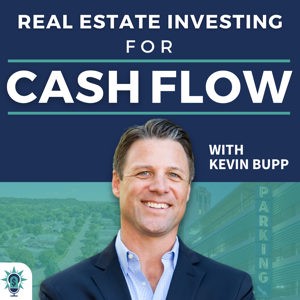
In this episode of the Real Estate Investing for Cashflow podcast, Kevin welcomes back real estate investment expert, Brian Murray. Brian is the founder and CEO of Washington Street Properties, a commercial real estate investment and property management company and one of the nation's fastest growing private companies. Bryan is also the author of the best selling book, Crushing It In Apartments and Commercial Real Estate, a definite must-read for anyone who wants to start in the commercial real estate space.
Brian talks about real estate management and how he manages to spread his focus geographically and on different asset types. He shares some insights about multifamily vis-à-vis commercial property real estate. He shares details on how his company re-purposed an old hotel into a thriving apartment complex. Kevin and Bryan also discuss how to find great opportunities and give some advice on how to thrive in these challenging times. QUOTES:
"That first acquisition kind of set the tone in terms of how I developed my own company and it's really based on value adds."
"We'll increase the income, drive those expenses down, create value and then we pull some cash out and grow, but that's becoming more of a challenge now."
"I feel like you've got a lot more control with multifamily, when you're managing a commercial property, it depends on the specific property but many, many times you have a disproportionate amount of rent coming in from individual tenants so if you lose a tenant in a commercial property, depending on the specific property, you may lose ten percent of your rent or even a hundred percent of your rent."
"With our residential tenants, we have primarily workforce housing type tenants, you know, people who are down to earth and frankly, I've been more comfortable dealing with them."
"Cap rates are so much higher in hotels right now than they are in multifamily that I think there's a lot of opportunity out there that people can pursue."
HIGHLIGHTS
Job Opportunities with my Team: Click Here
Recommended Resources:
Review and Subscribe
This week's episode of the Real Estate Investing For Cashflow podcast features real estate investment expert Ian Ross, founder of Somera Road, Inc; a real estate private equity firm based in New York. Somera takes an entrepreneurial and creative approach to value -add, opportunistic real estate in non-core markets. Since its inception in 2014, it has acquired about 10.5 million square feet in real estate across twenty US cities. Listeners get a glimpse of how Somera operates as Ian shares details on certain projects they're currently involved in. Ian also shares some perspectives on development and execution and how Somera envisions value in real estate. QUOTES:
"If you have grown up around sophisticated, highly complex, large-scale markets like New York city, and you understand how to underwrite those markets, I could take you to Cleveland and we could look at the relevant office buildings and you could figure out supply and demand, how people live, work, play, move, where they want to be, how they want to be there and how they're willing to pay to be there, fairly quickly."
"We're very micro-economic focused and focused on a deal by deal basis."
"We do what we say we're gonna do and I think that by taking that approach, we become a great liquidity provider to a lot of sellers who are looking for surety of close."
"I'm just trying to learn information and input that information to analysis, it's not that hard."
HIGHLIGHTS
Job Opportunities with my Team: Click Here
Recommended Resources:
Review and Subscribe
In this episode of the Real Estate Investing for Cash Flow podcast, Kevin talks to real estate investment expert Frank Gallinelli. Frank is a writer and author of the book "What Every Real Estate Investor Needs To Know About Cashflow." He has also served as assistant professor of real estate development at Columbia University and is the founder and president of Real Data, a real estate software firm with a focus on income property and cash flow analysis.
Kevin and Frank talk about what metric commercial income property investors should focus on as they're learning and navigating the business. Frank shows how metrics are interconnected and there's something to be learned from approaching things in a linear manner. Frank talks about his software Real Data and gives essential tips and perspectives on real estate metrics that can surely help any real estate investor. QUOTES: "When I teach my grad students at Columbia, I always tell them to think of an analysis in a linear way, kind of a step wise fashion where one thing more or less follows from another and so on."
"I would always start with NOI- net operating income because the logical place to begin the analysis of a property is to look at its current, and perhaps projected revenue and operating expenses."
"What's a good cap rate? Well, there's no such thing. A good cap rate is just an invention, market cap rate is very much like politics, it's extremely local and also pertains to a specific property type."
"You're more likely to encounter unexpected expenses than you're going to encounter unexpected revenue."
"There's present value and there's mid-present value and I can tell you, from having taught this to grad students for fifteen years, that no one in this planet knows what the difference is, really."
HIGHLIGHTS
Job Opportunities with my Team: Click Here
Recommended Resources:
Review and Subscribe
This episode of the Real Estate Investing for Cash Flow Podcast features Brandon Lacoff, CEO and Founder of the Belpointe REIT, a public equity investment firm and the first public opportunity zone REIT in the US.
Brandon is also the co-founder Belray Capital, a real estate and investment firm which Belpointe acquired in 2011. Belpointe has created a name for itself in luxury condominium developments and class A apartment communities. Belpointe also controls Belpointe Asset Management, LLC, a financial asset management firm that manages over $1 billion in tradable securities.
Brandon gives us an industry leader's insight on Opportunity Zones and how it can benefit all stakeholders, from investors to developers to the communities themselves.
Quotes:
"The opportunity zone rules are a little bit complicated, but if used correctly, are huge upside for both investors and the right developer and real estate investors. It doesn't make a bad deal a good deal. It allows good deals to be able to raise more capital." "[Opportunity zones] also give them the ability to get the tax benefit but also invest in communities that need the investment, which some people call impact investing. We also call it do good while doing good and giving back to other communities that were passed by in the last ten to twenty years for investment dollars."
"The biggest risk is over-leveraging, which we're taking a more conservative approach when it comes to leveraging especially when the real estate stabilized."
"The thing that we do to manage that risk is we are underwriting our deals ourselves. Even though we are going to be co-investing with other developers around the country, we underwrite every deal as if we were the developer and construction managers in-house." "We don't trend rents for two years from now when the building is done. We say the building was built today, what would be the yields, what would be return on that building and how long will it take to lease up."
Discussed in this Episode:
Job Opportunities with my Team: Click Here
Recommended Resources:
Review and Subscribe
Kevin Bupp welcomes you to another episode of the Real Estate Investing for Cash Flow Podcast with real estate investment veteran Welcome Wilson, who shares anecdotes rooted in incredibly rich personal experience during his 6 decades in real estate development. Welcome is the founder and chairman of the Board of Welcome Group, a privately held real estate development firm that owns 90 manufacturing and industrial facilities comprising 4 million square feet of space in Texas. He has developed 8,000 home sites in 4 counties. He has also developed apartments, retail centers, office buildings, and a hotel.
Quotes:
"Never go against your gut instinct because the expert tells you something like an engineer or an architect and then in your gut you know he's wrong. Go with your gut because your gut knows more about it than he does." "To succeed in business, you need to have guts and determination. Guts and determination. When he said guts, he didn't mean the guts to get into a fight. He meant the guts to make a pitch to somebody important that's highly in your favor and be able to keep a straight face and look him in the eye and be sincere." "Don't let success go to your head. The point is, in a good economy, everything works. Everything works. And you're not invincible. And when the economy turns, practically nothing works and you can't assume that everything is going to work out. You have to prepare for the worst because it's coming." "One rule that I always had is, if you have five and part of the things to do today, start with the most difficult one first. Do the most difficult one first." "Having the right partners and the right friends are everything in business. You need to give your partners credit. And by the way, don't ever issue an ultimatum especially to your spouse. Ultimatums do not work." Discussed in this Episode:
Job Opportunities with my Team: Click Here
Recommended Resources:
Review and Subscribe
From the publisher's feed
Ranked by our users in the last 21 days

16,700 Listeners
703 Listeners

3,838 Listeners
828 Listeners
423 Listeners

3,062 Listeners
558 Listeners
616 Listeners
697 Listeners
1,814 Listeners

157 Listeners

317 Listeners

893 Listeners
841 Listeners
697 Listeners