
Sign up to save your podcasts
Or



What if some of the ideas normalized in the practice of psychology are actually causing harm?
Psychologist Jonathan Mathias Lassiter joins Blair to uncover the white/Eurocentric assumptions embedded in the field of psychology. They talk about racism in the therapy room, the bizarre “diversity project” Lassiter had to complete as a doctoral student, unlearning queerphobia, finding the right therapist, and more.
Lassiter is author of How I Know White People Are Crazy and Other Stories: Notes from a Frustrated Black Psychologist.
Full transcript is available here at relationscapes.org.
Teresa Wong loved her newborn daughter. At the same time, she wondered if she hated her.
After giving birth to Scarlet, Teresa found herself consumed by exhaustion, shame, isolation, and self-loathing. In her graphic memoir, Dear Scarlet: The Story of My Postpartum Depression, she turns that experience into an intimate letter to the daughter she struggled to connect with.
Full transcript is available here at relationscapes.org.
Teresa Wong is the author of the acclaimed graphic memoirs All Our Ordinary Stories and Dear Scarlet, both longlisted for CBC Canada Reads and finalists for the W.O. Mitchell Book Prize. All Our Ordinary Stories won two Alberta Literary Awards and was also a finalist for the 2025 Governor General’s Literary Award in nonfiction. Her comics and writing have appeared in The Believer, The New Yorker, McSweeney’s and The Walrus. She teaches graphic narrative through Gotham Writers Workshop and was also the 2021–22 Canadian Writer-in-Residence at the University of Calgary.
In the wake of the #MeToo movement, another hashtag reckoning emerged: #ChurchToo. Religious women are coming forward with stories of being harmed by the tenets of Christian purity culture, which often foster sexual shame and disconnection from one's body, which contribute to environments where abuse is normalized or concealed, and which continue shaping people long after they leave evangelicalism
Scholar of religion Sara Moslener noticed a troubling trend in the stories women told about their purity culture upbringings: Purity culture was part of a much bigger project to gain political power, and it was deeply rooted in racism.
In her book After Purity: Race, Sex, and Religion in White Christian America, Moslener traces how ideals of white women’s sexual purity became entangled with slavery, racial violence, fears of interracial sex, and the construction of whiteness itself.
She says we can't fully reckon with purity culture without confronting the white supremacy at its core.
Full transcript is available here at relationscapes.org.
Sara Moslener is a lecturer in the Department of Philosophy, Anthropology, and Religion at Central Michigan University. She is the author of After Purity: Race, Sex, and Religion in White Christian America. She also wrote Virgin Nation: Sexual Purity and American Adolescence and created the podcast Pure White: Sexual Purity and White Supremacy.
After experiencing a devastating miscarriage, writer Ayana Lage was thrilled to welcome a new child. She wasn't so thrilled with the accompanying sleeplessness, mania, and hallucinations, which included the delusion that God was speaking directly to her. Ayana was experiencing postpartum psychosis, a rare but potentially life-threatening maternal mental health emergency.
In this deeply personal conversation, Ayana joins Blair Hodges to discuss her memoir, Missing Me: A Memoir of Postpartum Psychosis and the Long Road Back. She describes what psychosis actually felt like from the inside, including the strange exhilaration of mania, terrifying hallucinations, hospitalization, and the difficulty of learning to trust her own mind again.
We also explore depression and self-harm, religious trauma and faith deconstruction, the stigma surrounding severe mental illness, why postpartum psychosis is so often misunderstood through sensational stories of infanticide, and Ayana’s difficult decision to have another child.
It’s a conversation about what happens when reality itself becomes unreliable, and how a life can be rebuilt afterward.
Full transcript is available here at relationscapes.org.
Ayana Lage is author of Missing Me: A Memoir of Postpartum Psychosis and the Long Road Back. Her writing has appeared in places like The Washington Post, Cosmopolitan, Glamour, and more. She has a B.S. in journalism from the University of Florida. When she’s not working, you’ll find her exploring her hometown of Tampa, Florida, with her husband and two children.
Donald Trump launched his political career by spreading the lie that Barack Obama was not born in the United States. He launched his second term as president trying to overturn the plain and long-held intent of the 14th Amendment. In both cases, birth certificates played a crucial role.
Historian Susan J. Pearson returns to unpack the Supreme Court's recent birthright citizenship decision, the proposed SAVE Act, and why birth certificates have become one of the most politically contested documents in the United States.
Drawing on the history behind The Birth Certificate: An American History, she explains how government records shape citizenship, why the United States has no national proof of citizenship, and what happens when access to democracy depends on paperwork.
Full transcript is available here at relationscapes.org.
Susan J. Pearson (Ph.D., University of North Carolina, 2004) is an historian of the nineteenth- and early twentieth-century United States. She is particularly interested in the cultural politics of reform, the expansion of the state and forms of governance, and the development of American liberalism. Professor Pearson is the author of two prize-winning books, including The Birth Certificate: An American History. She has also published essays and articles in The Journal of American History, History and Theory, The Journal of Social History, Modern American History, and the Journal of the Civil War Era.
History is often told through revolutions, presidents, and wars. Historian Ada Ferrer tells it through the experience of her own family.
When Ferrer was just 11 months old, her mother fled Cuba with her in her arms, leaving behind a 9-year-old son she hoped to reunite with soon. Decades later, after her parents' deaths, Ferrer uncovered boxes of letters, keepsakes, and forgotten records that revealed not only what happened to her family, but what history can look like when seen through ordinary lives instead of famous names.
In this conversation, the Pulitzer Prize-winning historian discusses Keeper of My Kin: Memoir of an Immigrant Daughter, a memoir that blends archival detective work with profound personal reckoning. She reflects on exile, family separation, memory, guilt, forgiveness, and the uneasy truth that the people we love most can also wound us most deeply.
The result is a moving conversation about immigration, the Cuban Revolution, and the quiet, complicated lives that history books so often leave behind.
Full transcript is available here at relationscapes.org.
Ada Ferrer is a Cuban-American historian and author of the national best-seller, Keeper of My Kin: Memoir of an Immigrant Daughter. She joined the faculty at Princeton University as the Dayton-Stockton Professor of History in July 2024. She was awarded the 2022 Pulitzer Prize in History for her book Cuba: An American History.
If you have one, your American birth certificate may be the most powerful piece of paper you own.
It can open doors to citizenship, school, employment, and legal recognition. Which means it can also been used to enforce segregation, restrict marriage, erase Native identities, police gender, and m re.
Historian Susan J. Pearson uncovers the surprising history of the birth certificate and reveals how a seemingly mundane document became a powerful tool for defining race, family, and belonging in America.
At a moment when birth certificates are once again at the center of political battles over sex and gender, this history offers an essential guide to understanding what these documents do—for good and ill.
Susan is the author of The Birth Certificate: An American History.
Full transcript is available here at relationscapes.org.
Susan J. Pearson (Ph.D., University of North Carolina, 2004) is an historian of the nineteenth- and early twentieth-century United States. She is particularly interested in the cultural politics of reform, the expansion of the state and forms of governance, and the development of American liberalism. Professor Pearson is the author of two prize-winning books, including The Birth Certificate: An American History. She has also published essays and articles in The Journal of American History, History and Theory, The Journal of Social History, Modern American History, and the Journal of the Civil War Era.
In 1959, a young University of Florida student was pulled out of his final exam by police and taken to a motel room for interrogation. His suspected crime: being gay.
Journalist Robert Fieseler uncovers the hidden history of Florida's Johns Committee, a state-backed investigation that targeted Black activists, supposed communists, and LGBTQ people. Drawing from previously confidential records, Fieseler traces how fear became a political weapon—and how ordinary people fought back through the courts, protest, and in acts of personal courage.
Their conversation explores the human cost of these investigations, the rise of gay political consciousness in Florida, and why this history still matters today.
Full transcript is available here at relationscapes.org.
Robert W. Fieseler is a journalist investigating marginalized groups and a scholar excavating forgotten histories. A National Lesbian and Gay Journalists Association Journalist of the Year and recipient of the Pulitzer Traveling Fellowship, his debut book Tinderbox won seven awards, including the Edgar Award, and his reporting has appeared in Slate, Commonweal, and River Teeth, among others. Fieseler graduated co-valedictorian from the Columbia Journalism School and is pursuing a PhD at Tulane University as a Mellon Fellow. He lives with his husband on the gayest street in New Orleans. His latest book is American Scare: Florida's Hidden Cold War on Black and Queer Lives.
The rainbow flag signals unity. Reality under the banner is messier.
Professor Kaila Story has spent her life navigating spaces where parts of her identity are welcomed while other parts are pushed aside. As a Black lesbian, she has encountered racism within queer communities, queerphobia within Black communities, and exclusion even among people who claim to be fighting for liberation.
Drawing from her book The Rainbow Ain't Never Been Enuf: On the Myth of LGBTQ+ Solidarity, Kaila explores why marginalized groups don't automatically stand together, how racism and respectability politics continue to shape LGBTQ communities, and why genuine solidarity requires more than shared oppression.
A challenging, hopeful conversation about identity, community, and why our liberation remains bound up with one another.
Full transcript is available here at relationscapes.org.
Holly Brown loves TV sitcoms. Growing up, her own family looked like the prototype for must-see TV: a charismatic dad who worked on a top sitcom in Hollywood, siblings and a mother filling the other familiar family roles.
Until it all started to fall apart. As though the writers were playing some kind of sadistic joke. And as her father was dying of cancer, he revealed a secret no one had told her—Holly and her siblings had five-year-old twin half brothers.
Holly joins Blair to talk about her genre-bending new podcast, Everybody Knows But Me, which blends memoir, investigative storytelling, with fake sitcom scenes of her life complete with wisecracks and laugh tracks.
Full transcript is available here at relationscapes.org.
Holly Brown is an LA-based stand-up comedian, a podcast person at Tink Media, and also the host and creator of a new darkly comedic narrative podcast called Everybody Knows But Me.
From the publisher's feed
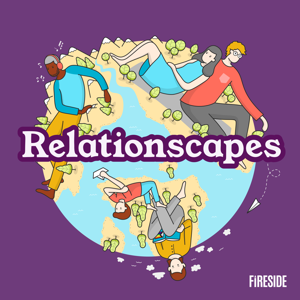
Your identity is a landscape, shaped by countless connections and crossroads with other people. Relationscapes explores our shared terrain—how we make each other who we are, often in ways we don't easily recognize.
Journalist Blair Hodges ventures into this terrain with fascinating people whose expertise and experiences reveal unexpected things about who we are and how we connect. Join us to explore gender, race, sexuality, ability, friendship, family, culture, and more. Expand your map of what it means to be human in turbulent times.

38,014 Listeners

43,324 Listeners
26,169 Listeners

111,874 Listeners

56,435 Listeners
335 Listeners

1,724 Listeners
5,116 Listeners
16,352 Listeners
37 Listeners

130 Listeners

15,917 Listeners

19,270 Listeners

1,882 Listeners
6,167 Listeners