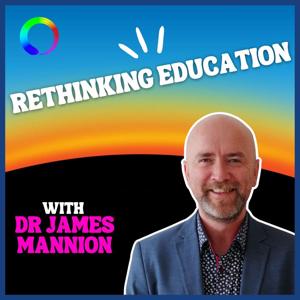
Rethinking Education

Rethinking Education

By Dr James MannionEducation
Download on the App Store

Rethinking Education episodes

  • Seven minutes out of every thirty are lost to low-level disruption. But why?
    In this episode, featuring a webinar we ran this week, Tara Elie and Dr James Mannion explore a question that many school leaders are quietly wrestling with:
    Why do so many behaviour initiatives fail to deliver sustained change?
    Across the system, the signals are hard to ignore – rising suspensions, internal removals, persistent absence, staff exhaustion, and a growing sense that behaviour reform is absorbing huge energy without always shifting underlying patterns.
    In this conversation, we argue that two critical ideas are largely missing from the behaviour debate:
    - The psychology of mattering
    - Implementation and improvement science
    When combined, these lenses offer a more systemic, more hopeful way forward.
    Part 1: The psychology of mattering
    Tara introduces the concept of mattering, drawing on the work of Morris Rosenberg and contemporary positive psychology. Mattering has two components: feeling valued, and adding value.
    We explore:
    - The difference between mattering and self-esteem
    - What staff mattering looks like in practice
    - What “anti-mattering” feels like in schools
    - The emotional and behavioural consequences of quiet disengagement
    - Why belonging is an outcome of mattering – not the target itself
    We discuss how staff who feel unseen, unheard or replaceable may withdraw effort, reduce collaboration, and disengage in subtle but powerful ways. Conversely, when staff feel significant and influential, resilience, agency and motivation follow.
    The same applies to students.
    Part 2: Why behaviour reform so often stalls
    James explores a sobering question:
    What proportion of school improvement initiatives actually improve outcomes in a sustained way?
    We examine two core reasons change efforts frequently falter:
    - Teachers and leaders are rarely taught how to implement change effectively
    - Schools default to top-down, “black box” leadership models
    We unpack the risks of:
    - Compliance cultures
    - Groupthink
    - ‘Us and them’ dynamics
    - Initiative fatigue
    And we introduce a more transparent alternative: the slice team – a representative cross-section of the school community that improves decision-making and strengthens buy-in.
    Root cause analysis: looking beneath the surface
    We then turn to a practical example.
    A widely cited statistic suggests that seven minutes out of every thirty are lost to low-level disruption.
    Rather than treating this as a behaviour problem alone, we demonstrate how to conduct a root cause analysis:
    - Identifying the trunk (the presenting issue)
    - Mapping the consequences
    - Investigating the roots across physical, emotional, relational, cognitive, behavioural and navigational domains
    The key insight: the same visible behaviour can arise from very different root systems.
    Behaviour reform without diagnosis is guesswork.
    Key ideas explored:
    - Mattering as a driver of culture
    - Anti-mattering and quiet withdrawal
    - Why belonging runs downstream of mattering
    - Black box vs glass box leadership
    - Slice teams as a mechanism for distributed ownership
    - Root cause analysis in school improvement
    - Why policy launch is not implementation
    - Habit change and “tight but loose” planning
    If behaviour is live in your context
    We are currently offering 20-minute Behaviour Strategy Calls for school leaders who would value a structured diagnostic conversation about behaviour, mattering and implementation.
    You can book here:
    https://calendly.com/rethinkingjames/chat-with-tara-james
    Further resources
    Download the Rethinking Behaviour guide - https://www.makingchangestick.co/rethinking-behaviour-free-guide
    Explore implementation science tools from Making Change Stick - https://www.makingchangestick.co

    1 hr 3 min
  • Generation to generation: Holocaust education in a changing world
    As the number of living Holocaust survivors declines, a profound question emerges: who carries these stories next – and how do we ensure they are heard, understood, and acted upon?
    In this episode, timed to mark Holocaust Memorial Day on January 27th, James and David are joined by Hannah Wilson, Outreach Officer at the charity Generation to Generation, alongside two G2G speakers, Vivienne Cato and and Calum Isaacs, who share their own family histories as descendants of Holocaust survivors. (You can read about their stories here
    https://www.generation2generation.org.uk/the-story-of-mirjam-finkelstein and here https://www.generation2generation.org.uk/holocaust-survivor-eva-cato).
    Together, they explore how Holocaust education remains as important, powerful and relevant for young people today – not as mere knowledge of the history, but as lived experience passed from one generation to the next.
    Vivienne shares the story of her mother Eva, a Slovak Jewish survivor who spent years in hiding under a false identity, and reflects on her experience of growing up in the shadow of survival, luck, and loss. Calum tells the story of his grandmother Mirjam, who survived Nazi persecution through a series of extraordinary events – including a last-minute prisoner exchange – and considers how those near-misses shape identity, values, and responsibility across generations.
    The conversation also examines:
    Why Holocaust education matters more than ever
    How personal testimony cuts through misinformation, distortion, and online extremism
    The role of ordinary people, bystanders, and complicity – not just dictators – in enabling atrocities
    Why students often respond with quiet focus, empathy, and deep moral questioning
    How Holocaust education connects to wider conversations about racism, antisemitism, democracy, and civic responsibility today
    Hannah reflects on what good Holocaust education looks like in practice, the challenges teachers face, and why grounding learning in real human stories helps young people develop critical thinking, empathy, and historical understanding – without reducing education to moral instruction or political indoctrination.
    This episode is about remembrance with purpose: how bearing witness is not only about preserving the past, but about shaping the kind of future we want to live in – and the small actions that can make a decisive difference.
    Support #repod
    The Rethinking Education podcast is brought to you by Crown House Publishing. It is hosted by Dr James Mannion and David Cameron, and produced by Sophie Dean.
    This podcast is a labour of love, with the emphasis on both the labour and the love. If you’d like to support the podcast and convey your appreciation for these conversations, you can:
    Become a patron: https://www.patreon.com/repod
    Buy us a coffee: https://www.buymeacoffee.com/repod
    1 hr 30 min
  • Why ‘consistency’ isn’t enough: the implementation blind spot in school behaviour
    In this second episode of a two-part mini-series, Tara Elie turns the tables and interviews Dr James Mannion about the thinking behind Making Change Stick – and why so many school behaviour initiatives fail, even when the policy itself is sound.
    Following on from the previous episode on the psychology of mattering, this conversation explores what happens after the policy launch: how change is (or isn’t) implemented in real schools, and why top-down, ‘black box’ approaches so often lead to inconsistency, frustration, and drift.
    James traces jis 12-year journey into implementation science, drawing on lessons from healthcare, engineering and systems change – including a powerful case study from Cincinnati Children’s Hospital – to show how schools can dramatically improve uptake, consistency and outcomes by changing how decisions are made.
    Together, they explore:
    - Why behaviour is often led by a single senior leader – and why this rarely works in practice
    - The importance of slice teams: representative groups that bring together staff from across a school (and sometimes students and families) to design, test and refine change
    - How slice teams improve both decision-making and buy-in by redistributing power without undermining leadership
    - Why implementation is a process, not an event – and why policies need ongoing review, feedback and adaptation
    - The role of mattering in behaviour systems: how staff feeling heard, trusted and involved leads to greater consistency for pupils
    - Practical tools schools rarely use – but should – including root cause analysis, communications plans, pre-mortems and ‘tight but loose’ implementation
    - How understanding the root causes of behaviour issues can lead to unexpected but powerful solutions (including links to oracy, wellbeing and relationships)
    - Why fear-based compliance may look like ‘good behaviour’ on the surface, but often masks deeper problems
    This episode is for school leaders, behaviour leads, teachers and system leaders who are tired of rolling out initiatives that never quite stick – and who want a more humane, effective and sustainable way to improve behaviour, relationships and attendance.
    Support #repod
    The Rethinking Education podcast is brought to you by Crown House Publishing. It is hosted by Dr James Mannion and David Cameron, and produced by Sophie Dean.
    This podcast is a labour of love, with the emphasis on both the labour and the love. If you’d like to support the podcast and convey your appreciation for these conversations, you can:
    Become a patron: https://www.patreon.com/repod
    Buy us a coffee: https://www.buymeacoffee.com/repod
    55 min
  • Rebooting behaviour: the two missing pieces of the puzzle (with Tara Elie)
    In this second episode of a two-part mini-series, Tara Elie turns the tables and interviews yours truly about the thinking behind Making Change Stick – and why so many school behaviour initiatives fail, even when the policy itself is sound.
    Following on from the previous episode on the psychology of mattering, this conversation explores what happens after the policy launch: how change is (or isn’t) implemented in real schools, and why top-down, ‘black box’ approaches so often lead to inconsistency, frustration, and drift.
    I trace my 12-year journey into implementation science, drawing on lessons from healthcare, engineering and systems change – including a powerful case study from Cincinnati Children’s Hospital – to show how schools can dramatically improve uptake, consistency and outcomes by changing how decisions are made.
    Together, we explore:
    - Why behaviour is often led by a single senior leader – and why this rarely works in practice
    - The importance of slice teams: representative groups that bring together staff from across a school (and sometimes students and families) to design, test and refine change
    - How slice teams improve both decision-making and buy-in by redistributing power without undermining leadership
    - Why implementation is a process, not an event – and why policies need ongoing review, feedback and adaptation
    - The role of mattering in behaviour systems: how staff feeling heard, trusted and involved leads to greater consistency for pupils
    - Practical tools schools rarely use – but should – including root cause analysis, communications plans, pre-mortems and ‘tight but loose’ implementation
    - How understanding the root causes of behaviour issues can lead to unexpected but powerful solutions (including links to oracy, wellbeing and relationships)
    - Why fear-based compliance may look like ‘good behaviour’ on the surface, but often masks deeper problems
    This episode is for school leaders, behaviour leads, teachers and system leaders who are tired of rolling out initiatives that never quite stick – and who want a more humane, effective and sustainable way to improve behaviour, relationships and attendance.
    Support #repod
    The Rethinking Education podcast is brought to you by Crown House Publishing. It is hosted by Dr James Mannion and David Cameron, and produced by Sophie Dean.
    This podcast is a labour of love, with the emphasis on both the labour and the love. If you’d like to support the podcast and convey your appreciation for these conversations, you can:
    Become a patron: https://www.patreon.com/repod
    Buy us a coffee: https://www.buymeacoffee.com/repod
    54 min
  • Why ‘belonging’ isn’t enough: The missing piece in behaviour, attendance and staff burnout (w/ Tara Elie)
    What if the real driver of behaviour, attendance, engagement – and staff retention – isn’t rules, rewards, or even belonging… but mattering?
    In this deep, reflective conversation, James is joined by Tara Elie – former teacher, behaviour specialist, and positive psychology practitioner – to explore the powerful but often overlooked psychology of mattering: the feeling that you are valued and that you add value.
    Drawing on Tara’s Master’s research, coaching work with schools, and lived experience as a teacher, the conversation reframes some of education’s biggest challenges through a radically human lens.
    Together, James and Tara explore:
    Why belonging is not the starting point, but an outcome of something deeper
    How low staff and student mattering shows up as disengagement, burnout, behaviour issues and poor attendance
    The two-part psychology of mattering – feeling valued and adding value – and why imbalance leads to compromised wellbeing
    Why many behaviour systems unintentionally communicate ‘you don’t add value’
    How mattering connects to agency, resilience, engagement, meaning and purpose
    What psychologically safe schools do differently – for adults and young people
    Practical ways leaders can audit mattering in their schools without adding workload
    This episode is especially relevant for:
    Senior leaders responsible for behaviour, relationships or attendance
    School leaders concerned about staff wellbeing and retention
    Anyone frustrated by surface-level fixes to deep, systemic issues
    If you’ve ever felt that schools are chasing the wrong outcomes – or that something vital is missing from the behaviour conversation – this episode offers a language, a framework, and a hopeful way forward.
    ‘Belonging isn’t something you can chase. It’s what happens when people genuinely matter.’
    The Rethinking Education podcast is brought to you by Crown House Publishing. It is hosted by Dr James Mannion and David Cameron, and produced by Sophie Dean.
    This podcast is a labour of love, with the emphasis on both the labour and the love. If you’d like to support the podcast and convey your appreciation for these conversations, you can:
    Become a patron: https://www.patreon.com/repod
    Buy us a coffee: https://www.buymeacoffee.com/repod
    42 min
  • "It’s choppy out there – but hope is happening...": Strap in for the 2025 end of year review!
    As 2025 draws to a close, James and David come together for a wide-ranging Christmas conversation that reflects on a turbulent year in education – and looks ahead to where hope, change, and renewal might yet be found.
    Kicking off with a powerful metaphor drawn from winter sea swimming, the discussion explores why schools currently feel so ‘choppy’, from behaviour and attendance to widening inequality and system-level pressures. Along the way, we reflect on what really matters in education – relationships, belonging, and being known – and why these often get squeezed out by accountability and assessment.
    The episode revisits key debates sparked by the Curriculum and Assessment Review, including the future of GCSEs, the limits of ‘manageable change’, and the uneasy separation of curriculum, assessment, and pedagogy.
    A detour into restorative justice, inspired by Punch and the story of Jacob Dunne, deepens the conversation about connection, responsibility, and what happens when people are truly seen. The parallels with schooling – and with how society treats its most vulnerable young people – are stark.
    The episode closes on a hopeful note, spotlighting examples of schools doing brave, relational, and imaginative work within the current system, and outlining plans for the podcast in 2026: fewer trench wars, more light-shining on practice that actually helps children and young people thrive.
    James also shares upcoming programmes and projects focused on oracy, behaviour, botheredness, and learning beyond subjects – all grounded in the belief that meaningful change is possible when we start with relationships and implementation.
    In this episode, we explore:
    - Why education feels ‘choppy’ – and what the winter swim metaphor reveals
    - Behaviour, discipline, and the limits of coercive models
    - Restorative justice, Punch, and the power of being known
    - What the Curriculum and Assessment Review did – and didn’t – make possible
    - GCSEs, adolescent development, and the problem of high-stakes exams at 16
    - Why relationships matter more than systems – and what the evidence says
    - Examples of hopeful practice already happening in schools
    - What’s next for the podcast in 2026
    Support #repod
    The Rethinking Education podcast is brought to you by Crown House Publishing. It is hosted by Dr James Mannion and David Cameron, and produced by Sophie Dean.
    This podcast is a labour of love, with the emphasis on both the labour and the love. If you’d like to support the podcast and convey your appreciation for these conversations, you can:
    Become a patron: https://www.patreon.com/repod
    Buy us a coffee: https://www.buymeacoffee.com/repod
    50 min
  • Inside the Curriculum & Assessment Review: What Changed, What Didn’t – And Why
    What really happens inside a national curriculum review?
    In this episode, James and David go beyond headlines to explore the thinking, tensions and trade-offs behind England’s Curriculum and Assessment Review - with two people who helped shape it.
    They’re joined by Lisa O’Loughlin, Principal and CEO of Nelson and Colne College Group, and Jon Hutchinson, Director of Curriculum and Teacher Development at the Reach Foundation - both panel members of the Curriculum & Assessment Review - who offer rare, first-hand insight into how the review was shaped and why its recommendations landed where they did.
    This is an honest, wide-ranging discussion about ambition, constraints, evidence, politics, and what ‘high standards for all’ actually means in practice.
    In this conversation, we explore:
    What it was like to sit on the Curriculum & Assessment Review panel - workload, process, and pressures
    Why the review focused on evolution rather than revolution
    The hidden constraints baked into the review - political, practical, and systemic
    Why post-16 recommendations matter more than many people realise
    The case for broadening pathways beyond a narrow academic route
    How oracy and the arts emerged as quiet winners in the final report
    The limits of assessment reform - and why GCSEs remain so hard to shift
    How evidence, professional judgement and lived experience were balanced
    What the review does not do - and why that has frustrated many critics
    This episode is essential listening for:
    School and college leaders
    Teachers and curriculum leads
    Policy-curious educators
    Anyone trying to make sense of what the review really changes - and what it doesn’t
    Links
    Curriculum and Assessment Review - Final Report: https://www.gov.uk/government/publications/curriculum-and-assessment-review-final-report
    Follow Jon - https://www.linkedin.com/in/jon-hutchinson-b3bbb568/
    Follow Lisa - https://www.linkedin.com/in/lisa-o-loughlin-0637b553/
    Follow David - https://www.linkedin.com/in/david-cameron-72061a15/
    Follow James - https://www.linkedin.com/in/drjamesmannion
    Support #repod
    The Rethinking Education podcast is brought to you by Crown House Publishing. It is hosted by Dr James Mannion and David Cameron, and produced by Sophie Dean.
    This podcast is a labour of love, with the emphasis on both the labour and the love. If you’d like to support the podcast and convey your appreciation for these conversations, you can:
    Become a patron: https://www.patreon.com/repod
    Buy us a coffee: https://www.buymeacoffee.com/repod
    1 hr 57 min
  • Dave Whitaker on relational practice, inclusive culture, and “battering them with kindness”
    In this energising and wide-ranging conversation, Dave Whitaker joins James and David to explore behaviour, belonging, learner effectiveness, and the courageous cultural work needed to create schools in which every child can thrive.
    Dave Whitaker is the Chief Education Officer at the Wellspring Academy Trust, working across 33 schools and alternative provisions in the north of England and Lincolnshire. A former geography teacher who moved through the pastoral route into leadership, Dave is known nationally for The Kindness Principle, his advocacy for relational practice, and his unwavering belief that children flourish when adults lead with compassion, consistency, and high expectations rooted in humanity. His Guardian-featured work on creating exclusion-free, restorative, relational schools challenged the national narrative on behaviour and ignited a conversation that still reverberates today.
    Across Wellspring’s mainstream, AP, SEMH and special schools, Dave supports leaders to build cultures of unconditional positive regard, trauma-informed practice, context-specific autonomy, and a strong collective commitment to inclusion. His work demonstrates that it is possible to run high-functioning, high-expectation schools without relying on zero-tolerance, punitive systems - but only if leaders invest in the three-to-five-year cultural journey required to get there.
    James and David share insights from the Education Policy Alliance and the urgent need to reconfigure systems that default to behaviourism, high-stakes testing, and top-down reform. They connect these ideas to the recent Everybody Thriving unconference and Wellspring’s Next Decade conference, examining how genuine change happens — and why it so often doesn’t.
    Together, they explore:
    Why kindness is not a soft option — and why it’s astonishing that this still needs saying
    How relational practice sits on a spectrum from zero-tolerance to “batter them with kindness”
    Why cultural transformation in schools takes 3-5 years, not weeks
    How Wellspring has never had a permanent exclusion
    Why some behaviour approaches become “selective by culture”
    The misconceptions that plague relational, restorative and trauma-informed practice
    The problem with national top-down reform, and why place-based change matters
    Why we need a more expansive definition of human development — beyond subjects
    How strong cultures give staff autonomy while holding shared values at the core
    Why bravery from leaders and trusts is essential in an Ofsted-driven system
    This is a hopeful, deeply practical conversation about culture, compassion, courage and what it really takes to build inclusive schools that work for ALL children.
    Links
    The Kindness Principle (Dave’s book): https://www.crownhouse.co.uk/the-kindness-principle
    Wellspring Academy Trust: https://wellspringacademytrust.co.uk
    Dave on Twitter/X: https://x.com/davewhitaker246
    Guardian article - ‘We batter them with kindness’: schools that reject super-strict values- https://www.theguardian.com/education/2018/feb/27/schools-discipline-unconditional-positive-regard
    School isolation rooms are damaging pupil wellbeing, new study warns - https://www.manchester.ac.uk/about/news/school-isolation-rooms-are-damaging-pupil-wellbeing
    Wellspring’s Next Decade conference: https://thenextdecade.co.uk/
    Support the pod
    The Rethinking Education podcast is brought to you by Crown House Publishing. It is hosted by Dr James Mannion and David Cameron, and produced by Sophie Dean.
    This podcast is a labour of love, and we love doing it. If you’d like to support the podcast and convey your appreciation for these conversations, you can:
    Become a patron: https://www.patreon.com/repod
    Buy us a coffee: https://www.buymeacoffee.com/repod
    1 hr 33 min
  • Boarding school trauma and "the myth of privilege” - a conversation with Chris Braitch
    In this rich crossover conversation, Chris Braitch and Dr James Mannion interview one another about trauma, healing, and the deep structural shifts needed in education.
    Chris Braitch is a father of three whose mission is to move himself and others towards connection and compassion. He works as an emotional health coach, a leadership coach with Compassionate Leaders Global, and is the founding director of Seen & Heard, a not-for-profit supporting the wellbeing of past and present pupils of the private school system - many of whom have experienced institutional neglect, emotional harm or abuse.
    After two decades in global sales and marketing, Chris realised that his life had been shaped by powerful, unexamined forces: early separation, boarding school culture, unresolved childhood experiences, and profound personal grief. Through coaching, men’s groups, the Emotional Freedom Technique, and a life-changing spiritual awakening, he discovered a new sense of purpose rooted in authenticity, service, and compassion. This journey transformed his parenting, his perspective, and the work he now offers to others.
    James shares the origins of the Rethinking Education Podcast, his work with the Learner Effectiveness Programme, slice teams, implementation science, and the Education Policy Alliance, and explores why so many top-down reforms fail to shift what actually happens in classrooms.
    Together, they explore:
    - The “myth of privilege” and why suffering in elite institutions is so often minimised
    - How early separation and boarding school cultures shape adult hypervigilance, self-protection, and leadership
    - The emotional and spiritual turning points that redirected Chris’s life
    - How Seen & Heard supports former pupils, works with schools, and campaigns for safer legislation
    - Why spoken language (oracy) is an overlooked equity issue
    - Why the system keeps “locating the problem in the child”
    - How learner-effectiveness, self-regulation, and holistic education can transform outcomes
    - The cultural assumptions baked into British schooling and politics
    - Why compassion-centred leadership matters now more than ever
    This is a deeply human, hopeful conversation about trauma, awareness, systemic change, and learning to live - and lead - with compassion.
    LINKS
    - Chris’s not for profit supporting the wellbeing of past pupils of boarding and independent day schools and their families – https://seenheard.org.uk
    - Chris’s not for profit supporting the wellbeing of present pupils of boarding and independent day schools and their families – https://seenheardschools.org.uk
    - Chris’s coaching business where I support men and women through 1-2-1’s and groups – https://growthwave.uk
    The Compassionate Leader Pathway Course - designed to help people lead with purpose, perform with clarity and live with integrity. https://compassionateleadersglobal.com
    CREDITS
    - The Rethinking Education podcast is brought to you by Crown House Publishing. It is hosted by Dr James Mannion and David Cameron, and produced by Sophie Dean.
    - Outro track: How it is and how it should be by Grit Control
    SUPPORT THE PODCAST:
    This podcast is a labour of love, with the emphasis on both the labour and the love.
    If you’d like to support the podcast or convey your appreciation for these conversations, you can:
    Become a patron: https://patreon.com/repod
    Buy us a coffee: https://buymeacoffee.com/repod
    1 hr 42 min
  • Nick Covington and Kate McAllister on Restoring Humanity to Education
    Nick Covington and Kate McAllister on Restoring Humanity to Education
    What does it mean to restore humanity to education?
    In this rich and wide-ranging three-way conversation, James is joined by Kate McAllister – co-founder of The Human Hive and lead educator at The Hive in the Dominican Republic – and Nick Covington, co-founder of the Human Restoration Project in the US.
    Together, we explore:
    The dehumanising effects of traditional schooling models
    What human-centred education looks like in practice – both inside and outside the mainstream
    Self-regulation, executive function and building trust with students
    The role of flow in learning, and why it's missing from most education policy discussions
    The Third Coast Learning Collaborative – a US-wide, government-funded project using project-based learning, portfolio assessment, and student-led exhibition
    The power of authentic audience and interdisciplinary learning
    How progressive educators can embrace data to strengthen their case for change
    The importance of courageous school leaders and communities of practice
    We also talk about Ozzy Osbourne's funeral procession, mangled chicken coops, flow states, poetry circles, grant funding, and catapults launching frisbees across middle school campuses.
    Education doesn’t have to be this way. Across the world, a quiet revolution is taking place – one built on trust, flow, curiosity and care. This episode offers a glimpse of what’s possible when we restore humanity to learning.
    LINKS
    Follow Nick - https://www.linkedin.com/in/nick-covington/
    Follow Kate - https://www.linkedin.com/in/misskatemcallister/
    Follow James - https://www.linkedin.com/in/james-mannion/
    Human Restoration Project - https://www.humanrestorationproject.org/
    The Hive – Dominican Republic - https://www.thehiveadventure.com/
    The Third Coast Learning Collaborative - https://www.thirdcoastlearning.org/
    Ron Berger on 20 years of 'An ethic of excellence' - and ending the trad-prog debate! - https://www.rethinking-ed.org/ron-berger
    Gallup Student Poll data on engagement, hope and belonging: https://msnpro1.gallup.com/report-generator/GSP/1.3/En-US?districtId=229403046&schoolId=229403048&cohortId=231774178
    Outro track: ‘How it is and how it should be’ by Grit Control: https://open.spotify.com/artist/1ud69RIV1eOV9poMR7AORI
    DON'T BE A STRANGER
    The Rethinking Education podcast is brought to you by Crown House Publishing. It is hosted by Dr James Mannion and David Cameron, and produced by Sophie Dean. Drop us a line at https://www.rethinking-ed.org/contact.
    CONVEY YOUR APPRECIATION FOR THE POD :)
    Become a patron: https://www.patreon.com/repod
    Buy us a coffee: https://www.buymeacoffee.com/repod
    2 hr 2 min

About Rethinking Education

From the publisher's feed

"Civilisation is a race between education and catastrophe." (HG Wells)

More shows like Rethinking Education

More or Less by BBC Radio 4

More or Less

868 Listeners

The Diary Of A CEO with Steven Bartlett by DOAC

The Diary Of A CEO with Steven Bartlett

8,326 Listeners

Feel Better, Live More with Dr Rangan Chatterjee by Dr Rangan Chatterjee: GP & Author

Feel Better, Live More with Dr Rangan Chatterjee

3,609 Listeners

Two Mr Ps in a Pod(Cast) by Two Mr Ps in a Pod(Cast)

Two Mr Ps in a Pod(Cast)

28 Listeners

Today in Focus by The Guardian

Today in Focus

968 Listeners

The High Performance Podcast by High Performance

The High Performance Podcast

623 Listeners

The Rest Is Politics by Goalhanger

The Rest Is Politics

3,138 Listeners

The News Agents by Global

The News Agents

1,132 Listeners

The Rest Is Politics: Leading by Goalhanger

The Rest Is Politics: Leading

935 Listeners

The Rest Is Entertainment by Goalhanger

The Rest Is Entertainment

910 Listeners

Electoral Dysfunction by Sky News

Electoral Dysfunction

97 Listeners

Political Currency by Persephonica

Political Currency

141 Listeners

The Rest Is Politics: US by Goalhanger

The Rest Is Politics: US

2,438 Listeners

They Behave For Me by Adam Boxer and Amy Forrester

They Behave For Me

4 Listeners

We Need To Talk with Paul C. Brunson by WNTT

We Need To Talk with Paul C. Brunson

480 Listeners