
Sign up to save your podcasts
Or


Send us Fan Mail
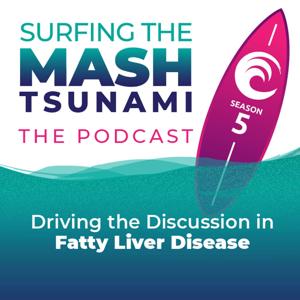
Last month, roughly 5,000 liver community stakeholders gathered in London for the 2022 International Liver Congress (#ILC2022,) the first major hepatology Congress to be held in person since the start of the pandemic (smaller, but very valuable, meetings like NASH-TAG, LiverCONNECT and Paris NASH have taken place with an in-person component, but the International Liver Congress and The Liver Meeting have not). This episode focuses on an abstract session Scott Friedman chaired on Thursday afternoon discussing advancing in the basic science of researching and understanding mechanisms surrounding fibrosis.
Scott starts by describing the session he co-chaired with Sophie Lotersztajn of INSERM as "one of the most exciting groups of presentations I've seen in many years." During this episode, he leads the rest of the panel through exploration of all six presentations. These include:
--Targeting the liver circadian clock by REV-ERB-alpha activation improves liver fibrosis by circadian gating of TGF-beta signaling, Atish Mukherji, University of Strasbourg. Scott describes this presentation, which demonstrates that stellate cells have a circadian clock, as "one of the most surprising results" in that circadian activity can be linked to the "lowly stellate cell." This paper generated significant conversation among the group, ranging from Neil Henderson's observation that circadian regulation is a powerful regulator of fibrotic processes to Jörn Schattenberg's observations about what this might mean for treating patients in the clinic to Roger Green asking whether this concept might be germane to specific drugs in development (Scott had mentioned that signalling occurred through TGFbeta. Louise Campbell and Rachel Zayas add comments about the relevance of circadian rhythm to care today and ways this paper might yield exciting new areas for research.
--Stellate cell dynamics in progression and regression of hepatic fibrosis, Laura Almale del Barrio, Denmark. This presentation, funded in part by Novo Nordisk, focused on how mouse livers respond when researchers stop injuring them. It leads Neil to comment on how little attention researchers pay to scar healing relative to how much more they pay to the process of scar creation and injury. In response to a question from Scott, Neil also discusses how advances in spatial transcriptomic will make questions like these easier to research in the not-too-distant future. After this, Jörn goes on to note that the paper discussed 14 different stellate cell states, which he interprets as involves activation and transitioning processes. He asks what this might imply for treating patients in the clinic.
The other four presentations engender a similar level of exploration. They include:
--Peroxidasin deficiency re-programs macrophages toward pro-fibrolysis function and promotes collagen resolution in liver, Mozhdeh Sojoodi, Mass General Hospital and Harvard.
--Machine learning methods for detailed characterization of TGF-beta-induced signatures in a large iPSC-derived hepatic stellate cell cohort, Kara Marie Liu, Insitro, United States
--The proteomic analysis of hepatic stellate cell differentiation from iPSCs identifies RORalpha as an antifibrogenic target, Raquel A. Martinez Garcia de la Torre, Spain
--Biliary epithelial cell-specific RAGE controls ductular reaction-mediated fibrosis during cholestasis, Macrina Lam, Germany
In each case, Scott starts by discussing the historic of scientific progress that predates the particular paper and topic, places the presentation properly within that context, and invites the others to comment. Each Surfer has unique (and uniquely interesting) comments in their own areas of expertise.
 View all episodes
 By SurfingNASH.com


3.9
2424 ratings
Send us Fan Mail
Last month, roughly 5,000 liver community stakeholders gathered in London for the 2022 International Liver Congress (#ILC2022,) the first major hepatology Congress to be held in person since the start of the pandemic (smaller, but very valuable, meetings like NASH-TAG, LiverCONNECT and Paris NASH have taken place with an in-person component, but the International Liver Congress and The Liver Meeting have not). This episode focuses on an abstract session Scott Friedman chaired on Thursday afternoon discussing advancing in the basic science of researching and understanding mechanisms surrounding fibrosis.
Scott starts by describing the session he co-chaired with Sophie Lotersztajn of INSERM as "one of the most exciting groups of presentations I've seen in many years." During this episode, he leads the rest of the panel through exploration of all six presentations. These include:
--Targeting the liver circadian clock by REV-ERB-alpha activation improves liver fibrosis by circadian gating of TGF-beta signaling, Atish Mukherji, University of Strasbourg. Scott describes this presentation, which demonstrates that stellate cells have a circadian clock, as "one of the most surprising results" in that circadian activity can be linked to the "lowly stellate cell." This paper generated significant conversation among the group, ranging from Neil Henderson's observation that circadian regulation is a powerful regulator of fibrotic processes to Jörn Schattenberg's observations about what this might mean for treating patients in the clinic to Roger Green asking whether this concept might be germane to specific drugs in development (Scott had mentioned that signalling occurred through TGFbeta. Louise Campbell and Rachel Zayas add comments about the relevance of circadian rhythm to care today and ways this paper might yield exciting new areas for research.
--Stellate cell dynamics in progression and regression of hepatic fibrosis, Laura Almale del Barrio, Denmark. This presentation, funded in part by Novo Nordisk, focused on how mouse livers respond when researchers stop injuring them. It leads Neil to comment on how little attention researchers pay to scar healing relative to how much more they pay to the process of scar creation and injury. In response to a question from Scott, Neil also discusses how advances in spatial transcriptomic will make questions like these easier to research in the not-too-distant future. After this, Jörn goes on to note that the paper discussed 14 different stellate cell states, which he interprets as involves activation and transitioning processes. He asks what this might imply for treating patients in the clinic.
The other four presentations engender a similar level of exploration. They include:
--Peroxidasin deficiency re-programs macrophages toward pro-fibrolysis function and promotes collagen resolution in liver, Mozhdeh Sojoodi, Mass General Hospital and Harvard.
--Machine learning methods for detailed characterization of TGF-beta-induced signatures in a large iPSC-derived hepatic stellate cell cohort, Kara Marie Liu, Insitro, United States
--The proteomic analysis of hepatic stellate cell differentiation from iPSCs identifies RORalpha as an antifibrogenic target, Raquel A. Martinez Garcia de la Torre, Spain
--Biliary epithelial cell-specific RAGE controls ductular reaction-mediated fibrosis during cholestasis, Macrina Lam, Germany
In each case, Scott starts by discussing the historic of scientific progress that predates the particular paper and topic, places the presentation properly within that context, and invites the others to comment. Each Surfer has unique (and uniquely interesting) comments in their own areas of expertise.

32,092 Listeners

30,716 Listeners
9,628 Listeners
105 Listeners
21,148 Listeners
3,365 Listeners

112,187 Listeners

56,559 Listeners
9,526 Listeners
8,030 Listeners

10,182 Listeners

6,404 Listeners
0 Listeners
427 Listeners

748 Listeners