
Sign up to save your podcasts
Or


Send us Fan Mail
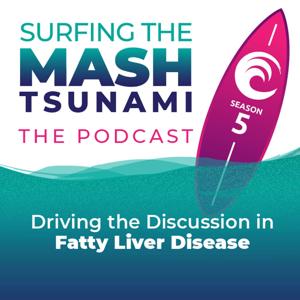
Surfing the NASH Tsunami has explored issues of NASH cirrhosis since our earliest episodes in 2020. This episode integrates panelists with three different perspectives to consider the most important challenges in treating patients with NASH cirrhosis today. Jörn Schattenberg was an author of the #ILC2022 late-breaker presentation discussing semaglutide in NASH cirrhosis. Antaros Medical co-founder and Chief Scientific Officer Lars Johansson has discussed and published on different ways to evaluate the impact of medications on cirrhosis. Louise Campbell's career in nursing and subsequent work at Tawazun Health has focused on providing patients with the information and support they need to improve their own conditions.
Roger Green starts the dialog by recounting the cirrhosis discussions over the life of the podcast, starting with discussions about using older medicines (statins, metformin) that might benefit patients, a significant number of which might decline relatively quickly. Jörn Schattenberg picks up this line of discussion, then goes on the describe the semaglutide late-breaker at ILC2022. Jörn notes that while the study failed to achieve fibrosis regression in 48 weeks, it improved a range of metabolic markers while demonstrating a strong safety profile in this population. Jörn goes on to note the importance of early (okay, earlier) diagnosis in these patients and notes that ELF is indicated in the US and EU to confirm a diagnosis of cirrhosis.
Lars Johansson joins the conversation to ask Jörn whether he believes 48 weeks is enough time to expect fibrotic regression in cirrhotic patients. After Jörn concurs, Lars comments that effects seen with sema in this population (20-30% reduction in spleen volume and early signs of portal pressure changes) suggest we are "doing something good" even if the drug did not regress fibrosis within the study period.
Lars goes on to discuss triggers that tell him how well (or poorly) the liver and overall metabolic system are working in a target patient. When evaluating other diseases (heart, kidney), he points out, we look directly at organ function. With liver, he notes, we look at biopsies.
At this point, Roger asks the group where the next breakthrough in cirrhosis therapy is likely to occur. Louise points to the need to improve patient communications, given how many patients do not learn they have ANY liver disease until their initial cirrhosis diagnoses. Jorn states that a key to improving communications and educating front-line physicians is to create simple, automated measures that will allow the patient's risk status to appear on an electronic medical record. Lars foresees a major breakthrough when we can study imaging results along with circulating biomarkers in order to identify a single biomarker (or a small group of them) that can predict advanced disease.
Louise returns to the point that without improved communications, we will fail to keep patients engaged in their own therapy, which will have severe consequences. This leads Roger to describe the next stage as a "pincer movement," with high-tech diagnostics and new drugs on one end and better human systems engineering and electronic communication on the other.
Next, Roger asks Lars where he believes what he is learning will translate into improved diagnostics. Lars and Jörn agree that the best strategy is a first stage of inexpensive screening to rule out patients without disease, and then probably a CT-based evaluation to appreciate the status of the liver and impact on related organ systems.
As the conversation wraps up, Roger asks where each panelist sees the greatest potential for growth in the next 1-2 year. Louise and Jörn focus on improved patient communication and simple screening, while Lars talks with excitement about starting to garner large amounts of data from some of the large, long-term outcome studi
 View all episodes
 By SurfingNASH.com


3.9
2424 ratings
Send us Fan Mail
Surfing the NASH Tsunami has explored issues of NASH cirrhosis since our earliest episodes in 2020. This episode integrates panelists with three different perspectives to consider the most important challenges in treating patients with NASH cirrhosis today. Jörn Schattenberg was an author of the #ILC2022 late-breaker presentation discussing semaglutide in NASH cirrhosis. Antaros Medical co-founder and Chief Scientific Officer Lars Johansson has discussed and published on different ways to evaluate the impact of medications on cirrhosis. Louise Campbell's career in nursing and subsequent work at Tawazun Health has focused on providing patients with the information and support they need to improve their own conditions.
Roger Green starts the dialog by recounting the cirrhosis discussions over the life of the podcast, starting with discussions about using older medicines (statins, metformin) that might benefit patients, a significant number of which might decline relatively quickly. Jörn Schattenberg picks up this line of discussion, then goes on the describe the semaglutide late-breaker at ILC2022. Jörn notes that while the study failed to achieve fibrosis regression in 48 weeks, it improved a range of metabolic markers while demonstrating a strong safety profile in this population. Jörn goes on to note the importance of early (okay, earlier) diagnosis in these patients and notes that ELF is indicated in the US and EU to confirm a diagnosis of cirrhosis.
Lars Johansson joins the conversation to ask Jörn whether he believes 48 weeks is enough time to expect fibrotic regression in cirrhotic patients. After Jörn concurs, Lars comments that effects seen with sema in this population (20-30% reduction in spleen volume and early signs of portal pressure changes) suggest we are "doing something good" even if the drug did not regress fibrosis within the study period.
Lars goes on to discuss triggers that tell him how well (or poorly) the liver and overall metabolic system are working in a target patient. When evaluating other diseases (heart, kidney), he points out, we look directly at organ function. With liver, he notes, we look at biopsies.
At this point, Roger asks the group where the next breakthrough in cirrhosis therapy is likely to occur. Louise points to the need to improve patient communications, given how many patients do not learn they have ANY liver disease until their initial cirrhosis diagnoses. Jorn states that a key to improving communications and educating front-line physicians is to create simple, automated measures that will allow the patient's risk status to appear on an electronic medical record. Lars foresees a major breakthrough when we can study imaging results along with circulating biomarkers in order to identify a single biomarker (or a small group of them) that can predict advanced disease.
Louise returns to the point that without improved communications, we will fail to keep patients engaged in their own therapy, which will have severe consequences. This leads Roger to describe the next stage as a "pincer movement," with high-tech diagnostics and new drugs on one end and better human systems engineering and electronic communication on the other.
Next, Roger asks Lars where he believes what he is learning will translate into improved diagnostics. Lars and Jörn agree that the best strategy is a first stage of inexpensive screening to rule out patients without disease, and then probably a CT-based evaluation to appreciate the status of the liver and impact on related organ systems.
As the conversation wraps up, Roger asks where each panelist sees the greatest potential for growth in the next 1-2 year. Louise and Jörn focus on improved patient communication and simple screening, while Lars talks with excitement about starting to garner large amounts of data from some of the large, long-term outcome studi

32,100 Listeners

30,666 Listeners

9,622 Listeners
102 Listeners

21,141 Listeners
3,360 Listeners

111,948 Listeners

56,508 Listeners

9,532 Listeners
7,995 Listeners

10,182 Listeners

6,381 Listeners

0 Listeners
425 Listeners

736 Listeners