
Sign up to save your podcasts
Or


Send us Fan Mail
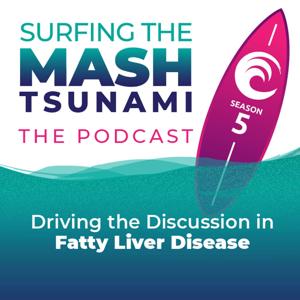
THE NASH Tsunami audience came to know Jörn Schattenberg in the Fall of 2020 when he shared a paper he had recently co-authored on why NASH drug trials failed. This week, the same group that discussed that paper – Jörn, Stephen Harrison, Louise Campbell and Roger Green – reflect on what has improved in the intervening time period and what has not.
After Roger Green sets the stage for this conversation, Jörn reflects back on the 2020 paper he co-authored with Joost Drenth and considers important changes in patient screening since then. In his own words, “The way we use biomarkers and AI to augment outcomes has changed the field dramatically.” Whereas biopsy used to be the core method used to recruit patients, Jörn notes that many practitioners now rely on NITs to assess the patient's likelihood of screening into a trial before conducting a biopsy. The result is a significant reduction in non-essential biopsies.
Stephen follows Jörn by discussing ways his own practice has benefitted greatly from the developing a prescreen strategy that relies heavily on NITs. Instead of doing "five biopsies a day, maybe 25 or 30 a week," he now starts with FAST scores and cT1 and, if these seem promising, moves to multiparametric MRI before deciding who to biopsy. Specifically, his practice is now able to utilize VCTE (FibroScan) and other NITs to mine data in real time and refer patients to the proper clinical trial as a result.
As the episode winds down, Stephen alludes to the idea of "mid-trial corrections" in pre-biopsy NIT screening criteria and advances in how biopsies are read in trials today as other areas where procedure has improved markedly.
 View all episodes
 By SurfingNASH.com


3.9
2424 ratings
Send us Fan Mail
THE NASH Tsunami audience came to know Jörn Schattenberg in the Fall of 2020 when he shared a paper he had recently co-authored on why NASH drug trials failed. This week, the same group that discussed that paper – Jörn, Stephen Harrison, Louise Campbell and Roger Green – reflect on what has improved in the intervening time period and what has not.
After Roger Green sets the stage for this conversation, Jörn reflects back on the 2020 paper he co-authored with Joost Drenth and considers important changes in patient screening since then. In his own words, “The way we use biomarkers and AI to augment outcomes has changed the field dramatically.” Whereas biopsy used to be the core method used to recruit patients, Jörn notes that many practitioners now rely on NITs to assess the patient's likelihood of screening into a trial before conducting a biopsy. The result is a significant reduction in non-essential biopsies.
Stephen follows Jörn by discussing ways his own practice has benefitted greatly from the developing a prescreen strategy that relies heavily on NITs. Instead of doing "five biopsies a day, maybe 25 or 30 a week," he now starts with FAST scores and cT1 and, if these seem promising, moves to multiparametric MRI before deciding who to biopsy. Specifically, his practice is now able to utilize VCTE (FibroScan) and other NITs to mine data in real time and refer patients to the proper clinical trial as a result.
As the episode winds down, Stephen alludes to the idea of "mid-trial corrections" in pre-biopsy NIT screening criteria and advances in how biopsies are read in trials today as other areas where procedure has improved markedly.

32,092 Listeners

30,716 Listeners
9,628 Listeners
105 Listeners

21,148 Listeners
3,365 Listeners

112,187 Listeners

56,559 Listeners

9,526 Listeners
8,030 Listeners

10,182 Listeners

6,404 Listeners

0 Listeners
427 Listeners

748 Listeners