
Sign up to save your podcasts
Or


Send us Fan Mail
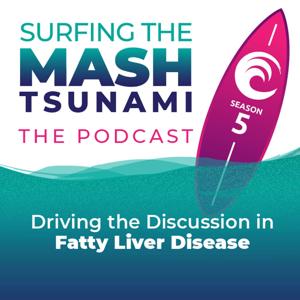
The 2022 NAFLD Summit presented a range of perspectives and insights on fatty liver and metabolic diseases. Program speakers Mazen Noureddin, Sven Francque and Hannes Hagström join Roger Green on-site from Dublin to review their reactions immediately after the conference ended. In this conversation, the panelists examine the impact of weight change and lifestyle modification in clinical trials while utilizing insights from the bariatric and diabetes fields.
This conversation continues the issue of Hawthorne effects in trial design. Hannes starts by noting we can learn from obesity trials – and also from TV shows like “Biggest Loser” – that people regain weight without continued support. Roger shares a thought he believes might have come from absent co-host Louise Campbell, recalling the immediate impact FibroScan has on illustrating results and influencing patient motivation. Sven notes that the issue of lifestyle management in a NASH trial has been a significant issue for the Liver Forum and other supportive groups in terms of trial design and also the power calculations that shape trial size. Mazen closes the discussion by stating that recent meta-analyses show that placebo rates tend to run around 20% and that this might be the right placebo result for power calculations. As the conversation winds down, he shares his guiding principle for these issues: “Prepare for the worst and hope for the best.”
This episode is sponsored by Resoundant, a Mayo Clinic company and the developers of Magnetic Resonance Elastography. MRE is widely available with over 2000 locations worldwide, and can be done as a low-cost, rapid exam in just 5 minutes. Together with PDFF, this quantitative exam is called an Hepatogram – a powerful non-invasive alternative to liver biopsy in many cases. For more information, visit www.resoundant.com on the web.
 View all episodes
 By SurfingNASH.com


3.9
2424 ratings
Send us Fan Mail
The 2022 NAFLD Summit presented a range of perspectives and insights on fatty liver and metabolic diseases. Program speakers Mazen Noureddin, Sven Francque and Hannes Hagström join Roger Green on-site from Dublin to review their reactions immediately after the conference ended. In this conversation, the panelists examine the impact of weight change and lifestyle modification in clinical trials while utilizing insights from the bariatric and diabetes fields.
This conversation continues the issue of Hawthorne effects in trial design. Hannes starts by noting we can learn from obesity trials – and also from TV shows like “Biggest Loser” – that people regain weight without continued support. Roger shares a thought he believes might have come from absent co-host Louise Campbell, recalling the immediate impact FibroScan has on illustrating results and influencing patient motivation. Sven notes that the issue of lifestyle management in a NASH trial has been a significant issue for the Liver Forum and other supportive groups in terms of trial design and also the power calculations that shape trial size. Mazen closes the discussion by stating that recent meta-analyses show that placebo rates tend to run around 20% and that this might be the right placebo result for power calculations. As the conversation winds down, he shares his guiding principle for these issues: “Prepare for the worst and hope for the best.”
This episode is sponsored by Resoundant, a Mayo Clinic company and the developers of Magnetic Resonance Elastography. MRE is widely available with over 2000 locations worldwide, and can be done as a low-cost, rapid exam in just 5 minutes. Together with PDFF, this quantitative exam is called an Hepatogram – a powerful non-invasive alternative to liver biopsy in many cases. For more information, visit www.resoundant.com on the web.

32,092 Listeners

30,714 Listeners
9,645 Listeners
105 Listeners

21,156 Listeners
3,368 Listeners

112,220 Listeners

56,587 Listeners
9,527 Listeners

8,032 Listeners

10,183 Listeners

6,410 Listeners
0 Listeners
428 Listeners

753 Listeners