
Sign up to save your podcasts
Or


Send us Fan Mail
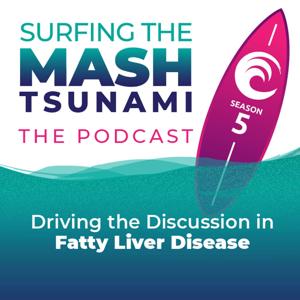
This week on SurfingNASH, we introduce the audience to new guest, Dr Roberta Forlano, who's been awarded an EASL Juan Rodes PhD Fellowship and has completed a PhD in Translational Hepatology at Imperial college London in 2022. Her current research interest are screening strategies for NAFLD in primary care, automated quantitation of histological features , lifestyle management, CV risk assessment and non-invasive markers in NAFLD. These interests and much more are shared and discussed with Jörn Schattenberg, Louise Campbell and Roger Green in a compelling episode with an overarching theme focusing on screening strategies for gender-based SLD challenges. To offer an example of how immensely productive and busy Roberta and her team have been, they recently presented 6 posters at the recently concluded SLD Summit.
This conversation starts with your Jörn returning to a key point from Roberta's paper around a 38% false negative rate for FIB-4 screening. Jörn notes that while this feels like a high rate for false negatives, it might not present as much of a diagnostic challenge if treaters repeat the screening every 2 to 3 years. Roberta agrees and notes how remarkably cost effective this screening strategy is. Even in an environment with no approved drugs for MASH, Louise notes that the false negative rate for Enhanced Liver Fibrosis (ELF™) Test was far higher, which Roberta attributed to the test thresholds which were set for severe disease. She suggests that if health is to be used in these situations, the cutoffs need to be far lower. From there, the group goes into several issues of the paper the value of VCTE diagnostics, the common theme that most patients come from a background of lower socioeconomic status and the idea that simple ultrasound produced reasonably reliable results. This last point matters tremendously because primary care clinics throughout the world are more likely to have access to ultrasound than VCTE, and in some countries, ultrasound is the only imaging technique reimbursed by the health care system.
With that as a very brief introduction to a fascinating conversation well-worth a listen, surf on to learn more about Roberta and critical ideas around screening strategies and much more. If you have questions or comments stemming from this episode, or any others for that matter, we kindly ask that you submit reviews wherever you download the discourse. Alternatively, you can write to us directly at [email protected].
Stay Safe and Surf On!
 View all episodes
 By SurfingNASH.com


3.9
2424 ratings
Send us Fan Mail
This week on SurfingNASH, we introduce the audience to new guest, Dr Roberta Forlano, who's been awarded an EASL Juan Rodes PhD Fellowship and has completed a PhD in Translational Hepatology at Imperial college London in 2022. Her current research interest are screening strategies for NAFLD in primary care, automated quantitation of histological features , lifestyle management, CV risk assessment and non-invasive markers in NAFLD. These interests and much more are shared and discussed with Jörn Schattenberg, Louise Campbell and Roger Green in a compelling episode with an overarching theme focusing on screening strategies for gender-based SLD challenges. To offer an example of how immensely productive and busy Roberta and her team have been, they recently presented 6 posters at the recently concluded SLD Summit.
This conversation starts with your Jörn returning to a key point from Roberta's paper around a 38% false negative rate for FIB-4 screening. Jörn notes that while this feels like a high rate for false negatives, it might not present as much of a diagnostic challenge if treaters repeat the screening every 2 to 3 years. Roberta agrees and notes how remarkably cost effective this screening strategy is. Even in an environment with no approved drugs for MASH, Louise notes that the false negative rate for Enhanced Liver Fibrosis (ELF™) Test was far higher, which Roberta attributed to the test thresholds which were set for severe disease. She suggests that if health is to be used in these situations, the cutoffs need to be far lower. From there, the group goes into several issues of the paper the value of VCTE diagnostics, the common theme that most patients come from a background of lower socioeconomic status and the idea that simple ultrasound produced reasonably reliable results. This last point matters tremendously because primary care clinics throughout the world are more likely to have access to ultrasound than VCTE, and in some countries, ultrasound is the only imaging technique reimbursed by the health care system.
With that as a very brief introduction to a fascinating conversation well-worth a listen, surf on to learn more about Roberta and critical ideas around screening strategies and much more. If you have questions or comments stemming from this episode, or any others for that matter, we kindly ask that you submit reviews wherever you download the discourse. Alternatively, you can write to us directly at [email protected].
Stay Safe and Surf On!

32,105 Listeners

30,729 Listeners
9,640 Listeners
105 Listeners

21,141 Listeners
3,364 Listeners

112,161 Listeners

56,561 Listeners
9,532 Listeners
8,033 Listeners

10,187 Listeners

6,405 Listeners
0 Listeners
427 Listeners

751 Listeners