
Sign up to save your podcasts
Or



Based on Podcast App listening data
Tonight, we’ll read the second half to “The Adventure of Charles Augustus Milverton” written by Sir Arthur Conan Doyle, as part of 1903’s “The Return of Sherlock Holmes”. The first half aired last week.
In the first half, Holmes was hired by the débutante Lady Eva Blackwell to retrieve compromising letters from a blackmailer named Milverton. The accused was known as "the king of blackmailers" where he would demand great sums in exchange for avoiding the release of letters that would cause great scandals.
Holmes, intrigued by the challenge and the injustice of Milverton's actions, agrees to take on the case. He sees it as an opportunity to thwart a master blackmailer and bring him to justice. As Holmes delves into the matter, he learns more about Milverton's methods and reputation. Milverton is known for his ruthlessness and lack of scruples; he preys on the secrets and vulnerabilities of others for his own profit.
— read by 'N' —
Sign up for Snoozecast+ to get expanded, ad-free access by going to snoozecast.com/plus!
Learn more about your ad choices. Visit megaphone.fm/adchoices
See Privacy Policy at https://art19.com/privacy and California Privacy Notice at https://art19.com/privacy#do-not-sell-my-info.
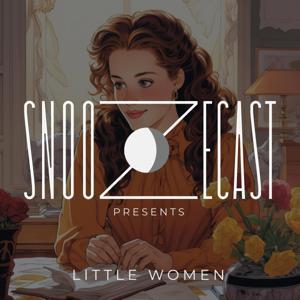
Tonight, we’ll read the 5th chapter to “Good Wives” written by Louisa May Alcott. This is also known as the second half of the “Little Women” novel. Originally, Alcott had it published as a second book but in later publishings the two were combined.
Our last episode was the chapter titled “Literary Lessons” in which Jo, consumed by her writing fervor, neglects basic needs as she delves into her craft. She shifts focus from romances to thrillers inspired by a chance encounter. Entering a contest, she wins $100, enabling her to send Beth and Marmee for a seaside retreat. Her new genre proves lucrative, supporting her family. Though facing revisions and mixed reviews, she ultimately earns several hundred dollars from her published novel.
— read by 'V' —
Sign up for Snoozecast+ to get expanded, ad-free access by going to snoozecast.com/plus!
Learn more about your ad choices. Visit megaphone.fm/adchoices
See Privacy Policy at https://art19.com/privacy and California Privacy Notice at https://art19.com/privacy#do-not-sell-my-info.
Tonight, we’ll read from “The Complete Herbal” written by Nicholas Culpeper, published in 1653. Culpeper was an English botanist, herbalist, physician and astrologer. This episode first aired in April of 2021.
Culpeper cataloged hundreds of outdoor medicinal herbs. He attempted to make medical treatments more accessible to lay persons by educating them about maintaining their health. Ultimately his ambition was to reform the system of medicine by questioning traditional methods and knowledge and exploring new solutions for ill health. The systematisation of the use of herbals by Culpeper was a key development in the evolution of modern pharmaceuticals, most of which originally had herbal origins.
Culpeper's emphasis on reason rather than tradition is reflected in the introduction to his Complete Herbal. He was one of the best-known astrological botanists of his day, pairing the plants and diseases with planetary influences.
Culpeper believed medicine was a public asset, not a commercial secret, and the prices physicians charged were far too high compared with the cheap and universal availability of nature's medicine. For this, he was considered a radical, and even accused of witchcraft.
— read by 'V' —
Sign up for Snoozecast+ to get expanded, ad-free access by going to snoozecast.com/plus!
Learn more about your ad choices. Visit megaphone.fm/adchoices
See Privacy Policy at https://art19.com/privacy and California Privacy Notice at https://art19.com/privacy#do-not-sell-my-info.
Tonight, we’ll read the first half to “The Adventure of Charles Augustus Milverton” written by Sir Arthur Conan Doyle, as part of 1903’s “The Return of Sherlock Holmes”. The second half will air next week.
In this story, Holmes is hired by the débutante Lady Eva Blackwell to retrieve compromising letters from a blackmailer named Milverton. The accused was known as "the king of blackmailers" where he would demand great sums in exchange for avoid the release of letters that would cause great scandals.
The character of Charles Augustus Milverton was based on a real-life blackmailer, Charles Augustus Howell. He was an art dealer who swindled an unknown number of people.
Doyle's literary inspiration often came from his natural interest in crime, and he had no tolerance for those that preyed on the innocent and unsuspecting. The character of Charles Augustus Milverton was based on a real-life blackmailer, Charles Augustus Howell. He was an art dealer who preyed upon an unknown number of people, and died in 1890 from circumstances as bizarre as those found in the author’s imagination.
— read by 'N' —
Sign up for Snoozecast+ to get expanded, ad-free access by going to snoozecast.com/plus!
Learn more about your ad choices. Visit megaphone.fm/adchoices
See Privacy Policy at https://art19.com/privacy and California Privacy Notice at https://art19.com/privacy#do-not-sell-my-info.
Tonight, we shall read the next part to “Persuasion”, the last novel fully completed by Jane Austen, and published in 1817. The story concerns Anne Elliot, a twenty-seven year old Englishwoman, whose family moves in order to lower their expenses and reduce their debt, by renting their home to an Admiral and his wife.
In the last episode, Sir Walter Elliot considers a Navy tenant for Kellynch Hall, dismissing the idea due to his disdain for the Navy's influence on social status and appearance. However, flattery sways him. Mr. Shepherd, his advisor, proposes Admiral Croft, emphasizing his respectability and lack of children. Despite initial reservations, Sir Walter agrees due to the Admiral's suitable social standing. Meanwhile, Anne Elliot's unresolved feelings for Captain Wentworth resurface. Seven years ago, Anne's engagement to Captain Wentworth was thwarted by familial pressure and societal expectations, particularly from Lady Russell. Heartbroken but obedient, Anne acquiesced, sacrificing her own happiness for perceived social propriety.
We will pick up towards the end of chapter 4.
— read by 'V' —
Sign up for Snoozecast+ to get expanded, ad-free access by going to snoozecast.com/plus!
Learn more about your ad choices. Visit megaphone.fm/adchoices
See Privacy Policy at https://art19.com/privacy and California Privacy Notice at https://art19.com/privacy#do-not-sell-my-info.
Tonight, we’ll read the complete story of “The Velveteen Rabbit”, a British children's book written by Margery Williams in 1922. It chronicles the story of a stuffed rabbit's desire to become real through the love of his owner.
Snoozecast first aired a version of this story that didn’t include the ending back in 2019. Many listeners requested the ending, so we rerecorded it in 2021, and are rebroadcasting it now. We hope you enjoy it as much this lovely tale as much as we do!
— read by 'V' —
Sign up for Snoozecast+ to get expanded, ad-free access by going to snoozecast.com/plus!
Learn more about your ad choices. Visit megaphone.fm/adchoices
See Privacy Policy at https://art19.com/privacy and California Privacy Notice at https://art19.com/privacy#do-not-sell-my-info.
Tonight, we’ll read “Nibbles Poppelty-Poppett, The Story of a Mouse” written by Edith B. Davidson and published in 1911.
In this story, Nibbles the mouse sets out to seek his fortune. Along the way, he encounters a peculiar inn run by guinea pigs, where he struggles to find food until he meets a sleepy but hospitable Salamander. After a hearty meal, the Salamander shares his love for coziness and poetry with Nibbles.
If you enjoy this sort of story, be sure to find the other recent Snoozecast episode by this author, titled “The Bunnikins-Bunnies and the Moon-King”.
— read by 'V' —
Sign up for Snoozecast+ to get expanded, ad-free access by going to snoozecast.com/plus!
Learn more about your ad choices. Visit megaphone.fm/adchoices
See Privacy Policy at https://art19.com/privacy and California Privacy Notice at https://art19.com/privacy#do-not-sell-my-info.
Tonight, we’ll read the next part to “Twenty Thousand Leagues Under the Sea,” a classic science fiction adventure novel by French writer Jules Verne.
In the last episode, the Nautilus passes through the Sargasso Sea, an underwater lake where currents meet, filled with aquatic plants. During this time, Aronnax wonders if Nemo will ever release them. He sees little of Nemo, and they spend much of their time on the surface.
— read by 'N' —
Sign up for Snoozecast+ to get expanded, ad-free access by going to snoozecast.com/plus!
Learn more about your ad choices. Visit megaphone.fm/adchoices
See Privacy Policy at https://art19.com/privacy and California Privacy Notice at https://art19.com/privacy#do-not-sell-my-info.
Tonight, we’ll read the opening to “The House of Mirth,” a 1905 novel by American author Edith Wharton. Snoozecast first aired this story in 2021. It tells the story of Lily Bart, a beautiful but impoverished New York City socialite.
The commercial and critical success of “The House of Mirth” solidified Wharton's reputation as a major novelist.
The central theme of “The House of Mirth” is essentially the struggle between who we are and what society tells us we should be. Thus, it is considered by many to be as relevant today as it was in 1905.
— read by 'N' —
Sign up for Snoozecast+ to get expanded, ad-free access by going to snoozecast.com/plus!
Learn more about your ad choices. Visit megaphone.fm/adchoices
See Privacy Policy at https://art19.com/privacy and California Privacy Notice at https://art19.com/privacy#do-not-sell-my-info.
Tonight, we’ll read a Snoozecast original about two sisters who experience the eclipse of 1918 as it passed over their part of Kansas.
In a quiet prairie town, Alice and Pearl find themselves caught in the path of a total solar eclipse. Together, they lay on a quilt in the farm field as day turns momentarily to night.
In this story, set in the year 1918, the sisters used “smoked glass” as a prudent way to protect the eyes to view the eclipsing of the sun as the moon moves over it. Now, we know that smoked glass is unfortunately not sufficient protection, and recommend eclipse watchers to wear specialized solar glasses.
Smoked glass was invented during the first telescopic viewing of a total solar eclipse by King Louis XIV of France. This method remained popular through the early 19th century, but by 1932 smoked glass started to fall out of favor. Either way, if you are in the path of totality, you do not need to use protection during the brief period of time when the sun is completely covered by the moon, referred to as “the totality.”
— read by 'N' —
Sign up for Snoozecast+ to get expanded, ad-free access by going to snoozecast.com/plus!
Learn more about your ad choices. Visit megaphone.fm/adchoices
See Privacy Policy at https://art19.com/privacy and California Privacy Notice at https://art19.com/privacy#do-not-sell-my-info.
From the publisher's feed
Snoozecast is the podcast designed to help you fall asleep.
Episodes air every Monday, Wednesday and Friday.
Learn about our premium listening options at
Ranked by our users in the last 21 days
1,261 Listeners

509 Listeners
913 Listeners
1,057 Listeners
1,456 Listeners
1,590 Listeners

349 Listeners
756 Listeners
3,357 Listeners
785 Listeners
611 Listeners

325 Listeners
71 Listeners

605 Listeners

20 Listeners

6 Listeners
3 Listeners
15 Listeners
2 Listeners
10 Listeners

18 Listeners
6 Listeners
1 Listeners
4 Listeners
3 Listeners
5 Listeners
8 Listeners
4 Listeners
0 Listeners
8 Listeners
0 Listeners