
Sign up to save your podcasts
Or



Based on Podcast App listening data
Tonight, we’ll read the next part to “Twenty Thousand Leagues Under the Sea,” a classic science fiction adventure novel by French writer Jules Verne.
Have you ever wished that a continuing Snoozecast story was easily available as a playlist so you could either start from the beginning, or play multiple episodes from just that story in a row, so that you don’t need to go searching through the catalog? In case you didn’t know, we also produce standalone versions of these stories as its own separate Snoozecast podcasts, for easy listening. Just search for “Snoozecast Presents” to find all the options available. And if you subscribe to Snoozecast+, you get complete access to all these series, ad-free. To learn more, go to snoozecast.com/plus .
In the last episode, the captives aboard the Nautilus awaken one day to learn that they are now underground, inside an extinct volcano. The cave is used by Nemo as a place of refuge, where he sources the elements needed to produce the electricity that makes the Nautilus run. While Nemo spends the day loading up the reserve stock of sodium they keep down there, Arronax, Conseil, and Ned explore the volcanic island. They forage for food including a beehive full of honey, before returning the ship.
— read by 'N' —
Sign up for Snoozecast+ to get expanded, ad-free access by going to snoozecast.com/plus!
Learn more about your ad choices. Visit megaphone.fm/adchoices
See Privacy Policy at https://art19.com/privacy and California Privacy Notice at https://art19.com/privacy#do-not-sell-my-info.
Tonight, we’ll read the opening section from FROM THE CAVES AND JUNGLES OF HINDOSTAN, written by Helen Blavatsky and published in 1883. This episode first aired in January of 2020.
Madame Blavatsky was a Russian occultist and philosopher who traveled around the world, including India, before moving to New York City. She co-founded the Theosophical Society in 1875 and gained an international following from the esoteric religion that the society promoted. Madame Blavatsky was a controversial figure, championed by supporters as an enlightened guru and derided as a fraudulent charlatan by critics. Her Theosophical doctrines influenced the spread of Hindu and Buddhist ideas in the West as well as the development of Western esoteric currents like the New Age Movement.
— read by 'V' —
Sign up for Snoozecast+ to get expanded, ad-free access by going to snoozecast.com/plus!
Learn more about your ad choices. Visit megaphone.fm/adchoices
See Privacy Policy at https://art19.com/privacy and California Privacy Notice at https://art19.com/privacy#do-not-sell-my-info.
Tonight, for our final selection in our “Woodcraft” series, we will read selections of the author’s poetry, published as “Forest Runes” by George Washington Sears and published in 1887. Sears was a writer and adventurer who penned essays on hunting, fishing, and camping for popular journals and magazines.
Runic alphabets are native to the ancient Germanic peoples, before they adopted the Latin alphabet. The earliest runic inscriptions found on artifacts give the name of either the craftsman or the proprietor, or sometimes, remain a linguistic mystery. Due to this, it is possible that the early runes were not used so much as a simple writing system, but rather as magical signs to be used for charms. Although some say the runes were used for divination, there is no direct evidence to suggest they were ever used in this way. The name rune itself, taken to mean "secret, something hidden", seems to indicate that knowledge of the runes was originally considered esoteric, or restricted to an elite.
The Bluetooth logo is the combination of two runes that are the initials of Harald “Bluetooth” Gormsson's who was a king of Denmark from the Viking Age.
— read by 'N' —
Sign up for Snoozecast+ to get expanded, ad-free access by going to snoozecast.com/plus!
Learn more about your ad choices. Visit megaphone.fm/adchoices
See Privacy Policy at https://art19.com/privacy and California Privacy Notice at https://art19.com/privacy#do-not-sell-my-info.
Tonight, we’ll read the thirteenth chapter to “Anne of Green Gables” the classic 1908 novel by Lucy Maud Montgomery. This chapter is titled “The Delights of Anticipation”.
In the last episode, titled “A Solemn Vow and a Promise,” Marilla is dismayed to hear about the wildflowers on Anne's Sunday school hat, and of course she lectures Anne about them. Though Anne points out many girls at church had bouquets pinned to their dresses—and many had artificial flowers on their hats—Marilla is worried about the bad impression Anne must have made.
Marilla may have been more anxious than usual because she is about to bring Anne with her to meet Diana Barry, who lives close by and is Anne's age. As she has done in the past, she warns Anne of the importance of impressing Diana's strict mother.
Out in the garden the two girls stare bashfully at each other until Anne breaks the silence by asking, "Do you think you can like me a little—enough to be my bosom friend?" It's an odd and startling question for someone Anne has just met, but Diana laughs and agrees. Diana says in response that, "I heard before that you were queer. But I believe I'm going to like you real well."
— read by 'N' —
Sign up for Snoozecast+ to get expanded, ad-free access by going to snoozecast.com/plus!
Learn more about your ad choices. Visit megaphone.fm/adchoices
See Privacy Policy at https://art19.com/privacy and California Privacy Notice at https://art19.com/privacy#do-not-sell-my-info.
Tonight, we’ll read the second half to “The Princess of Babylon”, found in the The Strange Storybook by Mrs. Lang, published in 1913. The first half aired last week. This story first aired way back in 2020.
The story is taken from a lesser known philosophical tale by Voltaire, written in 1768. Voltaire was a French Enlightenment writer, philosopher, satirist, and historian. Famous for his wit and social critiques, he was an advocate of freedom of speech, freedom of religion, and separation of church and state.
In the first episode, the king holds a competition of the world’s rulers who were interested in marrying his daughter, the princess. The games would be impossibly difficult. A handsome and magical stranger appears out of seeming thin air to win the games, however he is suddenly called away to care to matters at home.
— read by 'V' —
Sign up for Snoozecast+ to get expanded, ad-free access by going to snoozecast.com/plus!
Learn more about your ad choices. Visit megaphone.fm/adchoices
See Privacy Policy at https://art19.com/privacy and California Privacy Notice at https://art19.com/privacy#do-not-sell-my-info.
Tonight, we’ll read a Snoozecast original story about a family who is visited by the fairy Luminastra Slumbornia, who gives the gift of peaceful sleep.
Like Luminastra, all fairies are a type of mythical being, a form of spirit, often with metaphysical, supernatural, or preternatural qualities.
Let’s define those three common fairy qualities. The system of metaphysics is a philosophical branch dealing with the first principles of things. This includes abstract concepts such as being, knowing, substance, cause, identity, time, and space.
And whereas a supernatural force is one that is beyond scientific understanding or the laws of nature, a preternatural force is one which is simply beyond what is normal or natural. An example would be to say that “autumn arrived with preternatural speed.”
— read by 'N' —
Sign up for Snoozecast+ to get expanded, ad-free access by going to snoozecast.com/plus!
Learn more about your ad choices. Visit megaphone.fm/adchoices
See Privacy Policy at https://art19.com/privacy and California Privacy Notice at https://art19.com/privacy#do-not-sell-my-info.
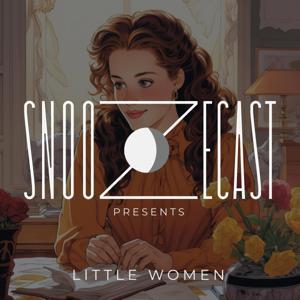
Tonight, we’ll read the third chapter to “Good Wives” written by Louisa May Alcott. This is also known as the second half of the “Little Women” novel. Originally, Alcott had it published as a second book but in later publishings the two were combined.
Our last episode was the chapter titled “The First Wedding” and it is Meg’s sweet, little wedding we attend. All of the March sisters look lovely as they’ve grown into themselves more over the last three years. When Laurie asks what happened to the fancy wine that his grandfather sent, Meg tells him that they have put a little aside for medicinal use and have given the rest away. Meg then asks Laurie to promise her to never drink alcohol. It is a tall order, but he can’t refuse her. As Meg departs to her new home down the road, she asks her family to keep her in their hearts.
— read by 'N' —
Sign up for Snoozecast+ to get expanded, ad-free access by going to snoozecast.com/plus!
Learn more about your ad choices. Visit megaphone.fm/adchoices
See Privacy Policy at https://art19.com/privacy and California Privacy Notice at https://art19.com/privacy#do-not-sell-my-info.
Tonight, for our monthly Snoozecast+ Deluxe bonus episode, we’ll read an original story that is about the dark side of birdwatching. And by dark, we simply mean that it is done in the cold and silence of a winter night.
For the residents of Russell Mills, it’s the night of the first annual “Midnight Owl Prowl”. Expert and amateur birders alike convene at midnight at Parsons Field, guided by a RMNRT volunteer, with hopes to spot the elusive Snowy Owl.
Mostly solitary and nocturnal birds of prey, owls are typified by their upright stance, large, broad heads, binocular vision, binaural hearing, sharp talons, and feathers adapted for silent flight.
Another notable feature of owls is their facial discs. These are the concave collection of feathers on owl’s faces surrounding their eyes. These facial discs collect sound waves and directs those waves towards the owl's ears. Owls can actually adjust their disc feathers to enable them to focus and locate prey by sound alone under snow, grass, and plant cover. In many species, these discs are placed asymmetrically, for better directional location.
— read by 'V' —
Sign up for Snoozecast+ Deluxe to get expanded, ad-free access by going to snoozecast.com/plus!
Learn more about your ad choices. Visit megaphone.fm/adchoices
Tonight, we’ll read the first half to “The Princess of Babylon”, found in the The Strange Storybook by Mrs. Lang, published in 1913. The second half will air next week.
The story is taken from a lesser known philosophical tale by Voltaire, written in 1768. The story focuses on Amazan, a handsome, unknown shepherd, and Formosanta, the Princess of Babylon, whose love and jealousy drive them to travel the world. Through their travels they encounter the basic values of the Enlightenment. This episode first aired in January of 2020.
— read by 'V' —
Sign up for Snoozecast+ to get expanded, ad-free access by going to snoozecast.com/plus!
Learn more about your ad choices. Visit megaphone.fm/adchoices
See Privacy Policy at https://art19.com/privacy and California Privacy Notice at https://art19.com/privacy#do-not-sell-my-info.
Tonight, we’ll read a light-hearted O. Henry short story that creates a pastiche out of the popular Sherlock Holmes stories.
In this story, a man searching for his missing sister in New York realizes the official police detective can’t help him. Only one man can: the famous private consulting detective named Shamrock Jolnes.
Although many of O. Henry’s stories involve crimes or contain some elements of mystery, the author never actually wrote detective fiction.
The character of Shamrock Jolnes also appears in O. Henry’s short stories "The Adventures of Shamrock Jolnes" and "The Detective Detector".
In reading about these stories, we found different but similar terms like pastiche, parody, spoof and satire. While both parody and pastiche imitate the works of others, pastiche does so respectfully. It is used to highlight and pay homage to the original works while not stealing directly from it. Parody, on the other hand, mocks and ridicules the original works. It exaggerates its form and language, often replacing serious subjects with silly ones. And whereas a parody imitates a specific work, a spoof imitates a general genre. Finally, satire is similar to parody in that it uses ridicule, exaggeration and irony, but instead of poking fun at a specific creative work, it comments on society, religion and politics.
— read by 'N' —
Sign up for Snoozecast+ to get expanded, ad-free access by going to snoozecast.com/plus!
Learn more about your ad choices. Visit megaphone.fm/adchoices
See Privacy Policy at https://art19.com/privacy and California Privacy Notice at https://art19.com/privacy#do-not-sell-my-info.
From the publisher's feed
Snoozecast is the podcast designed to help you fall asleep.
Episodes air every Monday, Wednesday and Friday.
Learn about our premium listening options at
Ranked by our users in the last 21 days
1,261 Listeners

509 Listeners
913 Listeners

1,057 Listeners
1,456 Listeners
1,590 Listeners

349 Listeners
756 Listeners
3,357 Listeners

785 Listeners
611 Listeners

325 Listeners
71 Listeners

605 Listeners

20 Listeners

6 Listeners
3 Listeners
15 Listeners
2 Listeners
10 Listeners
18 Listeners
6 Listeners
1 Listeners
4 Listeners
3 Listeners
5 Listeners
8 Listeners
4 Listeners
0 Listeners
8 Listeners
0 Listeners