
Sign up to save your podcasts
Or

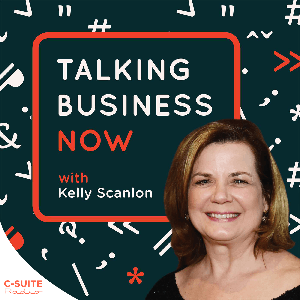


What do you do when you’re a guy strolling down the skin care aisle of a department store and you don’t like the experience you're having?
If you’re Kelley Thornton, you create a men’s skin care empire that's changing the face of men's grooming.
Thornton, the founder and CEO of Chicago-based Tiege Hanley, joins Talking Business Now host Kelly Scanlon, to talk about how he and his partners have built a multimillion dollar company featuring a skin care system that's easy for regular guys to understand and use.
Thornton drew on his 20 years of experience in consumer goods and collaborated with his college roommate turned software industry guru, Rob Hoxie, to help mastermind the new skin care solution. The two soon met Aaron Marino, a men's lifestyle expert, grooming guru and YouTube sensation (with more than 5 million subscribers), who became the company’s third partner.
Tune in to find out the behind-the-scenes story of a brand that's built a cult following:
■ The incident that inspired Thornton to start the business
■ The strategy behind the company's phenomenal growth—achieving 8-digit revenues after just two years
■ Why the company almost closed its door after 2 months—and what turned it around
■ What sets Tiege Hanley apart from other men's skin care products
■ How taking a chance and making an "ask" led to a key partnership with a YouTube influencer—and a dominating online presence
■ Why men care about skin care more today than they have in the past
■ The personal connection that made skin cancer awareness such an important cause to Thornton and Tiege
■ The impact of cause marketing—and what Tiege Hanley hopes to achieve by supporting the Skin Cancer Foundation
Thornton is a veteran of creating new and innovative ways to connect consumer packaged goods companies to retail customers. He's also the author of “The Inadequacy of POP Design and Ways to Improve."
Connect with Tiege Hanley
Facebook: https://www.facebook.com/tiegehanley/
Twitter: https://twitter.com/tiegehanley?lang=en
LinkedIn: https://www.linkedin.com/company/tiege-hanley-llc/about/
Connect with Kelly Scanlon
Facebook: https://www.facebook.com/InterrobangSolutions/
Twitter: https://twitter.com/KellyAScanlon
LinkedIn: https://www.linkedin.com/in/kellyascanlon/
Learn more about your ad choices. Visit megaphone.fm/adchoices
The story of Crazy Richard’s Peanut Butter is a family story that began in 1898 in Columbus, Ohio, with the oldest peanut butter company in the United States. Its most recent chapter began when the current owner, Kimmi Wernli, was six years old.
Wenli joins Talking Business Now host Kelly Scanlon to talk about bringing the natural peanut butter company into the 21st century—with sales in every state—and provides loads of takeaways you can use to grow your own business.
Tune in to find out how, in the short time since taking over Crazy Richard’s Peanut Butter from her father, Wernli has:
· Merged two companies into one.
· Overseen a major rebranding effort.
· Embraced social media to create a community of peanut butter lovers.
· Embarked on a mission to make it fun to eat healthy.
· How she’s using peanut butter to help alleviate childhood hunger.
· And what it takes to become a “B” Corporation.
Wernli also shares tips for ensuring a smooth ownership transition in a family business, modernizing an old business and positively impacting the community.
Connect with Kimmi Wernli
Facebook: https://www.facebook.com/crazyrichardspb/
Twitter: https://twitter.com/crazyrichardspb
LinkedIn: https://www.linkedin.com/in/kimmi-sonksen-wernli-a80581125/
Connect with Kelly Scanlon
Facebook: https://www.facebook.com/InterrobangSolutions/
Twitter: https://twitter.com/KellyAScanlon
LinkedIn: https://www.linkedin.com/in/kellyascanlon/
Learn more about your ad choices. Visit megaphone.fm/adchoices
Think about the times in your life when you’ve had to reimagine your future. Maybe it was leaving school and starting your career—or changing your career. Often, during these transitional times, we’re faced with many options and we’re concerned about making the RIGHT decision. Many times, there’s not a clear map for which path will lead to success.
My guest on this episode of Talking Business Now is Tina Seelig, author of "What I Wish I Knew When I Was 20: A Crash Course on Making Your Way in the World." Seelig, who is a Professor of the Practice at the School of Engineering at Stanford and a faculty director of the Stanford Technology Ventures Program, encourages us to toss out old models and old rules and provides a model for reaching our potential.
Seelig’s model has applications for students, entrepreneurs, business executives and others who want to throw out old assumptions for achieving success, want to discover how to have a healthy disregard for the impossible, learn a new approach for recovering from failure and be able to spot opportunity in challenges.
Seelig teaches courses in the Hasso Plattner Institute of Design (d.school) and leads three fellowship programs in the School of Engineering that are focused on creativity, innovation and entrepreneurship. She earned her doctorate in neuroscience at Stanford Medical School and has been a management consultant, entrepreneur and author of 17 books. She is the recipient of the Gordon Prize from the National Academy of Engineering, the Olympus Innovation Award and the Silicon Valley Visionary Award.
Connect with Tina Seelig:
Twitter Link: @tseelig
LinkedIn Profile: https://www.linkedin.com/in/tinaseelig/
Learn more about your ad choices. Visit megaphone.fm/adchoices
Conflict has become a dirty word in the workplace. But, according to our guest on this episode of Talking Business Now—New York Times bestselling author Dr. Liane Davey—companies that avoid or defer conflict find themselves struggling with "conflict debt.”
Davey, an organizational psychologist, is the author of The Good Fight: Use Productive Conflict to Get Your Team and Organization Back on Track. She says: "Think of conflict debt like credit card debt. Conflict debt is the sum of all the contentious issues that need to be addressed to be able to move forward but instead remain undiscussed and unresolved. Like credit card debt, conflict debt compounds as leaders who avoid conflict pay interest dealing with drama, tamping down passive-aggressive behavior, and trying to patch eroded trust."
Tune in to learn:Why we need more conflict in our organizations.How to have conflict productively.Why tension that is healthy and productive should be encouraged.The 3-step process for communicating with someone who disagrees with you.Tips for dealing with difficult personalities and behaviors.Why it's always important to have a "go-to" question that encourages the behavior you're looking for.Davey is a regular contributor to Harvard Business Review and the host of the ChangeYourTeam blog. As the co-founder of 3COze Inc., she advises on business strategy and executive team effectiveness, working with companies such as Amazon, Walmart and SONY PlayStation.
Connect With Liane Davey
Facebook: https://www.facebook.com/drlianedavey
Twitter: https://www.twitter.com/lianedavey
LinkedIn: https://www.linkedin.com/in/lianedavey/
Instagram: https://www.instragram.com/lianedavey
Learn more about your ad choices. Visit megaphone.fm/adchoices
Jeff Green was a teacher and elementary school principal for 16 years. In fact, he thought he would eventually retire as a school superintendent. But, after the Sandy Hook Elementary School shootings, Jeff, a father of three, wanted to find a better way to protect his own children and the children and staff under his watch.
On this episode of Talking Business Now, Green joins host Kelly Scanlon to discuss his journey from school principal to entrepreneur and how his company SafeDefend, specializing in emergency alert and lockdown systems and training, helps people survive an active shooter event.
Jeff said, "I was a principal during the time of the Sandy Hook shooting, and also a father of three. And after that, I realized that my building wasn't any better protected than Sandy Hook's and shared a lot of similarities. So, I just really never started out as a business. I was just a dad and a principal trying to figure out a better way to protect my students, my staff and my own children ... and just really sat down and said, 'Hey, what do we need to do? What is going to make a difference? How can we get proactive?' And that's how SafeDefend was born."
Jeff worked with law enforcement and threat assessment experts at the local, state and national level to determine what elements needed to be addressed to survive an active shooter.
He learned, according to the FBI, that most casualties occur within 3 minutes. The U.S. average police response is 11 minutes, with just over 5 minutes for metropolitan areas. He also found that the average 911 call takes 75 seconds from dialing to providing dispatch with enough information.
During the last six years, Jeff has worked to develop SafeDefend into a national leader on active shooter response and training, expanding from schools to hospitals, city government offices, manufacturing facilities, financial institutions and other public places.
Connect with Jeff Green
Facebook: facebook.com/safedefend
Twitter: @safedefend
LinkedIn: Safedefend, LLC
Learn more about your ad choices. Visit megaphone.fm/adchoices
Karen Walker, author of "No Dumbing Down: A No-Nonsense Guide for CEOs on Organization Growth," joins Talking Business Now host Kelly Scanlon to discuss how to align the skills and efforts of top management in your company. Karen offers five proven strategies that your senior leaders can capitalize on to create internal processes and strategies that support profitable and sustainable company growth.
Karen honed her expertise during the 14 years she worked at Compaq Computer. She joined the fast-growing company as its 104th employee and helped lead it to its first $1 billion in revenue. As vice president of operating services, she helped spur the company to more than $15 billion in value. After leaving Compaq, she started her own consultancy, Oneteam, to work with the senior leaders of startups, Inc. 500 and Fortune 500 firms. The outcomes of the executives she advises include IPOs, acquisitions, market share increases and leadership development.
Tune in to discover:
■ Why an emphasis on sales and revenue growth at the expense of building internal infrastructure can be detrimental to a company.
■ The five internal strategies that support external company growth: No Dumbing Down, Double Back, Play Bumper Cars, Become a Utility and Learn to Levitate
■ How to get to work implementing the strategies in your company
■ What company leaders should be Talking Business Now about in 2019
No Dumbing Down: A No-Nonsense Guide for CEOs on Organization Growth is a book for a company’s senior-most leaders. It teaches them how to do a job only they can do: aligning the organization’s internal and external strategies for profitable, sustainable growth. Why do leaders need this guidance? The problem is misunderstanding what it takes to grow. When most companies try to grow, they invariably over focus on sales and revenue-growth — at the expense of making sure they’ve aligned the infrastructure needed to support that growth. The result? Sales outpace the company’s ability to fulfill its promises. Suddenly, product quality drops; employees get overwhelmed by rework; customers grow dissatisfied as commitments are missed; firefighting becomes the norm; top people run for the exits; and the company’s reputation tanks. But it doesn’t have to be this way! Karen’s work with organizations from Fortune 500s to Inc. 500 start-ups, creating the infrastructure they need to start and sustain growth, substantiates the 5 strategies and keys for execution outlined in this book. Her motto truly is “no dumbing down.”
Connect with Karen Walker:
Website: www.karenwalker.us
Twitter: karenwalkerus
LinkedIn: karenwalkerus
Learn more about your ad choices. Visit megaphone.fm/adchoices
Bradley Charbonneau joins Talking Business Now to discuss the power of habit. He believes most of us suffer from one thing that is something of a quiet poison that keeps us from thriving to new heights. It's being comfortable. Yes, most of us suffer from the habitual, yet not-that-terrible lives we wake up to every day. Charbonneau was living a nice, comfortable life in San Francisco. He was running a successful agency, but it was killing him. His father's death in 2015 jolted him out of complacency. He said: "It was as if, for the first time, I realized we were mortal and had only this life to live." So, he shut down his agency, moved his family to Europe and started writing. A strong believer in the power of habit, Charbonneau made a decision to write for 30 days. He saw it as a formidable challenge. But he realized that if he approached it one day at a time, he could form a habit and achieve his goal. Charbonneau has been writing now for more than 2,000 and has authored 11 books and numerous blogs and articles. Tune in to discover: The power of daily habit and how it can lead to exponential growth.Why "deciding" doesn't need to be difficult.Why the best time to plant a tree was 20 years ago.The pattern of creating, failing and learning.A twist on what it means to "scale."How to shake the cobwebs out of your daily routine. Charbonneau's two latest books "One Day at a Time" and "Decide" are available on Amazon.
Learn more about your ad choices. Visit megaphone.fm/adchoices
In many cases, the solutions to our business challenges can be found if we only ask the right questions. On this episode, Greg Bustin joins Talking Business Now host Kelly Scanlon to discuss what today’s leaders can learn and which questions to ask by studying decisions made throughout history.
He’s written a book called How Leaders Decide: A Timeless Guide to Making Tough Choices. In it, he presents 52 stories featuring pivotal decisions that previous leaders—such as Alfred Nobel, Marie Curie and Winston Churchill—have made during some of the most critical moments in history. Those decisions had consequences for business, war, peace, sports, science, technology, government and the arts. At the end of each chapter, Bustin offers leadership questions that the situation prompted, and readers are encouraged to consider them in the context of their own circumstances.
Tune in to find out:
■ How to use questions to conquer tough decisions
■ The most commonly occurring decision-making mistakes
■ How to safeguard against making poor decisions
Bustin was the executive vice president and general manager of the Dallas office of Edelman Worldwide before founding his own marketing management consultancy, so he’s made plenty of tough decisions. He's helped leadership teams at multinational companies like Burger King, Sony, ConocoPhillips, PepsiCo, Nucor and Verizon as well as small- and medium-sized companies increase their effectiveness. He's delivered more than 500 keynotes and workshops on five continents, and he is the author of five leadership books.
Bustin has shared his insights on leadership in The WallStreet Journal, Chief Executive, Fast Company, Forbes, Inc., Investor’s Business Daily and other major publications.
Connect with Greg Bustin:
Facebook: https://www.facebook.com/GregBustinLeadership/
Twitter: https://twitter.com/GregBustin
Learn more about your ad choices. Visit megaphone.fm/adchoices
Bob McClure, co-founder of McClure’s Pickles, joins Talking Business Now host Kelly Scanlon to talk about his entrepreneurial journey and what it’s like working in a family business that grew into a nationally recognized brand.
McClure's is a specialty pickle brand with raving fans. Bob McClure grew up making pickles, using a recipe from his great grandmother. But he didn’t think the pickle industry was where he’d land as an adult. In fact, he left Michigan to work in New York, an actor. He has performed in commercials for several major brands, including Visa, The NFL, Verizon, Time Warner, Staples, and Quiznos. His film work includes The Brave One with Jodie Foster and the Brass Teapot. His work can also be seen on The Burg and All's Faire.
Nowadays, you'll find him back in Detroit at McClure's World Headquarters. He oversees business administration, key account management and brand development for the company.
What we're Talking Business Now about in this episode: The company's origin story: making pickles every summer using their great grandmother's recipeTurning the family passion into a business in 2006 and expanding it into a national brand with raving fansHow Bob's acting career prepared him for his role in the family businessHow McClure's has positioned itself in the changing pickle market—and the lessons business owners can learn about adaptingAdvertising and marketing tips for gaining market share against major brandsHow to successfully navigate the dynamics of a family-owned businessConnect with McClure's Pickles
■ Facebook: https://www.facebook.com/mcclurespickles
■ Twitter: https://twitter.com/mcclurespickles
■ Instagram: https://www.instagram.com/mcclurespickles/
■ Pinterest: https://www.pinterest.com/mcclurespickles/
Learn more about your ad choices. Visit megaphone.fm/adchoices
Most experts make the mistake of choosing just one way to deliver their expertise. The result? They never achieve the recognition and revenue they deserve.
Think about it. Accountants make money through accounting. Trainers make money from training. Chef’s cook. You get the picture. The secret to becoming a niche leader and having more revenue is to diversify how you deliver what you do.
That's the advice of Ronan Leonard, the founder of Eccountability. Also known as The Mastermind Guy, Leonard joins Talking Business Now host Kelly Scanlon to discuss how to leverage your intellectual property—in other words, the knowledge and expertise you've gained through years of experience—into additional revenue and a more pronounced industry profile. Leonard calls this Return on Intellect.
Tune in to discover:
• What Return on Intellect is—you may be surprised!
• How to leverage your Return on Intellect into additional revenue streams
• How Ronan's experience on a sinking cruise ship of the coast of South Africa in 1991 influenced his approached to business
• Why it's important to teach people what they want to learn instead of what you want to teach
Connect with Ronan Leonard on LinkedIn: https://www.linkedin.com/in/ronan-leonard/
Learn more about your ad choices. Visit megaphone.fm/adchoices
From the publisher's feed

38 Listeners
75 Listeners

126 Listeners

3 Listeners
44 Listeners

9 Listeners
85 Listeners