
Sign up to save your podcasts
Or

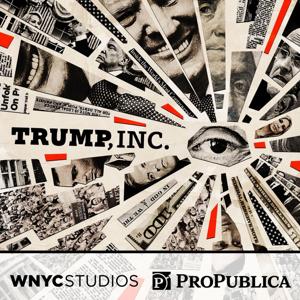

This story was co-published with ProPublica. Sign up for email updates from Trump, Inc. to get the latest on our investigations.
The Supreme Court heard oral arguments on Tuesday, via teleconference, about the power to investigate the president.
President Donald Trump has objected to subpoenas for his tax returns and other financial records. New York City prosecutors have demanded the documents as part of a criminal investigation into the president’s hush money payments to porn actress Stormy Daniels, while the House of Representatives has been seeking to investigate the conflicts of interests of a president who still owns a sprawling business.
Trump’s lawyers have argued that a president shouldn’t be subject to investigation while in office. “We're asking for temporary presidential immunity,” attorney Jay Sekulow said.
Andrea Bernstein of Trump, Inc. and NYU law professor Melissa Murray listened to the oral arguments and chatted with co-host Ilya Marritz about what struck them. A few takeaways:
• Fights between the legislative and executive branch are not normally heard in front of the Supreme Court. Congress and the White House have typically negotiated solutions to such disputes. “And the fact that we're in court is because this president hasn’t acceded to those norms,” Murray said.
• A phrase that came up repeatedly: “presidential harassment.” It’s language that Trump frequently uses on Twitter and his lawyers raised in court. The assertion, Murray said, “has transformed what would be considered, I think in other times, ordinary and essential legislative oversight into what accounts to bullying, harassment and mere partisan politics.”
• A number of the justices — including the liberal Stephen Breyer — expressed sympathy for the White House’s arguments against the House’s demands for documents, but they were far more skeptical about the claim that the president is immune from even criminal investigation. “The court seemed not to be amenable to that kind of argument at all,” Murray said.
The justices are expected to deliver a decision in the cases — Trump v. Mazars, Trump v. Deutsche Bank and Trump v. Vance — this summer.
Related reporting:• The Accountants• Trump and Deutsche Bank: It's Complicated• How Ivanka Trump and Donald Trump, Jr., Avoided A Criminal Indictment
Hosted by Simplecast, an AdsWizz company. See pcm.adswizz.com for information about our collection and use of personal data for advertising.
 View all episodes
 By WNYC Studios

4.6
55635,563 ratings
This story was co-published with ProPublica. Sign up for email updates from Trump, Inc. to get the latest on our investigations.
The Supreme Court heard oral arguments on Tuesday, via teleconference, about the power to investigate the president.
President Donald Trump has objected to subpoenas for his tax returns and other financial records. New York City prosecutors have demanded the documents as part of a criminal investigation into the president’s hush money payments to porn actress Stormy Daniels, while the House of Representatives has been seeking to investigate the conflicts of interests of a president who still owns a sprawling business.
Trump’s lawyers have argued that a president shouldn’t be subject to investigation while in office. “We're asking for temporary presidential immunity,” attorney Jay Sekulow said.
Andrea Bernstein of Trump, Inc. and NYU law professor Melissa Murray listened to the oral arguments and chatted with co-host Ilya Marritz about what struck them. A few takeaways:
• Fights between the legislative and executive branch are not normally heard in front of the Supreme Court. Congress and the White House have typically negotiated solutions to such disputes. “And the fact that we're in court is because this president hasn’t acceded to those norms,” Murray said.
• A phrase that came up repeatedly: “presidential harassment.” It’s language that Trump frequently uses on Twitter and his lawyers raised in court. The assertion, Murray said, “has transformed what would be considered, I think in other times, ordinary and essential legislative oversight into what accounts to bullying, harassment and mere partisan politics.”
• A number of the justices — including the liberal Stephen Breyer — expressed sympathy for the White House’s arguments against the House’s demands for documents, but they were far more skeptical about the claim that the president is immune from even criminal investigation. “The court seemed not to be amenable to that kind of argument at all,” Murray said.
The justices are expected to deliver a decision in the cases — Trump v. Mazars, Trump v. Deutsche Bank and Trump v. Vance — this summer.
Related reporting:• The Accountants• Trump and Deutsche Bank: It's Complicated• How Ivanka Trump and Donald Trump, Jr., Avoided A Criminal Indictment
Hosted by Simplecast, an AdsWizz company. See pcm.adswizz.com for information about our collection and use of personal data for advertising.

6,881 Listeners

9,238 Listeners

4,113 Listeners

1,576 Listeners

3,530 Listeners

484 Listeners

5,627 Listeners

12,704 Listeners

14,450 Listeners

6,467 Listeners

1,542 Listeners

3,506 Listeners

2,800 Listeners

1,405 Listeners

32,354 Listeners

1,196 Listeners
9,475 Listeners

5,767 Listeners

421 Listeners

12,874 Listeners

8,562 Listeners
670 Listeners

16,525 Listeners

2,821 Listeners

644 Listeners

11,013 Listeners

2,608 Listeners

1,965 Listeners
7,014 Listeners

82 Listeners

246 Listeners

20 Listeners

86 Listeners