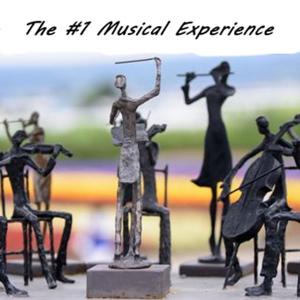
The #1 Musical Experience

The #1 Musical Experience

By Herb WilliamsArtsPerforming Arts
Download on the App Store

The #1 Musical Experience episodes

  • Mozart - Bastien und Bastienne K.50 - Aria No.11 to Aria No.16 Finale
    Mozart Bastien and Bastienne, K. 50/46b
    Sheet MusicWolfgang Amadeus MozartVoice(s) and OrchestraBastien and Bastienne
    Bastien und Bastienne (Bastien and Bastienne), K. 50/46b is a one-act singspiel by Wolfgang Amadeus Mozart. One of Mozart's earliest operas, it was written in 1768, when he was only twelve years old. It was allegedly commissioned by Viennese physician Dr. Franz Mesmer (who himself would later be parodied in Così fan tutte) as a satire of the 'pastoral' genre then prevalent. The German libretto is by F. Weiskern, J.H. Müller and J.A. Schachtner, based on Les Amours de Bastien et Bastienne by Favart and de Guerville (fr). After its supposed premiere in Mesmer's garden theater (that is only corroborated by an unverified account of Nissen), it was not revived again until 1890. Although he was very young, Mozart already had excellent vocal writing skills and a knack for parody and whimsy which would reach full flower in his later works. Bastien und Bastienne is possibly the easiest to perform of Mozart's juvenile works.
    About this Piece

    Hosted on Acast. See acast.com/privacy for more information.

    24 min
  • Hansel Und Gretel - c. Act I, Conclusion
    Humperdinck Hänsel und Gretel
    Sheet MusicEngelbert HumperdinckVoice(s) and OrchestraHänsel und Gretel
    Hansel and Gretel is an opera by Engelbert Humperdinck, who described it as a Märchenoper (fairy tale opera). The libretto was written by Humperdinck's sister, Adelheid Wette, based on the Grimm brothers' fairy tale "Hansel and Gretel". It is much admired for its folk music-inspired themes, one of the most famous being the Abendsegen (Evening Benediction) from act 2. Humperdinck composed Hansel and Gretel in Frankfurt in 1891 and 1892. The opera was first performed in Hoftheater in Weimar on 23 December 1893, conducted by Richard Strauss. It has been associated with Christmas since its earliest performances and today it is still most often performed at Christmas time.

    Hosted on Acast. See acast.com/privacy for more information.

    24 min
  • The Top 5 Issues Facing Black Americans
    What are the five biggest problems facing black Americans? Where do things like racism and police brutality rank? What about the absence of black fathers? Taleeb Starkes, author of Amazon #1 bestseller "Black Lies Matter," lists the five. They may surprise you.

    Hosted on Acast. See acast.com/privacy for more information.
    6 min
  • Piano Sonata no. 11, K. 331 - I. Andante grazioso (1)
    Piano Sonata No. 11 in A major, K. 331 (300i), is a piano sonata in three movements. It is uncertain where and when Mozart composed the sonata; however, Vienna or Salzburg around 1783 is currently thought to be most likely. A typical performance of this entire sonata takes about 20 minutes. The last movement of Sonata K. 331 by W.A. Mozart, alla turca, popularly known as the Turkish March, is often heard on its own and is one of Mozart's best known piano pieces: Mozart himself titled the movement Alla Turca. It imitates the sound of Turkish Janissary bands, the music of which was much in vogue at that time. Various other works of the time imitate this Turkish style, including Mozart's own opera Die Entführung aus dem Serail. In Mozart's time, the last movement was sometimes performed on pianos built with a "Turkish stop", allowing it to be embellished with extra percussion effects.
    About this Piece

    Hosted on Acast. See acast.com/privacy for more information.

    14 min
  • Antonio Vivaldi Violin Concerto in F minor, RV 297 'Winter'
    Antonio Vivaldi composed The Four Seasons ('Le quattro stagioni' in its original Italian) in 1723. It is a set of 4 violin concertos that propose an early form of descriptive music: for example, Winter makes prominent use of pizzicato notes in high registers, whereas Summer evokes a storm in its final movement. The work was first presented as part of Op. 8, being later catalogued as RV 269, 315, 293 & 297. The Four Seasons remain very popular to this day, some of its concertos spawning a great number of derivative works, whereas thousands of recordings of the original pieces have been made. It is still debated if Vivaldi wrote this concertos to accompany four sonnets that may have been written by himself.

    Hosted on Acast. See acast.com/privacy for more information.

    10 min
  • Schubert Piano Quintet in A major 'The Trout', D. 667 - IV. Andantino – Allegretto
    Schubert Piano Quintet in A major 'The Trout', D. 667

    Franz Schubert wrote his Piano Quintet in A major, D. 677, popularly known as The Trout, in 1819, when he was only 22 years old. Like a good fraction of his works, however, it was published after his death, in 1829. Schubert didn't employ the traditional quintet lineup (piano + string quartet), opting instead for replacing one violin with a double bass. The composer Johann Nepomuk Hummel had rearranged his own Septet for the same instrumentation, and the Trout was actually written for a group of musicians coming together to play Hummel's work.

    The nickname of the piece stems from the fourth movement, which is a set of variations on a lied by Schubert himself, named Die Forelle (the trout). Apparently the patron who commissioned the piece suggested that Schubert includ said set of variations.

    Hosted on Acast. See acast.com/privacy for more information.
    8 min
  • Antonio Rossini ~The Barber of Seville - Act I (First Part)
    Gioachino Antonio Rossini was Born 29 February 1792, Died 13 November 1868, was an Italian composer who gained fame for his 39 operas. He also wrote many songs, some chamber music , piano pieces, and some sacred music. He set new standards for both comic and serious opera before retiring from large-scale composition while still in his thirties, at the height of his popularity.

    Born in Pesaro to parents who were both musicians. His father was a trumpeter and his mother a singer. Rossini began to compose by the age of 12 and was educated at music school in Bologna.

    His first opera was performed in Venice in 1810 when he was 18 years old. In 1815 he was engaged to write operas and manage theatres in Naples. In the period 1810–1823 he wrote 34 operas for the Italian stage that were performed in Venice, Milan, Ferrara, Naples and elsewhere. His productivity necessitated an almost formulaic approach for some components , such as overtures and a certain amount of self-borrowing.

    During this period he produced his most popular works, including the comic operas L'italiana in Algeri, Il barbiere di Siviglia (known in English as The Barber of Seville) and La Cenerentola. His works of this period brought to a peak the opera buffa tradition he inherited from masters such as Domenico Cimarosa and Giovanni Paisiello.

    He also composed opera seria works such as Otello, Tancredi and Semiramide. All of these attracted admiration for their innovation in melody, harmonic and instrumental colour, and dramatic form.
    In 1824 he was contracted by the Opéra in Paris, for which he produced an opera to celebrate the coronation of Charles X, Il viaggio a Reims , later cannibalised for his first opera in French, Le comte Ory. Revisions of two of his Italian operas, Le siège de Corinthe and Moïse, and in 1829 his last opera, Guillaume Tell.

    Rossini's withdrawal from opera for the last 40 years of his life has never been fully explained. Contributary factors may have been ill-health, the wealth his success had brought him, and the rise of spectacular grand opera under composers such as Giacomo Meyerbeer. .

    In the early 1830s to 1855, when he left Paris and was based in Bologna, Rossini wrote relatively little.

    On his return to Paris in 1855 he became renowned for his musical salons on Saturdays. Regularly attended by musicians and the artistic and fashionable circles of Paris. for which he wrote the entertaining pieces Péchés de vieillesse.
    Guests included Franz Liszt, Anton Rubinstein, Giuseppe Verdi, Meyerbeer and Joseph Joachim. Rossini's last major composition was his Petite messe solennelle (1863). He died in Paris in 1868.

    Hosted on Acast. See acast.com/privacy for more information.

    27 min
  • Alexander Borodin's opera Prince Igor (1890) The Polovtsian Dances
    Borodin Prince Igor

    The Polovtsian Dances are perhaps the best known selections from Alexander Borodin's opera Prince Igor (1890). They are often played as a stand-alone concert piece. Borodin was the original composer, but the opera was left unfinished at his death and was subsequently completed by Nikolai Rimsky-Korsakov and Alexander Glazunov. In the opera the dances are performed with chorus, but concert performances often omit the choral parts. The dances do not include the "Polovtsian March," which opens Act III (No. 18), but the overture, dances, and march from the opera have been performed together to form a suite from Prince Igor. In the opera, the dances occur in Act II (in the original edition). A typical performance lasts between 11 and 14 minutes. The overture, never written out by Borodin, was reconstructed by Glazunov from his memory of the composer playing it at the piano and a few sketches. The overture file is scanned from the separate offprints for the Overture, Dances, and March.

    Hosted on Acast. See acast.com/privacy for more information.

    16 min
  • Liszt Hungarian Rhapsody no. 2, S. 244_2, orch. arr.
    Liszt Hungarian Rhapsody no. 2, S.

    Franz Liszt wrote his Hungarian Rhapsody no. 2, catalogued as S. 244/2, in 1847, and it quickly became the most famous of his rhapsodies. Besides its clear nationalistic influences, it was a piece that offered pianists the chance to reveal their skills while providing the listener with an immediate musical appeal. Its inmediate succes led to the creation of orchestral and duet piano versions. By the late 19th century, the technical challenges of the piano solo version led to its unofficial acceptance as a standard by which every notable pianist could demonstrate his level. It had become an expected staple of virtually every performance of the greatest pianists. Most unusual is the composer's explicit invitation for the performer to improvise an original cadenza, an invitation most performers chose to decline. Marc-Andre Hamelin, Rachmaninoff and Horowitz have written notable cadenzas. This composition has enjoyed widespread use in animated cartoons, and its themes have served as the basis of several popular songs.

    Hosted on Acast. See acast.com/privacy for more information.
    10 min
  • Rimsky-Korsakov Scheherazade, Op. 35
    Rimsky-Korsakov Scheherazade, Op. 35

    Scheherezade (Op. 35) is a symphonic suite written by Rimsky-Korsakov in 1888. Based on One Thousand and One Nights, this work combinates two features typical of both Russian music and Rimksy-Korsakov: a colorful, powerful orchestration and an interest in eastern themes. It is considered to be his most popular work, and it was later used as the basis of a ballet by Michel Fokine.
    Though the composer intended to name the movements as Prelude, Ballade, Adagio and Finale he ended setting for programatic titles, albeit vague ones, so that no connection could be made to specific tales. In later aditions he did away with the titles, though they remain in common use.
    The work is scored for 2 flutes, picollo, two oboes (2nd doubling cor anglais), 2 clarinets, 2 bassoons, 4 horns in F, 2 trumpets in A and B-flat, 3 trombones, tuba, timpani, bass drum, snare drum, cymbals, triangle, tambourine, tam-tam, harp and strings. The reasons for its popularity are clear: it is a score replete with beguiling orchestral colors, fresh and piquant melodies, with a mild oriental flavor, a rhythmic vitality largely absent from many major orchestral works of the later 19th century, and a directness of expression unhampered by quasi-symphonic complexities of texture and structure.

    Hosted on Acast. See acast.com/privacy for more information.
    13 min

About The #1 Musical Experience

From the publisher's feed

Works of classical repertoire often exhibit complexity in their use of orchestration, counterpoint, harmony, musical development, rhythm, phrasing, texture, and form. Whereas most popular styles are…

More shows like The #1 Musical Experience

Classical Performance by Classical Performance

Classical Performance

348 Listeners

Classical Music Free by Shiloh worship music

Classical Music Free

199 Listeners

Sticky Notes: The Classical Music Podcast by Joshua Weilerstein

Sticky Notes: The Classical Music Podcast

2,182 Listeners

Boring Books for Bedtime Readings to Help You Sleep by Sharon Handy

Boring Books for Bedtime Readings to Help You Sleep

1,261 Listeners

Sleep - Meandering Piano by Meandering Piano

Sleep - Meandering Piano

256 Listeners

I Can’t Sleep by Benjamin Boster

I Can’t Sleep

1,057 Listeners

Get Sleepy: stories for sleep by Slumber Studios

Get Sleepy: stories for sleep

9,350 Listeners

Sleep Tight Relax - Bedtime Stories That Take You Somewhere Peaceful by Sleep Tight Media | Calming Bedtime Podcasts for Kids & Starglow Media

Sleep Tight Relax - Bedtime Stories That Take You Somewhere Peaceful

886 Listeners

Just Sleep - Bedtime Stories for Adults by Bedtime Stories with Taesha Glasgow

Just Sleep - Bedtime Stories for Adults

756 Listeners

Sleep Magic: Sleep Hypnosis & Meditation for Sleep Podcast by Sleepiest: Hypnosis for Sleep Podcast

Sleep Magic: Sleep Hypnosis & Meditation for Sleep Podcast

1,613 Listeners

White Noise and Sleep Sounds (12 Hours) by White Noise and Sleep Sounds (12 Hours) to Sleep | Study | Relax | Soothe a Baby

White Noise and Sleep Sounds (12 Hours)

236 Listeners

Sounds for Deep Sleep: White Noise, Ambience, Nature Sounds by Sounds for Deep Sleep

Sounds for Deep Sleep: White Noise, Ambience, Nature Sounds

92 Listeners

Sleep & Relaxation Music to Calm the Nervous System by SOMA Sound

Sleep & Relaxation Music to Calm the Nervous System

129 Listeners

Boring History for Sleep by Velvet

Boring History for Sleep

560 Listeners