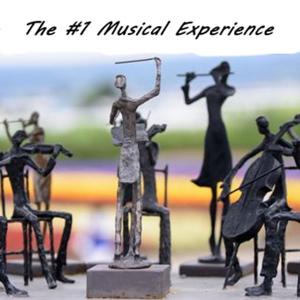
The #1 Musical Experience

The #1 Musical Experience

By Herb WilliamsArtsPerforming Arts
Download on the App Store

The #1 Musical Experience episodes

  • Johann Sebastian Bach Organ Fantasia and fugue in G minor
    Bach Fan OrganFantasia and fugue in G minor
    The Great Fantasia and Fugue in G minor, BWV 542, is an organ prelude and fugue by Johann Sebastian Bach. It acquired that name to distinguish it from the earlier Little Fugue in G minor, which is shorter. This piece is not to be confused with the Prelude and Fugue in A minor, which is also for organ and also sometimes called the Great.

    Hosted on Acast. See acast.com/privacy for more information.

    15 min
  • Concerto for Violin, Piano and String Quartet in D, Op. 21 - IV. Finale tres anime
    Chausson Concerto for Violin, Piano and String Quartet in D, Op. 21

    Composed beetween 1889 and 1891, this composition has been described as defying categorization. While it does not employ the traditional orchestra vs. soloist setting, it nevertheless manages to avoid sounding like a traditional sextet work. The string quartet functions as an accompaniment, leaving the main roles to the solo violin and the piano. Chausson chose to avoid the Wagnerian sound, instead settling for a number of compositional devices that allowed his work to create its own atmosphere, full with effects that sometimes recreate a religious setting (like the use of parallelisms).

    Hosted on Acast. See acast.com/privacy for more information.

    11 min
  • Symphony no. 5 in Cm, Op. 67 - I. Allegro con brio
    Beethoven Symphony no. 5 in C minor, Op. 67

    The Symphony No. 5 in C minor, Op. 67, was finished and first performed in 1808. It achieved fame soon enough, going on to become one of the most popular compositions in classical music. Beethoven was in his mid-thirties: his personal life was troubled by increasing deafness. In the world at large, the period was marked by the Napoleonic Wars. The symphony soon acquired status as a central item in the repertoire: groundbreaking in terms of both technical and emotional impact, it had a large influence on composers and music critics, and inspired work by such composers as Brahms, Tchaikovsky, Bruckner, Mahler, and Berlioz. The 1st mov. was featured on the Voyager Golden Record.

    Hosted on Acast. See acast.com/privacy for more information.
    8 min
  • Beethoven -Paul Pitman - Moonlight Sonata Op. 27 No. 2 - III. Presto
    Ludwig van Beethoven wrote his 32 mature piano sonatas between 1795 and 1822. Although originally not intended to be a meaningful whole, as a set they comprise one of the most important collections of works in the history of music. Hans von Bülow called them "The New Testament" of the piano literature. Beethoven's piano sonatas came to be seen as the first cycle of major piano pieces suited to concert hall performance. Being suitable for both private and public performance, Beethoven's sonatas form "a bridge between the worlds of the salon and the concert hall". The first person to play them all in a single concert cycle was Hans von Bülow, the first complete recording is Artur Schnabel's for the label His Master's Voice.

    Hosted on Acast. See acast.com/privacy for more information.

    9 min
  • Chinese Inspired Peritune-wuxia2-guzheng-pipa
    Wuxia2_Guzheng_Pipa by PeriTun

    Wuxia (武俠 [ù.ɕjǎ]), which literally means "martial heroes", is a genre of Chinese fiction concerning the adventures of martial artists in ancient China. Although wuxia is traditionally a form of fantasy literature, its popularity has caused it to be adapted for such diverse art forms as Chinese opera, mànhuà, films, television series, and video games. It forms part of popular culture in many Chinese-speaking communities around the world.

    The word "wǔxiá" is a compound composed of the elements wǔ (武, literally "martial", "military", or "armed") and xiá (俠, literally "chivalrous", "vigilante" or "hero"). A martial artist who follows the code of xia is often referred to as a xiákè (俠客, literally "follower of xia") or yóuxiá (遊俠, literally "wandering xia"). In some translations, the martial artist is referred to as a "swordsman" or "swordswoman" even though they may not necessarily wield a sword.

    The heroes in wuxia fiction typically do not serve a lord, wield military power, or belong to the aristocratic class. They often originate from the lower social classes of ancient Chinese society. A code of chivalry usually requires wuxia heroes to right and redress wrongs, fight for righteousness, remove oppressors, and bring retribution for past misdeeds. Chinese xia traditions can be compared to martial codes from other cultures, such as the Japanese samurai bushidō.

    Attribution 4.0 International (CC BY 4.0)
    https://creativecommons.org/licenses/by/4.0/
    Music promoted by https://www.chosic.com/free-music/all/

    Hosted on Acast. See acast.com/privacy for more information.

    3 min
  • Mozart Chamber group Piano Trio in B-flat major
    Wolfgang Amadeus Mozart Chamber grou pPiano Trio in B-flat major, K. 502
    The Piano Trio in Bb, K. 502 was written by Mozart in 1786. It has three sections and calls for violin, cello, and piano.

    Hosted on Acast. See acast.com/privacy for more information.
    9 min
  • Chopin - Piano Concerto no. 2 in F minor, Op. 21 - I. Maestoso
    Frédéric Chopin wrote his first piano concerto ever in 1830. It was premiered that same year, and published after his next concerto, hence it came to be known as the Piano Concerto no. 2, in F minor, even though it was the first to be composed. Written before Chopin finished his formal education, the piece betrays a certain sophistication in terms of formal development. It features an extremely dominant piano part, with the orchestra leaving all responsibility for musical development to the soloist, thus ignoring the interplay that is the mainstay of an instrumental concerto. The instrumentation of the concert has even been considered to be poor (Berlioz criticised Chopin's treatment of the orchestra). The piece bears the unmistakable influence of italian opera -a common denominator for pianists of Chopin's time- as well as the Polish mazurka.

    Hosted on Acast. See acast.com/privacy for more information.
    14 min
  • Kevin MacLeod-George-Street-Shuffle Classic Jazz
    Kevin MacLeod is an American composer and musician. MacLeod has composed over 2,000 pieces of royalty-free library music and made them available under a Creative Commons copyright license. His licensing options allow anyone to use his music for free as long as he receives attribution, which has led to his music being used in thousands of films.Wikipedia
    Born:
    September 28, 1972, Green Bay, Wisconsin, U.S.

    Hosted on Acast. See acast.com/privacy for more information.

    5 min
  • Scott-Buckley-i-walk-with-ghosts
    A bittersweet, meditative neoclassical track featuring atmospheric synth blended with emotional strings. An exploration of how we go through life with baggage that we all deal with in our own ways – ghosts of our past lives. Falls away at around 4:20, where some manipulated recordings add some reaching moments before building back up for a final playthrough of the theme.
    9 min
  • Gluck-Gluck-Ballet-Suite-no.-1
    Gluck Gluck Ballet Suite no. 1

    The Ballet Suite No. 1 includes selections from three of Gluck's greatest stage works. It begins with an Air Gai and Lento from Iphigenia in Aulis. Familiar music, taken from Gluck’s most frequently performed and famous opera Orfeo ed Euridice, follows the initial movement. This well-known music is arranged in a three-part form in which the graceful Dance of the Blessed Spirits, coupled with the eternally beautiful interlude for solo flute, one of the most poignant and memorable of all of Gluck’s melodies, becomes the centerpiece of the suite. The suite concludes with two excerpts from the opera Armide, a Musette and a Sicilienne.

    Hosted on Acast. See acast.com/privacy for more information.
    9 min

About The #1 Musical Experience

From the publisher's feed

Works of classical repertoire often exhibit complexity in their use of orchestration, counterpoint, harmony, musical development, rhythm, phrasing, texture, and form. Whereas most popular styles are…

More shows like The #1 Musical Experience

Classical Performance by Classical Performance

Classical Performance

348 Listeners

Classical Music Free by Shiloh worship music

Classical Music Free

199 Listeners

Sticky Notes: The Classical Music Podcast by Joshua Weilerstein

Sticky Notes: The Classical Music Podcast

2,182 Listeners

Boring Books for Bedtime Readings to Help You Sleep by Sharon Handy

Boring Books for Bedtime Readings to Help You Sleep

1,261 Listeners

Sleep - Meandering Piano by Meandering Piano

Sleep - Meandering Piano

256 Listeners

I Can’t Sleep by Benjamin Boster

I Can’t Sleep

1,057 Listeners

Get Sleepy: stories for sleep by Slumber Studios

Get Sleepy: stories for sleep

9,350 Listeners

Sleep Tight Relax - Bedtime Stories That Take You Somewhere Peaceful by Sleep Tight Media | Calming Bedtime Podcasts for Kids & Starglow Media

Sleep Tight Relax - Bedtime Stories That Take You Somewhere Peaceful

886 Listeners

Just Sleep - Bedtime Stories for Adults by Bedtime Stories with Taesha Glasgow

Just Sleep - Bedtime Stories for Adults

756 Listeners

Sleep Magic: Sleep Hypnosis & Meditation for Sleep Podcast by Sleepiest: Hypnosis for Sleep Podcast

Sleep Magic: Sleep Hypnosis & Meditation for Sleep Podcast

1,613 Listeners

White Noise and Sleep Sounds (12 Hours) by White Noise and Sleep Sounds (12 Hours) to Sleep | Study | Relax | Soothe a Baby

White Noise and Sleep Sounds (12 Hours)

236 Listeners

Sounds for Deep Sleep: White Noise, Ambience, Nature Sounds by Sounds for Deep Sleep

Sounds for Deep Sleep: White Noise, Ambience, Nature Sounds

92 Listeners

Sleep & Relaxation Music to Calm the Nervous System by SOMA Sound

Sleep & Relaxation Music to Calm the Nervous System

129 Listeners

Boring History for Sleep by Velvet

Boring History for Sleep

560 Listeners