
Sign up to save your podcasts
Or



Based on Podcast App listening data
In 1841 a few tiny islands of Pākehā settlement existed in an ocean of Māori land. Today, that picture has reversed & Māori own a fraction of Aotearoa. A big part of the reason? The Native Land Court.
Large chunks of land changed hands through the Native Land Court; or as it was also known: Te Kooti Tango Whenua - The Land Taking Court. Created by the 1862 Native Lands Act, the court was meant to establish individual land ownership under the new British colonial government. In practice it began a process of land alienation for Maori that continued until the 1990s.
Watch the video version of the episode here
In this episode we discuss:
For more on this subject:
Go to this episode on rnz.co.nz for more details
The discovery of gold drew tens of thousands to New Zealand in search of fortune. It was a hard life, but diggers brought mateship, fashion & egalitarian ideas that changed the country forever.
Gold! The mania for this shiny yellow metal swept all over Aotearoa in the second half of the 19th century and left the country, and many of its people, fundamentally changed.
Watch the video version of the episode here
This episode we ask:
For more on this subject:
Go to this episode on rnz.co.nz for more details
New Zealanders have battled Covid-19 for more than two years, but if you think it's the first time disease has knocked us around, well, this one's for you. Epidemics have long been part of our story.
During the Covid-19 pandemic we've heard people say stuff like "we're living in unprecedented times"... But every time they hear that, historians get extremely annoyed! Epidemics have had a huge impact on many countries through history and New Zealand is no exception.
Watch the video version of the episode here
In this episode we dig into the history of epidemics in Aotearoa New Zealand, including:
For more on this subject:
Go to this episode on rnz.co.nz for more details
The 1950s saw an explosion of youth culture. "Bodgies and widgies' ' tearing round on motorbikes & hanging out in milk bars scandalised many Kiwi adults. Was "the teenager" invented in the 1950s? And what is a "milk bar" anyway?
The 1950s saw an explosion of youth culture in Aotearoa. Stories about "bodgies and widgies' ' tearing up the streets on motorbikes, canoodling in the cinemas and hanging around in milk bars scandalised many kiwi adults. In fact, it's often said the whole idea of "the teenager" was born in the 1950s. But is that really true? And what even is a "milk bar" anyway?
Watch the video version of the episode here
In this episode we trace the history of kiwi teens including:
For more on this subject:
Go to this episode on rnz.co.nz for more details
The first 500 years of Māori settlement in Aotearoa saw significant, dynamic changes to how people lived; changes that challenge the idea of Māori culture as something carved in stone.
There's sometimes a temptation to think of Māori as a people "frozen in time" - that Māori culture and ways of life were unchanged between the time they arrived in Aotearoa sometime before 1300AD until Captain Cook and the Endeavour arrived in 1769.
But that's totally wrong! In 500 years, any people are going to change.... A lot!
Watch the video version of the episode here
In this episode we look at:
For more on this subject:
Go to this episode on rnz.co.nz for more details
No-one knows for sure who first introduced rabbits to New Zealand, because no-one wanted to take the blame for what became one of New Zealand's biggest environmental and economic disasters. We start season two burrowing into the devastating history of rabbits and other pests.
We start season two burrowing into the story of rabbits and other pests. What started with plenty of (h)optimism has led to generations of damage to our environment and economy.
Watch the video version of the episode here
By Tim Watkin
History is a river; fluid, flowing, always changing and always the same. That bit about history always changing is something that many people find hard to accept. It's behind us, it's happened, frozen in time. We often want to come to conclusions about the past and keep it, well, in the past. Wrap it up and move on. But as Billy Bragg once wrote, "The past is always knocking incessant / Trying to break through into the present".
And it often succeeds. Whenever as a country we debate issues such as inequality, co-governance, free speech, taxes... you name it, history is banging at the door wanting to have its say.
How you see that river of history or hītōria, ah well, that depends on where you're standing. And when you're standing there. And who you're standing with. And what you already know about rivers; or think you know. Perhaps which language you speak. As hard as it can be for people to accept, there is no right version of history, history does not end and our views of the events, people and issues of the past have always and will always keep changing. And that's a good thing. History is at its most revealing when you approach it with an open mind and a little empathy.
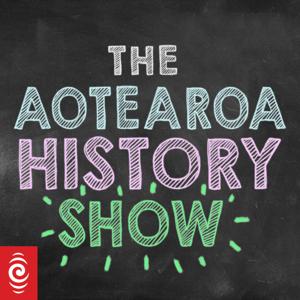
That's been a guiding principle for the team making the second season of The Aotearoa History Show. Our job is to explain history not to pass judgment on it. That's a tough thing to do in these times, when people seem more eager than ever to make declarations about the rights and wrongs of history and the people who made it. Standing on at one point on the riverbank, looking at one part of the river while making sweeping declarations about the whole river is likely to get you lots of likes on social media…
Go to this episode on rnz.co.nz for more details
Deep dive into a rigorous romp through the history of New Zealand, from its volcanic beginnings, through settlement, wars and social change to the late 20th century.
Go to this episode on rnz.co.nz for more details
It's the final episode of the Aotearoa History Show! Rogernomics, Ruthanasia and the referendum on MMP saw the total restructuring of our economy and voting system. Plus a snapshot of the changing demographics of Aotearoa/New Zealand, the growth of dairy and tourism and the challenges still to come.
The 1984 election is a tumultuous tipping point; the start of a new New Zealand with a more open, less equal economy; a new style of democracy and a more diverse population.
Watch here
By William Ray
As I've been releasing episode after episode of The Aotearoa History Show over the past few weeks, a colleague has taken to asking me, "how's New Zealand history going today?", writes Tim Watkin, RNZ executive producer, podcasts and series.
I think I must have looked a bit brow-beaten by what has been a mammoth piece of work. I mean, who in their right mind tries to tell the entire history of a nation in 14 15-20 minutes YouTube videos?
But each time I've replied, something like "oh it's getting there. A bit different from yesterday" or "still changing".
Because one of the great mistakes people make when they discuss history - be it the history of New Zealand or indeed anywhere - is to assume that facts are facts and what's done is done. The truth is quite the opposite. History is forever changing, morphing, evolving into something new.
At least, our understanding of it is. Excuse me if this sounds a bit Fight Club-esque, but one of the few unchanging facts of history, is that there are few unchanging facts in history.
Our willingness to be open to that is going to vital as we prepare to teach New Zealand history in our schools. It's so important that young New Zealanders will get to learn how we got from here to there, but just as crucial for us to keep an open mind as we do it.
The risk is always that we fall into the trap of insisting there is only one way to tell our stories or only certain stories that can be told. There are heroes and villains, triumphs and disasters in all times, cultures, genders, classes, faiths and more.
Sure, there's no excuse for simple inaccuracies. The stubborn myth that Moriori were the first people of New Zealand pre-dating Maori and conquered by them should be a cautionary tale to anyone wanting to dismiss the facts of history altogether.
The truth we know is quite different... and explained in episode two, by the way. But when we talk about events covered by the mist of time, culture, politics and any number of human failings, we must always be open to how much we don't know and how much our understanding can change…
Go to this episode on rnz.co.nz for more details
The 60s, 70s and 80s were rowdy decades. Kiwis were getting out in the streets and raising their voices about the rights of Māori, women and LGBT people, nuclear energy, the environment. Plus the most controversial sporting event in our history: The 1981 Springbok Tour.
Through the 60s and 70s generations clashed and minority groups fought for their rights. Social issues such as women's rights and nuclear power gained traction, as the economy stayed strong in Fortress New Zealand. The dominant politician was Robert Muldoon, but those social and economic issues were coming to a head.
Watch the video version of the episode here
Topics covered:
Go to this episode on rnz.co.nz for more details
After the war came a new quest for security and identity. With it came new political debates and alliances. Maori and Pasifika moved to the cities. The way we viewed ourselves as a nation was changing.
The 50s and 60s were decades of huge cultural change. Māori were moving into the cities in large numbers for the first time. Meanwhile, there were communist scares, industrial disputes, moral panics about rowdy teenagers - and the beginning of a new kind of kiwi identity.
Watch the video version of episode here
Topics covered:
Go to this episode on rnz.co.nz for more details
From the publisher's feed

7,563 Listeners

2,106 Listeners

4,825 Listeners

1,970 Listeners

4,755 Listeners

1 Listeners

1 Listeners
1 Listeners

1 Listeners
42 Listeners

102 Listeners

1 Listeners

7 Listeners

51 Listeners

3,209 Listeners
4 Listeners
3 Listeners

0 Listeners

31 Listeners

3,337 Listeners

15,582 Listeners
0 Listeners

1,885 Listeners

2,046 Listeners

4 Listeners

2,052 Listeners

9,413 Listeners
537 Listeners

4 Listeners

2 Listeners
0 Listeners
3 Listeners
14 Listeners
2 Listeners
1 Listeners