
Sign up to save your podcasts
Or



The provided sources offer a comprehensive overview of advanced biotechnologies, including gene editing, synthetic biology, neurotechnology, and the integration of artificial intelligence (AI). They explore the profound implications of these technologies across various domains, highlighting their transformative potential for human well-being, economic growth, and military applications. However, the texts also meticulously detail the significant ethical dilemmas (e.g., safety, consent, human enhancement, justice), acute security threats (e.g., bioweapons, data exploitation, cognitive manipulation), and new vulnerabilities these advancements introduce for individuals, societies, and global systems. Finally, the sources underscore the urgent need for robust, internationally coordinated, and ethically grounded governance frameworks to navigate the complex challenges and ensure responsible stewardship of this bio-revolution.
Research done with the help of artificial intelligence, and presented by two AI-generated hosts.
The provided text examines Iran's strategic approach to national security, emphasizing its reliance on a two-pillar alliance system. This system includes formal state-level partnerships, primarily with Russia and China for technological and economic benefits, and an informal network of non-state actors known as the "Axis of Resistance," which serves as the primary tool for asymmetric warfare and regional influence. The analysis highlights that while the Axis of Resistance, managed by the Islamic Revolutionary Guard Corps (IRGC), allows Iran to project power indirectly, it also introduces significant vulnerabilities due to a lack of complete control over these proxies. Despite these alliances, the text concludes that Iran's partners offer no direct mutual defense guarantee, leaving Iran exposed in direct confrontations and likely reinforcing its pursuit of a sovereign nuclear capability as the ultimate deterrent.
Research done with the help of artificial intelligence, and presented by two AI-generated hosts.
The provided sources offer an extensive examination of Neuralink, detailing its technological architecture, clinical progress, and future aspirations as of mid-2025. They highlight Neuralink's dual mission: both a medical device company aiming to restore function for those with neurological conditions and a transhumanist endeavor seeking human-AI symbiosis and cognitive enhancement. The texts break down the core components of the Neuralink system, including the N1 "Link" implant, neural threads, on-board processing (ASIC), and the R1 surgical robot, explaining how these elements work together for high-bandwidth brain-computer interface (BCI). Furthermore, the sources discuss the current human trials, such as the PRIME and CONVOY studies, and the upcoming Blindsight project, alongside the regulatory pathway including FDA approvals. Finally, they analyze the significant technical and biological challenges, such as biocompatibility and signal degradation, and contrast Neuralink's approach with its key competitors like Synchron and Precision Neuroscience, while also addressing the profound ethical and regulatory scrutiny the company faces regarding transparency, animal welfare, and the implications of human enhancement.
Research done with the help of artificial intelligence, and presented by two AI-generated hosts.
The provided text offers a comprehensive analysis of AlphaFold 3, a groundbreaking AI model developed by Google DeepMind and Isomorphic Labs, which significantly advances computational structural biology. It details the model's architectural innovations, particularly its generative diffusion network, allowing it to predict the 3D structures and interactions of a wide array of biomolecules—including proteins, DNA, RNA, and small molecules—surpassing the protein-centric capabilities of its predecessor, AlphaFold 2. The sources highlight AlphaFold 3's superior accuracy compared to existing methods, especially in drug discovery, and explore its transformative applications across medicine, agriculture, and biomaterials. However, they also critically examine its limitations, such as its inability to model molecular dynamics and potential "hallucinations," emphasizing the continued need for experimental validation and addressing the controversial balance between commercial interests and open science.
Research done with the help of artificial intelligence, and presented by two AI-generated hosts.
The provided text offers a comprehensive overview of multiverse theories, exploring their historical roots from ancient philosophy to modern physics. It outlines four major theoretical frameworks: the Inflationary Multiverse, Quantum Multiverse (Many-Worlds Interpretation), String/M-Theory Multiverse, and the Mathematical Multiverse, each proposing different natures and origins for parallel universes. The text further discusses the ongoing search for empirical evidence, including potential signatures in the Cosmic Microwave Background and implications from high-energy physics experiments like the LHC, as well as the controversial link to quantum computing advancements. Finally, it addresses the profound scientific and philosophical debates surrounding the multiverse concept, particularly regarding the fine-tuning problem of our universe and the crucial criterion of falsifiability in scientific inquiry.
Research done with the help of artificial intelligence, and presented by two AI-generated hosts.
This comprehensive report, updated to mid-2025, offers a detailed overview of black hole physics. It begins by explaining the theoretical framework of black holes, rooted in Einstein's general relativity, including concepts like the event horizon and singularity, and the "no-hair" theorem. The text then describes the anatomy and different classifications of black holes—stellar-mass, supermassive, intermediate-mass, and primordial—along with their formation and observable features like accretion disks and relativistic jets. It further details the observational evidence confirming black holes, such as stellar orbits, gravitational lensing, gravitational waves, and direct imaging from the Event Horizon Telescope, highlighting recent discoveries. Finally, the report addresses unsolved problems like the information paradox and the ongoing quest for a quantum gravity theory, also exploring the intriguing possibility of primordial black holes as dark matter, demonstrating their continued importance as theoretical laboratories for fundamental physics.
Research done with the help of artificial intelligence, and presented by two AI-generated hosts.
The provided text offers a comprehensive overview of the current understanding and ongoing quest for dark matter, a mysterious substance inferred from its gravitational effects. It traces the historical development of the concept from early observations by scientists like Fritz Zwicky and Vera Rubin to modern cosmological measurements that confirm its abundance. The text explains the observational evidence for dark matter, including flat galactic rotation curves, its role in large-scale structure formation, and compelling evidence from gravitational lensing, notably the Bullet Cluster. Furthermore, it discusses the inferred properties and particle candidates for dark matter, highlighting the diminishing prospects for Weakly Interacting Massive Particles (WIMPs) and the rising interest in alternative candidates like axions and particles within a "dark sector." Finally, the text details the three-pronged experimental approach—direct detection, indirect detection, and collider searches—and briefly examines Modified Newtonian Dynamics (MOND) as an alternative theory, ultimately concluding that the dark matter paradigm remains the most robust explanation for the observed universe.
Research done with the help of artificial intelligence, and presented by two AI-generated hosts.
The provided text explores the Quantum Memory Matrix (QMM) hypothesis, a radical new theory proposing that spacetime is fundamentally a discrete, information-storing system at the Planck scale. This theory aims to resolve long-standing conflicts in modern physics, particularly the black hole information paradox, by suggesting that information is locally imprinted and unitarily retrieved from these "memory cells" within the bulk of spacetime, preserving the smooth event horizon. Beyond this, QMM offers a unified framework for all four fundamental forces, reinterpreting dark matter as the gravitational effect of stored information, and making several testable predictions for cosmological observations and quantum computer simulations. The text distinguishes QMM from other quantum gravity theories like Loop Quantum Gravity, the Holographic Principle, and the Firewall hypothesis, highlighting its unique information-centric approach and its potential to recast reality as a computational entity.
Research done with the help of artificial intelligence, and presented by two AI-generated hosts.
The provided text offers a comprehensive technical assessment of portable and highly sensitive passive radar systems, specifically for aircraft and meteorite detection. It begins by defining passive radar's reliance on "Illuminators of Opportunity" (IoOs) like broadcast signals rather than dedicated transmitters, highlighting its covert operation and lower costs but also challenges like complex signal processing and dependence on uncontrolled external sources. The document then explores the fundamental principles, including bistatic/multistatic geometry and system architecture, before examining various IoO types and their suitability, emphasizing trade-offs between sensitivity, resolution, and portability. Significant attention is paid to achieving high sensitivity through hardware and interference/clutter mitigation techniques, noting the conflict between these requirements and portability constraints on Size, Weight, and Power (SWaP). Finally, the text addresses application-specific challenges for aircraft (including stealth and UAVs) and meteorites (due to extreme velocities and plasma effects), concluding with future trends and recommendations for developing such complex yet advantageous systems.
Research done with the help of artificial intelligence, and presented by two AI-generated hosts.
The provided text explores the transformative potential of nanobot swarms across various sectors, defining them as collections of microscopic robots working cooperatively. It details their applications in medicine, for tasks like targeted drug delivery and advanced diagnostics; in environmental stewardship, for pollution remediation and air quality monitoring; and in manufacturing and materials science, for creating self-assembling materials and enabling self-repairing electronics. The document also highlights their promising uses in information technology, such as ultra-high-density data storage and ubiquitous sensing, and in defense and aerospace for surveillance and space exploration. Despite these significant advancements, the text emphasizes critical challenges including technical hurdles in power and control, crucial biocompatibility and safety concerns, and complex ethical, legal, and societal implications that necessitate careful consideration and regulatory development.
Research done with the help of artificial intelligence, and presented by two AI-generated hosts.
From the publisher's feed
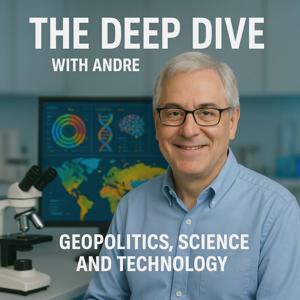
This podcast channel delivers in-depth, educational content across a broad range of topics. A large collection of episodes are available to you, the oldest being as relevant as the newest since this channel is not about daily news. Each episode runs between 30 and 120 minutes and is intentionally designed to go beyond casual listening. The research behind every episode is conducted with the support of advanced artificial intelligence and presented by two AI-generated hosts.
If you’re uncomfortable with the use of cutting-edge AI as both researcher and presenter, this podcast may not be for you. Its mission is to provide access to expert-level knowledge—insights that are typically out of reach through simple web searches or general-purpose AI tools.
“The Deep Dive with Andre” is not about connecting with the personality and voice of a human podcaster — it’s about connecting with expert-level knowledge, for those who value insight over persona. At times, the generated virtual hosts may exhibit an inappropriate voice tone, which can be disconcerting. The technology is still evolving.
Unlike traditional Text-to-Speech (TTS) services, the experimental AI powering the virtual hosts develops an independent understanding of the input information before generating speech. While the resulting voices do not match the quality of those produced by services like ElevenLabs, the AI’s ability to generate dynamic dialogues between two virtual hosts is a distinctive feature. Also, the cost of high-quality voiceovers would be astronomical, given the length of each episode (30 to 120 minutes). Quantity takes precedence over voice quality, given the vast knowledge conveyed by the episodes.
Note: When the hosts mention the “report,” “sources,” or “text,” they are unknowingly referring to the in-depth research and analysis generated by the first-stage AI. That output is then passed on to the second-stage AI, which handles the virtual hosts.
Disclaimer: This content is intended for educational purposes only and should not be construed as professional advice. It is derived exclusively from publicly available sources. No proprietary, confidential, or non-public information has been used in their preparation. However, through deep analytical synthesis, it is possible that some insights or conclusions presented here represent emergent interpretations that have not yet been formally published or broadly disseminated within the scientific and technological communities.
Please share your comments here:
https://the-deep-dive-with-andre.podbean.com
That would help improving this podcast show. Some podcast apps give direct access to the episode website.
Available on Amazon Music, Apple Podcasts, Audible, Castbox, Castro, Deezer, Goodpods, iHeartRadio, MyTuner, Overcast, Player FM, Pocket Casts, Podbean, Podcast Addict, Spotify, TuneIn Radio and others.

14,352 Listeners

5,518 Listeners

12,158 Listeners

4,165 Listeners
1,621 Listeners

19 Listeners

16,072 Listeners