
Sign up to save your podcasts
Or

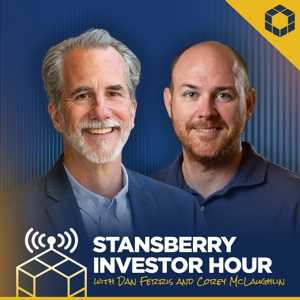

In this week's Stansberry Investor Hour, Dan welcomes James Weatherall to the show. Unlike most of our guests, James does not come from a finance background. However, he has found interesting ways in which physics can change investing. You can check out his book The Physics of Wall Street here.
James kicks things off by sharing his background in physics and philosophy. He's interested in mathematics and how it can be applied to the markets. He's a firm believer in using mathematical models to assist in investing but says that it's important to examine your models and check your assumptions that result from them. If one model is good for a particular use case, trying to use it in a different area or within a larger scope than it was originally intended can yield different results than expected. James discusses the models that Louis Bachelier and Edward Thorp (whom he writes about in his book The Physics of Wall Street) created that would have a major impact on investing. (0:00)
Next, James mentions extreme events similar to Black Monday and their probability of occurring. He notes that in the long term, investors with 401(k)s would be able to survive and even recover after major crashes. However, anyone who overleverages a trade or invests heavily in the short term is at a greater risk of having their portfolios be wiped out. James also mentions the Kelly criterion, a strategy developed by mathematician John Kelly. In short, this method involves having an understanding of what could happen with stocks better than the markets and using that to your advantage to make the optimized trades possible. And when asked if he would change anything about his ideas in The Physics of Wall Street, he remains adamant that his argument still holds up. (19:01)
Finally, James mentions passive trading and volatility and how, over time, the addition of new passive investors will gradually increase market volatility. He adds that there's a scalability problem in the markets. In one example, he says that private markets "worked great 20 years ago" but only "worked OK" 10 years ago. Private markets are slowly becoming less able to sustain the growth they have. And James wraps things up by sharing his personal use cases of AI and his fears with the technology. (34:44)
 View all episodes
 By Stansberry Research

4.3
668668 ratings
In this week's Stansberry Investor Hour, Dan welcomes James Weatherall to the show. Unlike most of our guests, James does not come from a finance background. However, he has found interesting ways in which physics can change investing. You can check out his book The Physics of Wall Street here.
James kicks things off by sharing his background in physics and philosophy. He's interested in mathematics and how it can be applied to the markets. He's a firm believer in using mathematical models to assist in investing but says that it's important to examine your models and check your assumptions that result from them. If one model is good for a particular use case, trying to use it in a different area or within a larger scope than it was originally intended can yield different results than expected. James discusses the models that Louis Bachelier and Edward Thorp (whom he writes about in his book The Physics of Wall Street) created that would have a major impact on investing. (0:00)
Next, James mentions extreme events similar to Black Monday and their probability of occurring. He notes that in the long term, investors with 401(k)s would be able to survive and even recover after major crashes. However, anyone who overleverages a trade or invests heavily in the short term is at a greater risk of having their portfolios be wiped out. James also mentions the Kelly criterion, a strategy developed by mathematician John Kelly. In short, this method involves having an understanding of what could happen with stocks better than the markets and using that to your advantage to make the optimized trades possible. And when asked if he would change anything about his ideas in The Physics of Wall Street, he remains adamant that his argument still holds up. (19:01)
Finally, James mentions passive trading and volatility and how, over time, the addition of new passive investors will gradually increase market volatility. He adds that there's a scalability problem in the markets. In one example, he says that private markets "worked great 20 years ago" but only "worked OK" 10 years ago. Private markets are slowly becoming less able to sustain the growth they have. And James wraps things up by sharing his personal use cases of AI and his fears with the technology. (34:44)
1,085 Listeners
3,075 Listeners

146 Listeners
948 Listeners
659 Listeners

202 Listeners

357 Listeners

264 Listeners

300 Listeners
90 Listeners
1,347 Listeners

367 Listeners

66 Listeners
419 Listeners

79 Listeners