
Sign up to save your podcasts
Or

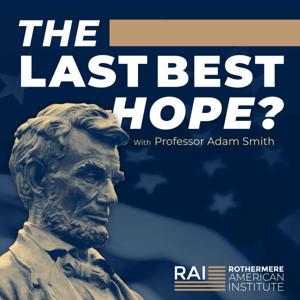


Hillary Rodham Clinton has been at the centre of American public life for thirty years. She has exercised more power from more senior positions than any other woman in American history. Clinton has just co-edited a new book Inside the Situation Room: The Theory and Practice of Crisis Decision-making. and in this special episode, she discusses with Adam a key case study in that book -- the raid in which Bin Laden was killed -- and in doing so, reflects on her idea of what America is and can be.
The Last Best Hope? is a podcast of the Rothermere American Institute at the University of Oxford and is kindly supported by Tom Amraoui. For details of our programming, go to rai.ox.ac.uk
If you would like to support us by making a donation go to https://www.rai.ox.ac.uk/giving
Producer: Emily Williams. Presenter: Adam Smith
Hosted on Acast. See acast.com/privacy for more information.
In the new series beginning on the 11th of February 2026, Adam speaks to Former Secretary of State Hillary Clinton about her vision of America and its place in the world and considers whether “states’ rights” should now become the battle cry of progressives. And this year of course marks the 250th anniversary of the Declaration of Independence, in special two-part documentary, The Last Best Hope explores why the authors chose to use write it in the way they did, and why that matters.
"The Last Best Hope is an absolutely brilliant podcast. Thoughtful, clever, engaging and accessible, Adam Smith always gets the best out of his guests, and I’ve learned an enormous amount from every episode. I love it."
Dominic Sandbrook, Historian and co-host of The Rest is History
“The must-listen US podcast”
Nick Bryant, former BBC Correspondent in New York
The Last Best Hope is a podcast produced by the Rothermere American Institute at Oxford University. The presenter is Adam Smith, Orsborn Professor of US Politics and Political History, and the Producer is Emily Williams.
For more information about the Rothermere American Institute and our programme of events visit https://www.rai.ox.ac.uk/home
The RAI achieves all it does through the generosity of individual benefactors, trusts, and foundations who share the Institute's commitment to world-class research on the United States. If you would like to support us by making a donation go to https://www.rai.ox.ac.uk/giving
Hosted on Acast. See acast.com/privacy for more information.
It is one of the most famous speeches in the English language and one of the most consequential. In this special two-part documentary, we explore Abraham Lincoln’s Gettysburg Address – why he gave it, what it meant, and its impact at the time and ever since. From the rolling fields of Pennsylvania to Parliament Square in London and the dust of Havana, Cuba, Adam Smith follows the path of the Gettysburg Address and asks why it is has mattered.
Contributors: Steve Scafidi, a poet and the author of To the Bramble and the Briar (University of Arkansas Press, 2014); Richard Carwardine, Rhodes Professor Emeritus at the University of Oxford and author of Righteous Strife: How Warring Religious Nationalists Forged Lincoln’s Union (Knopf, 2024); Elizabeth Varon, Langbourne M. Williams Professor of American History at the University of Virginia and author of Armies of Deliverance: A New History of the Civil War (Oxford University Press, 2019); Martin P. Johnson, Associate Professor of History at Miami University in Ohio and author of Writing the Gettysburg Address (University Press of Kansas, 2013); and Dr Jared Peatman, George Washington University, and author of The Long Shadow of Lincoln’s Gettysburg Address (Illinois University Press, 2013).
Adam's latest book is Gettysburg (Oxford University Press, 2025)
The Last Best Hope? is a podcast of the Rothermere American Institute at the University of Oxford. For details of our programming go to rai.ox.ac.uk
Producer: Emily Williams. Presenter: Adam Smith
Hosted on Acast. See acast.com/privacy for more information.
It is one of the most famous speeches in the English language and one of the most consequential. In this special two-part documentary, we explore Abraham Lincoln’s Gettysburg Address – why he gave it, what it meant, and its impact at the time and ever since. From the rolling fields of Pennsylvania to Parliament Square in London and the dust of Havana, Cuba, Adam Smith follows the path of the Gettysburg Address and asks why it is has mattered.
Contributors: Steve Scafidi, a poet and the author of To the Bramble and the Briar (University of Arkansas Press, 2014); Richard Carwardine, Rhodes Professor Emeritus at the University of Oxford and author of Righteous Strife: How Warring Religious Nationalists Forged Lincoln’s Union (Knopf, 2024); Elizabeth Varon, Langbourne M. Williams Professor of American History at the University of Virginia and author of Armies of Deliverance: A New History of the Civil War (Oxford University Press, 2019); Martin P. Johnson, Associate Professor of History at Miami University in Ohio and author of Writing the Gettysburg Address (University Press of Kansas, 2013); and Dr Jared Peatman, George Washington University, and author of The Long Shadow of Lincoln’s Gettysburg Address (Illinois University Press, 2013).
Adam's latest book is Gettysburg (Oxford University Press, 2025)
The Last Best Hope? is a podcast of the Rothermere American Institute at the University of Oxford. For details of our programming go to rai.ox.ac.uk
Producer: Emily Williams. Presenter: Adam Smith
Hosted on Acast. See acast.com/privacy for more information.
A year on, what does Trump’s comeback say about Biden’s understanding of the country he led? Was his vision of America already obsolete — a relic of the bipartisan consensus forged in the 1950s when young Joe was coming of age?
In this episode, we trace Biden’s life through the long arc of American politics over the last 80 years, examining the forces that shaped him and the decisions that defined his time in office, his personal story—tragedy, perseverance, and decades of political ambition—and his commitment to a particular vision of America, as the last best hope of earth.
In the end, what do Biden’s undoubted successes and ultimate, era-defining failure tell us about that optimistic, exceptionalist vision of America in which he so passionately believed?
Adam Smith is joined by Franklin Foer, staff writer at The Atlantic and author of The Last Politician: Inside Joe Biden’s White House and the Struggle for America’s Future. And Bruce Schulman, William E. Huntington Professor of History at Boston University, and pre-eminent scholar of American political history.
The Last Best Hope? is a podcast of the Rothermere American Institute at the University of Oxford. For details of our programming go to rai.ox.ac.uk
Producer: Emily Williams. Presenter: Adam Smith
Hosted on Acast. See acast.com/privacy for more information.
If America is the last, best hope of earth, one reason is the frontier. The frontier has been imagined as the place—or perhaps the process—through which the American character is forged—rugged individualism, the possibility of acquiring land and wealth, where happiness is pursued. For the historian Frederick Jackson Turner in the 1890s, the frontier was what made Americans different. Democracy was not born of a theorists dream, Turner said, nor was freedom something transplanted by Puritans from England, it was forged every time Americans found new frontiers. The frontier gave Americans a restless, nervous energy, a sense of purpose and direction. The frontier was, perhaps above all, a way that Americans, uniquely, could escape the bounds of history, the constraints of resources, of space of land that hampered less favoured nations – it was therefore a way of talking about the future and the endless barrelling forward of their raucous, capitalist, populist society.
But where did the myth of the frontier come from? How does it relate to the reality of western expansion, if it does at all? And what of today? How does the optimistic myth of a frontier as a place of possibility fare in a world of ICE agents and border walls. Rather than the endless expansion promised by the myth of the frontier, is America closing in?
Adam Smith is joined by two great historians: Patrician Nelson Limerick, professor of history at the University of Colorado, Boulder, one of the founders of the “New Western History” and author of Legacy of Conquest: the unbroken past of the American West. And Greg Grandin, Professor of History at Yale, and the author of The End of the Myth: From the Frontier to the Border Wall in the Mind of America which won the Pulitzer Prize for General Nonfiction in 2020.
The Last Best Hope? is a podcast of the Rothermere American Institute at the University of Oxford. For details of our programming go to rai.ox.ac.uk
Producer: Emily Williams. Presenter: Adam Smith
Hosted on Acast. See acast.com/privacy for more information.
Beneath the chaos of Donald Trump’s second term foreign policy—the bluster, bravado, back-handers and backdowns—is there something else going on? Has the United States reached a turning point in its relationship to the rest of the world?
The era in which the United States constructed multilateral alliances to defend western Europe and advance a global free trade agenda appears to be over. Listen to the people around Trump and you will hear them talking in quite different ways – contempt for Western Europe, admiration for the audacity of Putin in reasserting Russia’s regional sphere of influence. It is as if the United States has decided to retrench geopolitically – controlling Greenland, fantasising about annexing Canada, realising total domination of the northern part of the western hemisphere with all its mineral wealth and, with climate change, new strategically vital sea-lanes?
But if this is a new American foreign policy, is it one that has more than an echo of the pre-Second World War past? After all, it was a commonplace of nineteenth-century US politicians to make fiery speeches threatening to annexe Canada, and they actually did annexe half of Mexico and threaten much more.
So, are there ways in which pre-1941 ideas about the US’s role in the world are relevant to understanding the US’s current geopolitical choices? And what does that tell us about the future?
Adam Smith speaks to Daniel Drezner, Distinguished Professor of International Politics and Academic Dean at The Fletcher School of Law and Diplomacy at Tufts University., prolific writer and author, among many other books and article, of The Toddler in Chief: What Donald Trump teaches us about the modern presidency and to Jay Sexton, President of the Society for Historians of American Foreign Relations, Rich and Nancy Kinder Chair of Constitutional Democracy at the University of Missouri, also a prolific writer, among his influential books is The Monroe Doctrine: Empire and Nation in Nineteenth Century America
The Last Best Hope? is a podcast of the Rothermere American Institute at the University of Oxford. For details of our programming go to rai.ox.ac.uk
Producer: Emily Williams. Presenter: Adam Smith
Hosted on Acast. See acast.com/privacy for more information.
A hundred years ago, Walter Lippmann, one of the great analysts of democratic life, wrote that the present crisis of western democracy is a crisis in journalism. Press barons, Lippmann feared, were so powerful that government based on the consent of the governed was under threat if unregulated media owners could manufacture consent. If the facts were not being made available to the public, how could the public make proper democratic choices? Today, those words ring as true as they ever did. In place of press barons like William Randolph Hearst are corporations that curry favour with an administration that has no compunction about making regulatory decisions based on who the President thinks are his friends. TV networks remove comedians who offend the President for fear of retribution. Jeff Bezos, the Amazon billionaire owner of the Washington Post, a newspaper that for a while adopted the slogan “democracy dies in darkness”, prevented the Post from endorsing Kamala Harris and subsequently announced that the opinions page would henceforth only carry pieces that supported free markets and personal liberties. And in an age when most people get their news in two-second bites from social media, how can the governed give meaningful consent?
These are of course age-old questions about democracy: what does government of the people, by the people look like? How do we have a functioning democracy if we agree on a common set of facts – and how can journalists do their work if people don’t believe they’re pursuing the truth?
Each generation wrestles with these kinds of questions in new ways, not least in the face of new media technology—whether the spread of the millionaire-owned popular press in the early twentieth century, the rise of radio or cable TV or the internet.
In this episode, we draw on Walter Lippmann’s 20th-century warnings about the vulnerability of democracy to propaganda, misinformation, and public disengagement, to assess the challenges facing journalism in 2025.
Adam Smith speaks to Marty Baron, former Washington Post executive editor between 2013 and 2021 and to Dr Tom Arnold Forster, author of Walter Lippmann: An Intellectual Biography, published by Princeton University Press.
The Last Best Hope? is a podcast of the Rothermere American Institute at the University of Oxford. For details of our programming go to rai.ox.ac.uk
Producer: Emily Williams. Presenter: Adam Smith
Hosted on Acast. See acast.com/privacy for more information.
It's been almost a year since The Last Best Hope aired, and in that time, America has changed dramatically. So in the new series, we’ll be attempting to put Trump’s foreign policy in a historical context, we’ll be discussing the enduring myth of the frontier, and asking how history will judge Joe Biden. And in a special two-part documentary, we’ll return to Lincoln’s Gettysburg Address, delivered in 1863 in the midst of the Civil War, and ask what significance it still has at another moment of national crisis.
“Adam Smith is one of the UK’s foremost historians of America, and communicates his expertise with zest, wit and unforced passion. The Last Best Hope? brings him together with fellow scholars to provide a unique insight we can’t do without.”
Phil Tinline, BBC radio documentary-maker and author
"The Last Best Hope is an absolutely brilliant podcast. Thoughtful, clever, engaging and accessible, Adam Smith always gets the best out of his guests, and I’ve learned an enormous amount from every episode. I love it."
Dominic Sandbrook, Historian and co-host of The Rest is History
“The must-listen US podcast”
Nick Bryant, former BBC Correspondent in New York
The Last Best Hope is a podcast produced by the Rothermere American Institute at Oxford University. The presenter is Adam Smith, Orsborn Professor of US Politics and Political History, and the Producer is Emily Williams.
Hosted on Acast. See acast.com/privacy for more information.
In this special episode of The Last Best Hope, we bring you a recording of a live event at the Rothermere American Institute in Oxford on Thursday, November 7. Adam Smith and guests discussed why the election turned out the way it did.
The panellists are:
Jason Casellas ABC News election decision desk. Jason Casellas is an Associate Professor of Political Science at the University of Houston. He is an expert in Latino politics and has published widely on state and local politics.
Clare Malone New Yorker staff writer. Clare Malone reports on politics, media, and journalism for the New Yorker. She previously covered both the 2016 and 2020 Presidential campaigns as a senior political writer for FiveThirtyEight.
Mike Murphy Republican political strategist and media consultant. Mike Murphy has worked on the presidential campaigns of George H.W. Bush and John McCain. He also co-hosts the popular politics podcast Hacks on Tap with David Axelrod.
Kimberley Johnson John G. Winant Visiting Professor of American Government. Kimberley Johnson is a Professor of Social and Cultural Analysis at New York University and an expert on racial and ethnic, and suburban and urban politics.
Hosted on Acast. See acast.com/privacy for more information.
From the publisher's feed
Abraham Lincoln called the United States “the last best hope of Earth.” In this podcast, we ask whether that claim still holds — and whether it ever did.
Each episode takes a…
Hosted by Adam Smith, Orsborn Professor of American Political History and Director of the Rothermere American Institute at Oxford, The Last Best Hope? brings him into conversation with leading scholars and public figures, including Hillary Clinton, Annette Gordon-Reed, Eric Foner, David Frum, Heather Cox Richardson, Stacy Schiff, Jonathan Freedland, James Morone, Michael Kazin, Kevin Kruse, Julian Zelizer, Bruce Schulman, Ty Seidule, Liz Varon, Eric Rauchway, Phil Tinline, Emily Bazelon, Richard Carwardine, Rachel Shelden, Richard Blackett, Devin Fergus, and Dan Jackson.
“Adam Smith is one of the UK’s foremost historians of America, and communicates his expertise with zest, wit and unforced passion. The Last Best Hope? brings him together with fellow scholars to provide a unique insight we can’t do without.” — Phil Tinline, BBC radio documentary-maker and author
“The Last Best Hope is an absolutely brilliant podcast. Thoughtful, clever, engaging and accessible, Adam Smith always gets the best out of his guests, and I’ve learned an enormous amount from every episode. I love it.” — Dominic Sandbrook, historian and co-host of The Rest is History
“The must-listen US podcast.” — Nick Bryant, former BBC Correspondent in New York
Produced by the Rothermere American Institute, University of Oxford. https://www.rai.ox.ac.uk/home
Hosted on Acast. See acast.com/privacy for more information.

5,486 Listeners

3,197 Listeners

4,768 Listeners

63 Listeners

1,427 Listeners

15,577 Listeners

3,043 Listeners

338 Listeners

2,452 Listeners

836 Listeners

333 Listeners

148 Listeners

2,229 Listeners

1,105 Listeners

180 Listeners