
Sign up to save your podcasts
Or



At the heart of the "promise" of the American Revolution and the new republic's claim to be the last, best hope of earth, is the assertion in the Declaration of Independence that "all men are created equal". How did Black Americans react to the Declaration? How did they seek to shape the character of the new Republic? And what was the relationship between the Black struggle for freedom and equality and the American Revolution? To examine this once-hidden history of Black Americans in the founding era, Adam is joined by Professor James Basker, the President of the Gilder Lehrman Institute of American History and the Richard Gilder Professor of Literary History at Barnard College. Jim is the editor, with Nicole Seary, of a remarkable new collection published by the Library of America called “Black Writers of the Founding Era” which contains texts – most previously unpublished – by more than 120 Black Americans.
Readings in this episode were performed by Chelsi Campbell and Darius Jackson. Producer: Emily Williams. Presenter: Adam Smith.
Hosted on Acast. See acast.com/privacy for more information.
Hosted on Acast. See acast.com/privacy for more information.
Cricket was once the most popular summer game in the United States – the first ever international match was played not, as you might expect between England and one of its colonies, but between Canada and the United States, in 1844. The first overseas England tour was to the US in 1859. The professional players earned the unheard-of sum of 90 pounds – America then, just as now, was an El Dorado of sporting riches. Yet just ten years later, after four years of civil war and the rebirth of a newly consolidated United States, the new sport of baseball had all but erased cricket from the New York sporting press. The prize money and betting markets that were once drawn to the cricket field now turned to the baseball diamond. As one old American cricketer sadly observed in his memoirs, “We had a large number of good young men playing the game up to the time when the war fever took hold of them. When hostility between North and South broke out, away went our players to the front and the cricket field was deserted. Those that returned from the war never took up the game again.” So, what went wrong? How can we explain the strange death of American cricket, and how should we explain its present-day partial revival? Adam talks to Ed Smith, former England cricketer and an award-winning journalist and to Joe Lynn Curator at The C. Christopher Morris Cricket Library at Haverford College.
Hosted on Acast. See acast.com/privacy for more information.
Presidential primaries – the circus that has traditionally wended its way from Iowa to New Hampshire and beyond every four years -- is one of the most distinctive features of American political life. From the insurgent campaigns of Jimmy Carter in 1976 to Barack Obama in 2008 and even Donald Trump in 2016, primaries have enabled the rise of politicians who could never have succeeded under the old boss-controlled system. US political parties are private organisations albeit without the formal membership of parties in other countries, yet their candidate nomination process is regulated by state law. So, how, why, and when did US political parties come to choose their presidential candidates in this way? How have primaries shaped elections and the trajectory of politics? And in a year in which both parties appear set to nominate unpopular candidates, does this reflect the failure of this system for presidential candidate selection? Adam talks about these issues with the leading historian of modern US politics, Professor Julian Zelizer of Princeton University, a CNN contributor and author or editor of fifteen books on political history.
Hosted on Acast. See acast.com/privacy for more information.
Today, Mexicans and people from Latin America make up about half of the total immigrant population and Latinos are now the single largest “non-white” block in the electorate – if, that is, they can be considered a coherent “block” at all. In the early years of the twenty-first century one of the axioms of American politics was that the ever-rising share of Latinos in the electorate would deliver Democratic majorities. That’s not exactly how things have panned out. So, who are we really talking about when we talk about Latino voters, what binds these 60 million people who are from, such different experience and such different histories together? How has their vote mattered in the past and how does it matter now? Joining Adam to discuss these issues are Jason Casellas of the University of Houston, currently Winant Professor of American government at Oxford, and Anna Sampaio, Santa Clara University.
The Last Best Hope? is the podcast of the Rothermere American Insitute at the University of Oxford. Presenter: Adam Smith. Producer: Emily Williams.
Hosted on Acast. See acast.com/privacy for more information.
In 1930s America, fascism was on the march – not just right-wing politicians who might be pejoratively described like that, but actual fascists who embraced the title. And the core claim they made was that fascism was as American as motherhood, apple pie, and George Washington himself. Yet the US eventually entered the war against Naziism because fascism and Americanism were antithetical. To explore the fraught relationship and enduring appeal of fascist ideas in America, Adam talks to Sarah Churchwell, author of Behold America: A History of America First, and Will Hitchcock, host of the Democracy in Danger podcast who’s working on a book on the fascist threat and America’s path to World War II.
The Last Best Hope? is the podcast of the Rothermere American Insitute at the University of Oxford. Presenter: Adam Smith. Producer: Emily Williams.
Hosted on Acast. See acast.com/privacy for more information.
Hosted on Acast. See acast.com/privacy for more information.
Hosted on Acast. See acast.com/privacy for more information.
Sixty years ago, President John F. Kennedy was shot and killed in Dallas, Texas. It was quickly mythologised as an end-of-innocence moment, the death of "Camelot". It is natural to believe that big events must have big causes. Could such a shattering, shocking event really have been triggered--figuratively as well as literally--by one troubled man? The historians Phil Tinline and Steve Gillon join Adam to discuss how the assassination spawned the mother of all conspiracy theories and what that tells us about America.
The Last Best Hope? is the podcast of the Rothermere American Insitute at the University of Oxford. Presenter: Adam Smith. Producer: Emily Williams.
Hosted on Acast. See acast.com/privacy for more information.
You cannot begin to understand US politics without encountering the 14th Amendment, ratified in 1868 in the wake of the Civil War. On the surface, the Amendment seems straightforward: it guarantees the equal rights of citizens. But does that mean that race cannot be taken into account even in order to help ensure equality? In his concurring opinion in the affirmative action cases this year, Justice Clarence Thomas argued that the framers of the 14th Amendment intended to create a “colorblind” constitution. Any policy that took race into account – even if well-intentioned – was therefore unconstitutional. In her dissenting opinion, Justice Jackson took a very different view, arguing that the 14th Amendment justified programmes that gave Black people the leg up they needed to be truly equal. As so often in America, an argument about current politics is also an argument about history. Adam is joined by Professor Liz Varon, this year’s Harmsworth Visiting Professor at Oxford, and Emily Bazelon, staff writer for the New York Times Magazine and co-host of the Slate Political Gabfest.
The Last Best Hope? is the podcast of the Rothermere American Insitute at the University of Oxford. Presenter: Adam Smith. Producer: Emily Williams.
Hosted on Acast. See acast.com/privacy for more information.
From the publisher's feed
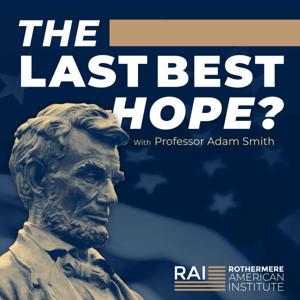
Abraham Lincoln called the United States “the last best hope of Earth.” In this podcast, we ask whether that claim still holds — and whether it ever did.
Each episode takes a…
Hosted by Adam Smith, Orsborn Professor of American Political History and Director of the Rothermere American Institute at Oxford, The Last Best Hope? brings him into conversation with leading scholars and public figures, including Hillary Clinton, Annette Gordon-Reed, Eric Foner, David Frum, Heather Cox Richardson, Stacy Schiff, Jonathan Freedland, James Morone, Michael Kazin, Kevin Kruse, Julian Zelizer, Bruce Schulman, Ty Seidule, Liz Varon, Eric Rauchway, Phil Tinline, Emily Bazelon, Richard Carwardine, Rachel Shelden, Richard Blackett, Devin Fergus, and Dan Jackson.
“Adam Smith is one of the UK’s foremost historians of America, and communicates his expertise with zest, wit and unforced passion. The Last Best Hope? brings him together with fellow scholars to provide a unique insight we can’t do without.” — Phil Tinline, BBC radio documentary-maker and author
“The Last Best Hope is an absolutely brilliant podcast. Thoughtful, clever, engaging and accessible, Adam Smith always gets the best out of his guests, and I’ve learned an enormous amount from every episode. I love it.” — Dominic Sandbrook, historian and co-host of The Rest is History
“The must-listen US podcast.” — Nick Bryant, former BBC Correspondent in New York
Produced by the Rothermere American Institute, University of Oxford. https://www.rai.ox.ac.uk/home
Hosted on Acast. See acast.com/privacy for more information.

5,486 Listeners

3,197 Listeners

4,768 Listeners

63 Listeners

1,427 Listeners

15,577 Listeners

3,043 Listeners

338 Listeners

2,452 Listeners

836 Listeners

333 Listeners

148 Listeners

2,229 Listeners

1,105 Listeners

180 Listeners