
Sign up to save your podcasts
Or

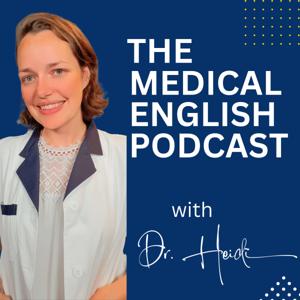
By Dr Heidi


4.7
77 ratings


The podcast currently has 97 episodes available.
The most played episodes among Podcast App listeners.
In this episode of the Medical English Podcast, we break down vitamin D deficiency — one of the most common findings in clinical practice — with a focus on explaining it to patients without reaching for intimidating jargon. You'll learn how to: • Pronounce and use "deficiency," "osteoporosis," "supplement," "hypercalcemia," and "rickets" with confidence • Explain how vitamin D deficiency shows up differently across children, adults, and older adults • Translate technical terms like "osteomalacia" and "cholecalciferol" into language patients can actually digest • Avoid alarming direct translations like "your vitamin D is toxic" • Use simple, reassuring alternatives such as "not having enough of a vitamin" and "too much calcium in your blood" We explore the clinical context behind vitamin D deficiency, the key terminology you need on the ward, and how patient-friendly phrasing lowers anxiety and builds understanding. This episode is perfect for doctors, nurses, dietitians, international medical graduates, and healthcare professionals preparing for exams like the OET, who want to sharpen both their clinical English vocabulary and patient communication skills. Enhance your practical medical English with the Medical English Collection: https://australiabiomed.com/med 🎧 Free transcript & practice quiz for this episode: https://australiabiomed.com/mep-s5e4/ Structured lessons, real-world case dialogues, pronunciation practice, and exam preparation — all designed for healthcare professionals who want to communicate with confidence. Disclaimer: This podcast is for educational purposes only and does not provide medical advice.

In this episode of the Medical English Podcast, we do a deep dive into hyperthyroidism and hypothyroidism — two of the most common endocrine conditions you'll encounter on the ward — with a focus on translating clinical terminology into language your patients will actually understand. You'll learn how to: • Pronounce and use "hyperthyroidism," "hypothyroidism," "goiter," "palpitations," and "autoimmune" with natural clinical rhythm • Explain an overactive vs. underactive thyroid to patients without relying on frightening jargon • Describe Graves' disease and Hashimoto's disease as the autoimmune drivers behind each condition • Avoid alarmist direct translations like "your gland is broken" • Swap terms like "thyrotoxicosis" for reassuring, patient-friendly phrasing We explore the clinical context behind these two extremes of thyroid function, the key vocabulary you need to sound confident in the clinic, and how small language choices can make a big difference to a worried patient. This episode is perfect for doctors, nurses, endocrinology teams, international medical graduates, and healthcare professionals preparing for exams like the OET, who want to sharpen both their clinical English vocabulary and patient communication skills. Enhance your practical medical English with the Medical English Collection: https://australiabiomed.com/med 🎧 Free transcript & practice quiz for this episode: https://australiabiomed.com/mep-s5e1/ Structured lessons, real-world case dialogues, pronunciation practice, and exam preparation — all designed for healthcare professionals who want to communicate with confidence. Disclaimer: This podcast is for educational purposes only and does not provide medical advice.
In this episode of the Medical English Podcast, we tackle four expressions patients use every day to describe altered consciousness and vague symptoms — and why treating them as interchangeable is a mistake that can affect your clinical notes and your diagnosis. You'll learn how to: • Distinguish "blacked out" (a memory gap or possible syncope) from "fainted" (a true collapse with loss of consciousness) • Translate a patient's spoken report of blacking out into correct formal documentation • Take "not quite right" seriously as a potential early warning sign, especially in elderly patients • Use open-ended questions instead of closed questions when a patient's complaint is vague • Recognise "out of it" as reduced alertness while still awake — not full unconsciousness We explore the subtle but clinically important differences between these four everyday phrases, and how mastering them sharpens both your history-taking and your documentation. This episode is perfect for doctors, nurses, ED staff, international medical graduates, and healthcare professionals preparing for exams like the OET, who want to sharpen both their clinical English vocabulary and documentation skills. Enhance your practical medical English with the Medical English Collection: https://australiabiomed.com/med 🎧 Free transcript & practice quiz for this episode: https://australiabiomed.com/mep-s5e5/ Structured lessons, real-world case dialogues, pronunciation practice, and exam preparation — all designed for healthcare professionals who want to communicate with confidence. Disclaimer: This podcast is for educational purposes only and does not provide medical advice.
In this episode of the Medical English Podcast, we follow a real consultation with Mark, a patient with a twenty pack-year smoking history, as he works with his doctor to try quitting again — this time with the right support in place. You'll learn how to: • Use key vocabulary including "nicotine withdrawal," "cravings," "nicotine replacement therapy (NRT)," "cold turkey," and "relapse" • Discuss withdrawal symptoms like irritability, difficulty concentrating, and intense cravings • Explain how NRT and prescription medications work, and why combining medication with behavioural counselling roughly doubles quit success • Identify a patient's personal triggers and build a quit plan around them • Reframe a relapse, or "slip," as a normal part of quitting rather than a failure We explore the full arc of a smoking cessation consultation — from withdrawal and cravings through to treatment planning and follow-up — and how the right language builds trust and motivation. This episode is perfect for doctors, nurses, GPs, international medical graduates, and healthcare professionals preparing for exams like the OET, who want to sharpen both their clinical English vocabulary and patient communication skills. Enhance your practical medical English with the Medical English Collection: https://australiabiomed.com/med 🎧 Free transcript & practice quiz for this episode: https://australiabiomed.com/mep-s5e3/ Structured lessons, real-world case dialogues, pronunciation practice, and exam preparation — all designed for healthcare professionals who want to communicate with confidence. Disclaimer: This podcast is for educational purposes only and does not provide medical advice.
In this episode of the Medical English Podcast, we tackle one of the most practical challenges for healthcare professionals: how to translate what patients are actually saying into precise clinical language — and how to document it correctly. Bridging this gap is essential for accurate records, professional communication, and confident clinical practice. You'll learn how to: • Recognise and translate three key patient phrases — "run down," "pins and needles," and "numb" — into their correct clinical equivalents • Document patient complaints using professional terms: fatigue, malaise, lethargy, paresthesia, hypoesthesia, and anesthesia • Understand the important clinical difference between numbness and tingling, and why specificity matters in your notes • Avoid common mistakes including using patient slang in clinical documentation • Pronounce key terms correctly, including the silent "b" in "numb" We cover a practical cheat sheet for direct translation, real practice sentences, and the key rule that underpins all of it: understand your patient's language, but always document like a clinician. This episode is perfect for doctors, nurses, international medical graduates, and healthcare professionals preparing for exams like the OET, who want to improve both their clinical English vocabulary and documentation skills. Enhance your practical medical English with the Medical English Collection: https://australiabiomed.com/med 🎧 Free transcript & practice quiz for this episode: https://australiabiomed.com/mep-s4e31/ Structured lessons, real-world case dialogues, pronunciation practice, and exam preparation — all designed for healthcare professionals who want to communicate with confidence. Disclaimer: This podcast is for educational purposes only and does not provide medical advice.
The podcast currently has 97 episodes available.

1,821 Listeners

1,037 Listeners

977 Listeners

415 Listeners

506 Listeners

381 Listeners
409 Listeners

462 Listeners

303 Listeners

552 Listeners

238 Listeners
110 Listeners
547 Listeners
40 Listeners
119 Listeners