
Sign up to save your podcasts
Or

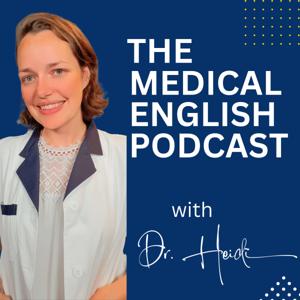
By Dr Heidi


4.7
77 ratings


The podcast currently has 97 episodes available.
The most played episodes among Podcast App listeners.
In this episode of the Medical English Podcast, we break down vitamin D deficiency — one of the most common findings in clinical practice — with a focus on explaining it to patients without reaching for intimidating jargon. You'll learn how to: • Pronounce and use "deficiency," "osteoporosis," "supplement," "hypercalcemia," and "rickets" with confidence • Explain how vitamin D deficiency shows up differently across children, adults, and older adults • Translate technical terms like "osteomalacia" and "cholecalciferol" into language patients can actually digest • Avoid alarming direct translations like "your vitamin D is toxic" • Use simple, reassuring alternatives such as "not having enough of a vitamin" and "too much calcium in your blood" We explore the clinical context behind vitamin D deficiency, the key terminology you need on the ward, and how patient-friendly phrasing lowers anxiety and builds understanding. This episode is perfect for doctors, nurses, dietitians, international medical graduates, and healthcare professionals preparing for exams like the OET, who want to sharpen both their clinical English vocabulary and patient communication skills. Enhance your practical medical English with the Medical English Collection: https://australiabiomed.com/med 🎧 Free transcript & practice quiz for this episode: https://australiabiomed.com/mep-s5e4/ Structured lessons, real-world case dialogues, pronunciation practice, and exam preparation — all designed for healthcare professionals who want to communicate with confidence. Disclaimer: This podcast is for educational purposes only and does not provide medical advice.

In this episode of the Medical English Podcast, we do a deep dive into hyperthyroidism and hypothyroidism — two of the most common endocrine conditions you'll encounter on the ward — with a focus on translating clinical terminology into language your patients will actually understand. You'll learn how to: • Pronounce and use "hyperthyroidism," "hypothyroidism," "goiter," "palpitations," and "autoimmune" with natural clinical rhythm • Explain an overactive vs. underactive thyroid to patients without relying on frightening jargon • Describe Graves' disease and Hashimoto's disease as the autoimmune drivers behind each condition • Avoid alarmist direct translations like "your gland is broken" • Swap terms like "thyrotoxicosis" for reassuring, patient-friendly phrasing We explore the clinical context behind these two extremes of thyroid function, the key vocabulary you need to sound confident in the clinic, and how small language choices can make a big difference to a worried patient. This episode is perfect for doctors, nurses, endocrinology teams, international medical graduates, and healthcare professionals preparing for exams like the OET, who want to sharpen both their clinical English vocabulary and patient communication skills. Enhance your practical medical English with the Medical English Collection: https://australiabiomed.com/med 🎧 Free transcript & practice quiz for this episode: https://australiabiomed.com/mep-s5e1/ Structured lessons, real-world case dialogues, pronunciation practice, and exam preparation — all designed for healthcare professionals who want to communicate with confidence. Disclaimer: This podcast is for educational purposes only and does not provide medical advice.
In this episode of the Medical English Podcast, we do a deep dive into pulmonary fibrosis, a progressive lung disease, with a focus on the precise English vocabulary you need to explain it clearly to both colleagues and patients. You'll learn how to: • Pronounce and use "idiopathic," "fibrosis," "alveoli," "exacerbation," and "interstitial" with clinical confidence • Explain how thickened, scarred lung tissue makes oxygen transfer harder over time • Translate dense terminology into patient-friendly language like "scarring," "air sacs," and "a sudden flare-up" • Avoid frightening direct translations like "your interstitial is ruined" • Use gentler, more accurate alternatives such as "the tissue around your air sacs is stiff" We explore the clinical context behind pulmonary fibrosis, the essential terminology for handovers and case presentations, and how patient-friendly language builds trust during a serious diagnosis. This episode is perfect for doctors, nurses, respiratory teams, international medical graduates, and healthcare professionals preparing for exams like the OET, who want to sharpen both their clinical English vocabulary and patient communication skills. Enhance your practical medical English with the Medical English Collection: https://australiabiomed.com/med 🎧 Free transcript & practice quiz for this episode: https://australiabiomed.com/mep-s5e10/ Structured lessons, real-world case dialogues, pronunciation practice, and exam preparation — all designed for healthcare professionals who want to communicate with confidence. Disclaimer: This podcast is for educational purposes only and does not provide medical advice.
In this episode of the Medical English Podcast, we follow a consultation with David, a patient presenting with fatigue and yellowing eyes, as his doctor works through a differential between hepatitis A, B, and C based on his travel and tattoo history. You'll learn how to: • Use key vocabulary including "jaundice," "liver function tests (LFTs)," "transmission," "antiviral treatment," and "cirrhosis" • Take a history that identifies risk factors for different hepatitis types • Explain the difference in treatment approach between acute hepatitis A and chronic hepatitis B or C • Discuss modern antiviral therapy and its high cure rates for hepatitis C • Advise patients on precautions to protect their liver and reduce transmission risk to family We explore a full hepatitis consultation from history-taking through to diagnosis, treatment planning, and safety-netting, and how clear explanations ease a worried patient's mind. This episode is perfect for doctors, nurses, gastroenterology and hepatology teams, international medical graduates, and healthcare professionals preparing for exams like the OET, who want to sharpen both their clinical English vocabulary and patient communication skills. Enhance your practical medical English with the Medical English Collection: https://australiabiomed.com/med 🎧 Free transcript & practice quiz for this episode: https://australiabiomed.com/mep-s5e9/ Structured lessons, real-world case dialogues, pronunciation practice, and exam preparation — all designed for healthcare professionals who want to communicate with confidence. Disclaimer: This podcast is for educational purposes only and does not provide medical advice.
In this episode of the Medical English Podcast, we tackle four expressions patients use every day to describe altered consciousness and vague symptoms — and why treating them as interchangeable is a mistake that can affect your clinical notes and your diagnosis. You'll learn how to: • Distinguish "blacked out" (a memory gap or possible syncope) from "fainted" (a true collapse with loss of consciousness) • Translate a patient's spoken report of blacking out into correct formal documentation • Take "not quite right" seriously as a potential early warning sign, especially in elderly patients • Use open-ended questions instead of closed questions when a patient's complaint is vague • Recognise "out of it" as reduced alertness while still awake — not full unconsciousness We explore the subtle but clinically important differences between these four everyday phrases, and how mastering them sharpens both your history-taking and your documentation. This episode is perfect for doctors, nurses, ED staff, international medical graduates, and healthcare professionals preparing for exams like the OET, who want to sharpen both their clinical English vocabulary and documentation skills. Enhance your practical medical English with the Medical English Collection: https://australiabiomed.com/med 🎧 Free transcript & practice quiz for this episode: https://australiabiomed.com/mep-s5e5/ Structured lessons, real-world case dialogues, pronunciation practice, and exam preparation — all designed for healthcare professionals who want to communicate with confidence. Disclaimer: This podcast is for educational purposes only and does not provide medical advice.
The podcast currently has 97 episodes available.

1,811 Listeners

1,039 Listeners

977 Listeners

415 Listeners

507 Listeners

380 Listeners

409 Listeners

463 Listeners

306 Listeners

553 Listeners

239 Listeners

110 Listeners
550 Listeners
39 Listeners

117 Listeners