
Sign up to save your podcasts
Or

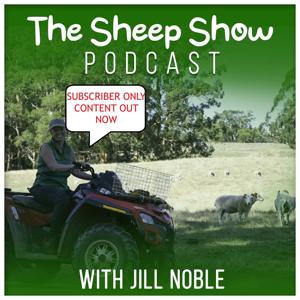


Get in touch to share sheeping stories or questions anytime!
Salt is vitally important to ruminants, playing an essential role in growth, efficiency and reproduction. With careful consideration of flock salt requirements, shepherds can take simple steps to ensure demands are met thus maximising health and productivity.
The information above was only a brief overview. The decision to supplement should be based on flock need and production goals. If you are unsure, it is best to seek expert advice. Further interesting information regarding salt in animal physiology and pasture systems can be found online.
Salt and Reproduction: https://www.sciencedirect.com/science/article/pii/S1751731111000152
Fertiliser affects: https://www.pda.org.uk/pda_leaflets/6-potash-magnesium-sodium/grazing/
Salt to ruminant and horses: https://core.ac.uk/download/pdf/11987906.pdf
Salt and water quality · https://www.dpi.nsw.gov.au/__data/assets/pdf_file/0018/111348/water-for-livestock-interpreting-water-quality-tests.pdf
Support the show
Thank you for supporting our pod! Sign up via our sheep supporters tab !
https://www.buzzsprout.com/954910/supporters/new
Subscriber-only episode
Get in touch to share sheeping stories or questions anytime!
Not vet bashing but helping us understand more about why vets say the things they say, how we can work with our vet better and how we can see the bigger picture but they may not.
Dr Ken Berry's book I refer to is called Lies my Doctor told me, it's an intriguing read!
Want more! Want to show us some sheep love? Sign up for extra content via our sheep supporters tab !
https://www.buzzsprout.com/954910/supporters/new
Get in touch to share sheeping stories or questions anytime!
What sort of sheep equipment is right for me? This is a question I get asked all the time. There is no one size fits all, it's all about what do you do with your sheep.
In this episode we explore how to make the best decision to help you, and explore the different sort of sheep handlers and equipment that is on the market. Happy shopping!
Support the show
Thank you for supporting our pod! Sign up via our sheep supporters tab !
https://www.buzzsprout.com/954910/supporters/new
Get in touch to share sheeping stories or questions anytime!
As always lambing has its ups and downs. Here is what the 2023 lambing season has offered us so far!
Support the show
Thank you for supporting our pod! Sign up via our sheep supporters tab !
https://www.buzzsprout.com/954910/supporters/new
Subscriber-only episode
Get in touch to share sheeping stories or questions anytime!
Is showing ruining the commercial sheep industry and vice versa. What really goes on behind the scenes with some producers who show sheep and how sustainable are these practices for those of us who are also running commercial enterprises. In this premium episode we explore the challenges and woes!
Want more! Want to show us some sheep love? Sign up for extra content via our sheep supporters tab !
https://www.buzzsprout.com/954910/supporters/new
Get in touch to share sheeping stories or questions anytime!
What do you need to have in your birthing kit and lamb survival kits and what is new in my kit for 2023 - check it all out in this episode!
Support the show
Thank you for supporting our pod! Sign up via our sheep supporters tab !
https://www.buzzsprout.com/954910/supporters/new
Get in touch to share sheeping stories or questions anytime!
Not ideal of course but if we are aiming for maximum lamb survival bottle feeding lambs is a part of shepherding. So what are the pros and cons. Why would we do it, how to know you need to intervene and how do we actually do it and for how long do we do it. All you bottle feeding questions are answered in this timely episode! Thanks Robyn for the idea for this episode!
Support the show
Thank you for supporting our pod! Sign up via our sheep supporters tab !
https://www.buzzsprout.com/954910/supporters/new
Get in touch to share sheeping stories or questions anytime!
The Ovine mammary gland is an intricate structure composed of secretory tissue (Parenchyma) and supporting ligaments, venous, lymphatic, adipose and nervous tissue (Stroma). There are two mammary glands divided by a suspensory ligament contained within the udder as shown in the Ovine udder anatomy diagram.
Mammary Gland Development
The development of the mammary gland (mamogenesis) commences in the embryo and continues through to lactation. Ewe lambs are born with cistern, teats and some large ducts. Alveoli and interlobular ducts develop several months after birth along with fat and connective tissue. During pregnancy and in response to estrogen and progesterone, the concentration of blood vessels and secretory cells increases, with new alveoli and duct formation continuing for several weeks post lambing.
Lactation
In the last trimester of pregnancy, changes in the concentration of circulating hormones and growth factors induces lactogenesis, enabling milk production. Nutrients, white blood cells and antibodies are transported to the secretory alveoli by surrounding blood vessels and lymphatic tissue. The secretory epithelial cells produce milk particles from the nutrients absorbed from stromal tissue. Milk globules, composed of milk particles and cytoplasmic fluid, are moved to the inner lumen by pinch off part of the cell wall in a process known as apocrine secretion. In response to external stimuli, nerves innervating the udder signal the release of oxytocin from the brain, which acts on the myoepithelial layer causing the alveolus to contract and forcibly expel milk from the lumen into the network of ducts and down to the gland cistern. Suckling or manual milking causes milk to pass through the annular ring into the teat cistern where it is ejected from the teat through the streak canal. Shortly after milking, the teat sphincter closes preventing milk leakage and infection.
In sheep and goats approximately 50-70% of the milk is stored in the glands cistern unlike 20% in cattle. Sheep with larger gland cistern can store more milk and cope with less frequent milking, which is beneficial for dairy sheep.
Support the show
Thank you for supporting our pod! Sign up via our sheep supporters tab !
https://www.buzzsprout.com/954910/supporters/new
Subscriber-only episode
Get in touch to share sheeping stories or questions anytime!
We've all been there, sheep go down and we are hoping and praying they will get up again. In this subscriber only episode we explore some strategies on how to save a sheep - what I have tried recently, what I used and the results!
Want more! Want to show us some sheep love? Sign up for extra content via our sheep supporters tab !
https://www.buzzsprout.com/954910/supporters/new
Get in touch to share sheeping stories or questions anytime!
OJD – an iceberg disease
Ovine Johne's Disease (OJD) is endemic across NSW after its detection on the Northern Tablelands in May 2023. While the infection was traditionally considered a southern disease, a number of cases across the Northern Tablelands have been diagnosed over the past 12 months. OJD is said to be an iceberg disease. For ever one animal showing signs of OJD another 25 most likely are sub clinically infected and show no signs. So that visibly impacted animal is the tip of the iceberg.
Ovine Johne’s disease (OJD) is an incurable, infectious wasting disease of sheep. OJD is caused by the sheep strain of the bacterium Mycobacterium paratuberculosis, which leads to the intestinal wall slowly thickening, causing reduced absorption of nutrients from the intestine. This eventually leads to severe loss of condition – infected sheep can waste away and die.
The bacteria are passed in the manure of infected animals, contaminating pasture and water supplies and spreading infection to other susceptible sheep. Once a flock is endemically infected with OJD, it is difficult to eradicate.
OJD is often not diagnosed in a flock until a significant proportion of the flock is already infected and deaths are occurring. There is often no sign for the first few years – that is why it is often referred to as a ‘silent but costly disease’. Infected sheep can be shedding the bacteria in their manure for a considerable period (sometimes years) even though the flock still looks healthy, but they are contaminating the pasture and infecting other sheep.
http://www.ojd.com.au/
http://www.ojd.com.au/publications/
OJD and Crohns
https://r.search.yahoo.com/_ylt=Awr933VrTJBkDE4ApAk36At.;_ylu=Y29sbwNncTEEcG9zAzIEdnRpZAMEc2VjA3Ny/RV=2/RE=1687207147/RO=10/RU=https%3a%2f%2fwww.foodstandards.gov.au%2fpublications%2fdocuments%2fedit_Report_JD%2520and%2520CD-%2520Final%2520Dec%25202004.pdf/RK=2/RS=NnhmukaeZ5y5g06X7280P2l6eXs-
Support the show
Thank you for supporting our pod! Sign up via our sheep supporters tab !
https://www.buzzsprout.com/954910/supporters/new
From the publisher's feed
All things ovine, sheep farming and learning more about sheep and shepherding. Learn about breeding animals and being a sheep farmer. Brother and sister team across two hemispheres explore sheep…

56,445 Listeners
436 Listeners
520 Listeners

10,186 Listeners
117 Listeners
10 Listeners
62 Listeners

15,948 Listeners
21 Listeners
36 Listeners
14 Listeners

1,121 Listeners
7 Listeners