
Sign up to save your podcasts
Or



We spend our life trying to gain Olam Habbah. All of our learning, all of our chessesd, all of our davening, is directed towards creating what I will be forever. Yet sometimes it seems that we work harder and not smarter towards our goal.
In this Shmuz, we are introduced to a simple method to dramatically increase our portion in Olam Habbah- a smarter way.
If a person looks at the features of this world they will quickly see that Hashem invested great wisdom and care in making man 's stay on the planet enjoyable. From the different foods, each one with its unique flavor, aroma and textures; to the colors of flowers and magnificent sea scapes , so much of the beauty of this world was not necessary. It is clear that Hashem put much thought into creating a world that man can enjoy. The question is, Do we in fact enjoy it?
This Shmuz focuses on the Torah's attitude towards enjoying the pleasures of this world. This may come as a surprise to some people.
Have you ever heard of something called a guilty conscience? What about a Jewish guilty conscience? While we all recognize that Voice Inside, that seems to moralize and lecture to us when we have stepped over the line, we assume that this is just one of those things that we have to sort of ignore.
In this Shmuz we are brought to understand that Voice that HASHEM put inside every human is actually a highly sophisticated tool --almost a moral compass-- that will allow us to find our path amongst the many choices that life brings our way.
Using the event of Eliezer Bar Dudia gaining the title of Rebbe, we are introduced to one of the greatest acts of teshuvah ever achieved by a human. We witness a human rise from the depths of depravity to the heights of spirituality in the course of a few hours. Through the story of his life, we see what a man accomplished in but a day -- and we are brought to a new appreciation of how great the potential of the human being is.
It almost seems as if some people are born with a silver spoon in their mouth, while others are destined to suffer. Why is it is that some people are born with amazing capacity, and others are created so simple? Why is there autism in the world? Why Down Syndrome? If in fact God is just, why not mete out talents and abilities in an equal manner to all people?
Using the backdrop of a famous event brought in the Talmud; this Shmuz focuses us on some of the big picture issues of life, helping us understand life settings, as they apply to each person.
Why are some people blessed with success and others not?
Is there a reason for suffering in the world?
What about pain?
What about death?
To many of us the issue of belief in the Creator boils down to logic against faith. As if from a purely rational, intellectual point of view it would appear that the world evolved, and we who believe have to hold on to our faith against the onslaught of logic and scientific discoveries.
In this Shmuz we are asked to look at matters from a very different vantage point, namely: that which passes in the media as popular science, is neither popular nor science. And the reality is that from a dispassionate position of pure logic, the basic premise that the world just occurred on its own, is so implausible as to make it almost untenable. In the end we are brought to the question: Does Evolution make any sense?
Over the course of history, it seems that there has been no shortage of anti-Semites, people who truly hate Jews and would do anything in their power to put an end to the Jewish Problem. Yet it also seems that if you ask the common anti-Semite, why is it that you hate the Jew? Likely, he wouldnt be able to answer. I know that you dream about their demise- but why? What is it about them that bothers you so? Yet there was a time when anti-Semites not only hated Jews, but they could tell you why. And that reason is very important for us as Jews to understand.
Using Megillas Esther as the background for the Shmuz, we are introduced to the Torahs understanding of why there is Anti-Semitism in the world.
Of course loshon horah is forbidden. We know it was the prime cause of the destruction of the Bais HaMikdash, and of course we know that we arent supposed to speak it--yet we do. A big part of the reason is that we dont really see it as wrong, we dont see it as damaging, and we certainly dont see the act of speaking as something that will cost us in the future.
This Shmuz is a powerful introduction to the effects that our words have on other peoples lives in this world, and on ours in the World to Come.
We know the Avos and Imahos were great individuals -- but what made them so great? Where did they get the moral courage to see what was right, and stick to it against all external pressures?
Through the famous story of Rochel giving up her husband to her sister Leah so as not to embarrass her, we are introduced to some of the basic ingredients that shape any great persons success the moral strength to be a person of principle.
We live in a world of disrespect. Children dont respect parents. Students dont respect teachers, spouses dont respect each other and I certainly cant respect a President or world leader who gives in to his every passion and whim.
In this Shmuz we find that Torah has a very different understanding of respect, and who is worthy of respect. We are introduced to the Torahs concept of respecting the institution even if we dont respect the person. And we are brought to focus on the tremendous sense of appreciation we must have for all the good that we experience living in this land.
From the publisher's feed
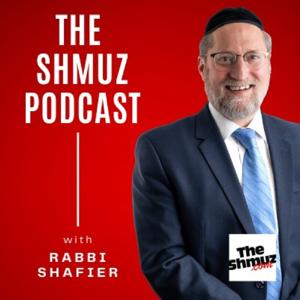
Welcome to The Shmuz Podcast! Here’s your chance to
infuse an inspiring dose of ruchnius, encouragement and positivity into your
day. But don’t just stop here. Go to TheShmuz.com and gain…

152,887 Listeners

556 Listeners

310 Listeners

1,985 Listeners
234 Listeners

3,181 Listeners

1,062 Listeners

818 Listeners
232 Listeners

399 Listeners

1,120 Listeners

373 Listeners
146 Listeners

321 Listeners

910 Listeners