
Sign up to save your podcasts
Or

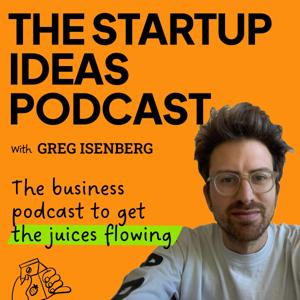
By Greg Isenberg


4.7
204204 ratings


The podcast currently has 378 episodes available.
The most played episodes among Podcast App listeners.
Get Claude Code: https://startup-ideas-pod.link/claude-greg In this solo episode I lay out the exact system I use to turn Claude Code into what I call an AI employee. My premise is simple: give Claude the same things you would give a person joining your company (a workspace, memory, a brief, a clear ticket, eyes, review, a schedule, and permissions). I build the whole setup live around a real idea I found on ideabrowser.com , a missed-lead responder for med spas, and I share the specific prompts I use at each step. By the end, the product, the customer feedback, the docs, the demos, the reviews, and the recurring work all live inside one operating loop. I close with a seven-day plan you can run at your own pace. And thank you to Claude and Anthropic for supporting the podcast. Setup Claude Code to be your 24/7 employee: https://startup-ideas-pod.link/Claude-codeTimestamps00:00 – Intro: The AI Employee Map05:47 – Step 1: Creating The Workspace In Claude Desktop14:53 – Step 2: The Brief And Plan Mode18:08 – Step 3: The Ticket And Defining Done22:15 – Step 4: The Eyes And Desktop Preview26:13 – Step 5: Review In Layers And The Diff View29:34 – Step 6: The Schedule And Routines34:32 – Step 7: Parallel Agents And Worktree Isolation39:14 – Step 8: Permissions: Safe, Ask First, Human-Owned41:15 – Step 9: Skills, Connectors, And Hooks44:28 – The Seven-Day Plan47:42 – Closing ThoughtsKey PointsI treat Claude Code like a new hire: workspace, memory, brief, ticket, eyes, review, schedule, permissions.The repo brain teaches Claude how I work and what good looks like.Plan mode comes first: Claude reads the context, proposes an approach, and waits for my approval.One ticket at a time means one task, one finish line, and one reviewable change.The eyes matter: Claude opens the app in desktop preview, clicks the flow, checks the console, and reports what a buyer experiences.Routines and permissions turn a chat tool into a 24/7 operator with clear boundaries.The #1 tool to find startup ideas/trends - https://www.ideabrowser.comLCA helps Fortune 500s and fast-growing startups build their future - from Warner Music to Fortnite to Dropbox. We turn 'what if' into reality with AI, apps, and next-gen products https://latecheckout.agency/The Vibe Marketer - Resources for people into vibe marketing/marketing with AI: https://www.thevibemarketer.com/FIND ME ON SOCIALX/Twitter: https://twitter.com/gregisenbergInstagram: https://instagram.com/gregisenberg/LinkedIn: https://www.linkedin.com/in/gisenberg/

On this week’s SIP Live we dive deep on the X timeline to give each post a sip or a skip, and we answer questions from the chat. This episode covers AI-native operations, a baby food app that earns a million dollars a month, iMessage agents, human customer support as a brand advantage, small teams, reading habits, and sales advice for builders. Listeners get concrete first steps, business ideas they can copy today, and two clear opinions on each take.Timestamps00:00 – Intro00:59 – Where an AI-Native Company Starts04:48 – The $1M-a-Month Baby Food App10:31 – An App Store for iMessage Agents16:32 – Customer Support Is Eating Engineering23:38 – RIP to the 2-Pizza Team26:36 – Paul Graham on Reading as an Advantage33:31 – The Worst Moves for 202637:01 – From Designer to SalespersonKey PointsMake the company legible first: keep meeting notes and SOPs in files that an LLM can read.Let the team explore AI tools freely, then ask one department, such as admin, to lead.A million-dollar-a-month app leaves room for niche copies that earn 10K to 30K a month.Build loops that turn daily support transcripts into prototypes and measurable goals.Human support works as a marketing advantage, and premium buyers pay for it.Sales stays part of the owner's job, so learn the frameworks and start cold calling. The #1 tool to find startup ideas/trends - https://www.ideabrowser.comLCA helps Fortune 500s and fast-growing startups build their future - from Warner Music to Fortnite to Dropbox. We turn 'what if' into reality with AI, apps, and next-gen products https://latecheckout.agency/The Vibe Marketer - Resources for people into vibe marketing/marketing with AI: https://www.thevibemarketer.com/FIND ME ON SOCIALX/Twitter: https://twitter.com/gregisenbergInstagram: https://instagram.com/gregisenberg/LinkedIn: https://www.linkedin.com/in/gisenberg/FIND JONATHAN ON SOCIALUnscheduled CEO Podcast: https://www.unscheduledceo.com/X/Twitter: https://twitter.com/JicecreamLinkedIn: https://www.linkedin.com/in/jonathan-courtney-4510644b/
I sit down with Billy Howell for an inside look at a real business that runs on Grok Bot agent teams. Billy tests hundreds of tools for The Rundown, and he uses Grok Bot to run his local newsletter, The Arlington Bagel, which goes to 6,000 readers every Thursday. He walks me through his chief of staff bot, his research and sales agents, and the routines that move work forward while he sleeps. We cover the token math, the four-week plan he follows, and the business models that fit this tool best: newsletters, directories, and Shopify stores. You leave with a setup you can copy for one project this month.Timestamps00:00 – Intro02:22 – Grok Bot Overview03:12 – What makes GrokBot special06:09 – Pick one project08:09 – Creating your initial agent team11:19 – First week sprint with Grok Bot13:06 – Automated Routines within Grok Bot15:51 – Agent Org Structure17:35 – Best Practices for building Agents19:45 – Newsletter playbook21:12 – Plugins22:24 – Newsletter playbook pt 225:43 – Sales agent29:06 – Iterating and Improving Agents33:34 – Grok Bot business ideas36:45 – Site stack builder38:36 – Directories and landing pages41:42 – One project for a month42:50 – Closing ThoughtsKey PointsKeep one project per Grok Bot account, so context stays clean and tokens stay available.Start with a chief of staff bot, and let it audit your business and name the first three agents.Follow the four weeks: build the team, execute, hire and fire, then automate.Ask each agent for a five-line brief: what shipped, what is stuck, what needs you.Move repeatable steps into scripts or make com, and keep agent tokens for high value work.Newsletters and directories give the easiest entry, and the two models feed each other.The #1 tool to find startup ideas/trends - https://www.ideabrowser.comLCA helps Fortune 500s and fast-growing startups build their future - from Warner Music to Fortnite to Dropbox. We turn 'what if' into reality with AI, apps, and next-gen products https://latecheckout.agency/The Vibe Marketer - Resources for people into vibe marketing/marketing with AI: https://www.thevibemarketer.com/FIND ME ON SOCIALX/Twitter: https://twitter.com/gregisenbergInstagram: https://instagram.com/gregisenberg/LinkedIn: https://www.linkedin.com/in/gisenberg/FIND BILLY ON SOCIAL:X/Twitter: https://x.com/billyjhowellInstagram: https://www.instagram.com/billyjhowellTiktok: https://www.tiktok.com/@saasfatigueYoutube: https://www.youtube.com/@billyjhowell
On this solo episode, I review five free, open source GitHub repos that help you build products, make money, or save time: Peter Yang's No AI Slop Skill, the CRM by TryComp AI, Video Use by browser use, SkillSpector by NVIDIA, and Phone Harness. For each repo I explain what it does, why it matters, how to install it, and the first small workflow to try. I close with a simple three-step method: install the repo, make one small workflow work, then decide to productize it or keep it as your own leverage.Timestamps00:00 – Intro01:44 – Repo 1: No AI Slop05:20 – Repo 2: Agentic-first CRM10:52 – Repo 3: Video Use15:15 – Repo 4: SkillSpector18:49 – Repo 5: Phone Harness22:25 – Closing ThoughtsLinks to repos:petergyang/no-ai-slop — https://github.com/petergyang/no-ai-sloptrycompai/crm — https://github.com/trycompai/crmbrowser-use/video-use — https://github.com/browser-use/video-useNVIDIA SkillSpector — https://github.com/NVIDIA/SkillSpectorphone-harness — https://github.com/ShawnPana/phone-harness The #1 tool to find startup ideas/trends - https://www.ideabrowser.comLCA helps Fortune 500s and fast-growing startups build their future - from Warner Music to Fortnite to Dropbox. We turn 'what if' into reality with AI, apps, and next-gen products https://latecheckout.agency/FIND ME ON SOCIALX/Twitter: https://twitter.com/gregisenbergInstagram: https://instagram.com/gregisenberg/LinkedIn: https://www.linkedin.com/in/gisenberg/
I run this episode solo. I explain local AI in plain terms: the model runs on hardware I control, and a cloud model runs somewhere else. I map the four pieces of the local AI landscape — the model, the warehouse, the software, and the workflow — and I define the words that beginners meet first: parameters, tokens, context window, quantization, and GGUF. I walk through the Google open model stack (Gemma 4, Google AI Edge, LiteRT-LM, AI Edge Gallery), compare the other open model families, and show three ways to run a model today. I close with a first workflow you can copy and three startup ideas that use local AI as the wedge.And a special thank you to Google for supporting the podcast. Timestamps00:00 – Intro01:35 – The Open Model the Landscape03:09 – Vocab Decoder06:48 – Google Gemma Clearly Explained10:29 – Other Open Model Families14:20 – Path 1: Run Gemma in LM Studio18:17 – Path 2: Ollama20:15 – Path 3: Google AI Edge21:07 – Hardware Cheat Sheet21:52 – First Workflow to Build22:47 – Workflows Before Fine-Tuning25:06 – Local vs Cloud vs Hybrid Eval26:33 – Framework for Local AI Startup Ideas27:22 – Startup Idea 1: Home Health QA Reviewer29:24 – Startup Idea 2: Offline Field Report Copilot32:10 – Startup Idea 3: Pre-Send Reviewer for Professional Services34:47 – Build Your Local AI Lab37:55 – Closing ThoughtsKey PointsAsk whether the model is good enough for the job, and the business opportunities become clear.Local AI has four pieces: the model, the warehouse (Hugging Face), the software (LM Studio or Ollama), and the workflow you build around them.Gemma 4 E4B is my practical starting point; E2B fits phones and older machines.Hybrid architecture wins: local does the private first pass, cloud does the heavy reasoning, and a human approves anything important.Start with one repeated workflow — one folder, one model, one output — and run it 10 times.I see a 24-month window to build local-AI-native software for verticals that still run early-2000s tools.The #1 tool to find startup ideas/trends - https://www.ideabrowser.comLCA helps Fortune 500s and fast-growing startups build their future - from Warner Music to Fortnite to Dropbox. We turn 'what if' into reality with AI, apps, and next-gen products https://latecheckout.agency/The Vibe Marketer - Resources for people into vibe marketing/marketing with AI: https://www.thevibemarketer.com/FIND ME ON SOCIALX/Twitter: https://twitter.com/gregisenbergInstagram: https://instagram.com/gregisenberg/LinkedIn: https://www.linkedin.com/in/gisenberg/
The podcast currently has 378 episodes available.
3,446 Listeners
1,289 Listeners

541 Listeners
1,574 Listeners
1,086 Listeners

1,252 Listeners
2,198 Listeners

230 Listeners

4,460 Listeners

2,657 Listeners
357 Listeners

658 Listeners
262 Listeners
54 Listeners

32 Listeners