
Sign up to save your podcasts
Or

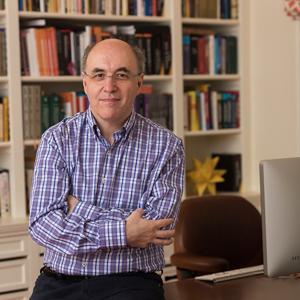


Stephen Wolfram answers questions from his viewers about the history of science and technology as part of an unscripted livestream series, also available on YouTube here: https://wolfr.am/youtube-sw-qa
Questions include: Can you discuss the thinking process of the discovery of complex numbers, quaternions and octonions? - Can you go over the history of Grothendieck? What lead to the homotopy hypothesis? - Can you talk about the history of four-function calculators? - Could you tell us when cybersecurity was considered an important topic in computer science? - I bet one of the first major applications of cybersecurity was for the telephone system, which was essentially a giant computer that people started hacking to make free long-distance calls in the 1960s. - If nature is fundamentally computational, then what are the bugs in nature? - Can you talk about Steve Jobs's NeXTSTEP approach to software? Does it have an ongoing legacy? - In the Netherlands, if you dial #31# before the phone number, the other person won't see your phone number, so these things still exist. - So is evolution a bug or a feature?
Stephen Wolfram answers general questions from his viewers about science and technology as part of an unscripted livestream series, also available on YouTube here: https://wolfr.am/youtube-sw-qa
Questions include: Considering visual perception discontinuous or discrete, can we also consider it quantized? In that case, could it be calculated as "discrete packets of visual perception," based on quantum physics? - If the level of CO2 was much higher in the past, why wasn't there a runaway greenhouse effect back then? - I looked into it, and apparently limestone rocks absorb carbonic acid in rain and "scrub" the CO2 out of the atmosphere, but it takes forever! - Do the electron orbitals of an atom ever rotate? Do they rotate at the same rate as the nucleus, or can they rotate independently? Is this the same property as electron spin, or is it separate?
Stephen Wolfram answers questions from his viewers about business, innovation, and managing life as part of an unscripted livestream series, also available on YouTube here: https://wolfr.am/youtube-sw-business-qa
Questions include: Do you take work problems home? What are your thoughts about a balanced work life? - What is a "shocking" meeting? - What do you think of Elon Musk buying Twitter? - It's like voting for algorithms in elections! Algorithm personalities or bias will be increasingly important, I think. - Now that I think of it, a "master AI" will basically mimic a human—a "well-rounded" human derived from all the info out there. - The real world is also highly dynamic, so one AI might be ideal for a while, and then another will be better. - When something seems to be a mishmash of complicated spaghetti code, it's often because the obvious and simple solution is being dismissed early on for mistaken reasons. - No code is the best code in the case of Twitter ranking algorithms. Just let users do it with sorting/filters! - It's pretty funny watching people get excited about Twitter again. How can we avoid the world becoming an electronic panopticon when everything goes digital (currency, ID, AI government...)? - I do think the marketplace approach isn't a bad option, but it seems like the optimal way to do that is just to reopen the Twitter API and let different people create clients. - You end up with a social network as good as the people in the network. I don't think you can elevate people by moderating what they are allowed to say. - I don't think you can avoid bias; it's just inherent to language and minimally complex knowledge units. Bias should be a feature more than something to avoid. It's more useful to understand bias than to attempt to neutralize it. - What tools do you use to get refocused? How do you set yourself up for more creative exploratory activities?
Part 2 (of 2)—Stephen Wolfram plays the role of Salonnière in an on-going series of intellectual explorations with special guests. In this episode, Terry Sejnowski joins Stephen to discuss the the long story of how neural nets got to where they are. Watch all of the conversations here: https://wolfr.am/youtube-sw-conversations
Part 1 (of 2)—Stephen Wolfram plays the role of Salonnière in an on-going series of intellectual explorations with special guests. In this episode, Terry Sejnowski joins Stephen to discuss the the long story of how neural nets got to where they are. Watch all of the conversations here: https://wolfr.am/youtube-sw-conversations
Stephen Wolfram answers general questions from his viewers about science and technology as part of an unscripted livestream series, also available on YouTube here: https://wolfr.am/youtube-sw-qa
Questions include: What is quantum chemistry good for? Anything interesting? - Chemistry is great! Just fertilizer has made an incredible impact throughout history. The Haber process almost single-handedly changed human history. - Isn't organic chemistry/biology the study of programmable matter? - Can you tell the story of traveling through a central processing unit from the electron's perspective? - FETs use voltage at the gate to make a field that "pinches off" the flow of current from the drain to the source.
Stephen Wolfram answers questions from his viewers about the history of science and technology as part of an unscripted livestream series, also available on YouTube here: https://wolfr.am/youtube-sw-qa
Questions include: What is the history of dimensional regularization and zeta regularization? How are they related to renormalization? - When and how was the first compiler made? What language was it for, and what language was it written in? - Can you talk about the history of computer graphics standards and libraries, such as OpenGL etc.? - Larry Sanger - HP 9800s were awesome. They had two overlap video memories. One was ASCII character–based, and the other was HP plotter language controlled. They both showed up on the screen. Handy/versatile.
Stephen Wolfram answers general questions from his viewers about science and technology as part of an unscripted livestream series, also available on YouTube here: https://wolfr.am/youtube-sw-qa
Questions include: Questions include: How does an Easter Bunny lay eggs? - Why is the Planck temperature the limit of potential heat? - Is void space really void, or is there something there? - Does that mean there are more dimensions than the typical ones? - From how many discrete stars was our Earth made?
Stephen Wolfram answers questions from his viewers about business, innovation, and managing life as part of an unscripted livestream series, also available on YouTube here: https://wolfr.am/youtube-sw-business-qa
Questions include: Did you have any fun April Fools' Day occurrences this year? - What is the best April Fools' joke you've been a part of or experienced? - Do you enjoy traveling? Is there anywhere you haven't been yet that you've always wanted to visit? Good food is an added benefit also. - Travel tip: I always have a big snack hidden in my bag, just in case. - There is nothing wrong with chocolate (no matter what the truth is). - These days, people don't remember portable computers being 10+ pounds. I'm curious: did you ever own an old Toshiba? - This is what I feel we are on the cusp of. Less rigid paradigms like general media consumption have ballooned (look at Twitch). - I hope to see the day that unknown citizen scientists can democratically do research with thousands of others, and get compensated for that research. - Absolutely. I can only feel like academia is on its way out, and more sophisticated platforms will emerge for collaboration.
Stephen Wolfram answers general questions from his viewers about science and technology as part of an unscripted livestream series, also available on YouTube here: https://wolfr.am/youtube-sw-qa
Questions include: How was it possible for civilizations across the world to develop pyramids independently (Egypt and Mayans/Aztecs)? Is there any scientific significance to this? - Does the double-helix shape in DNA show up anywhere else in nature? - Are there any examples of logical gates being built out of chemical reactions? What breakthroughs are needed to achieve this? - How many gates are needed for a programming language like C? - Is it necessary to have supercomputers to do meaningful biomolecule-level simulations? - What life forms have arbitrary differences between individuals and what life forms have meaningfully "unique" individuals? - Are Darwin's survival of the fittest, evolution and machine learning all basically the same thing? If not, how do they differ? - Can you please say something about the formation of buckyballs? - How are gemstones formed and how can we model all gem features? Colors, textures, asterism, anisotropy, everything? What do you know? - In quartz, I also notice imperfections like streaks; seems to be the molecular analog to cellular automata.
From the publisher's feed

31,931 Listeners

3,376 Listeners

4,271 Listeners

2,448 Listeners

1,095 Listeners

623 Listeners

542 Listeners
1,068 Listeners

4,168 Listeners

212 Listeners
503 Listeners

97 Listeners

553 Listeners

19 Listeners

5,566 Listeners