
Sign up to save your podcasts
Or

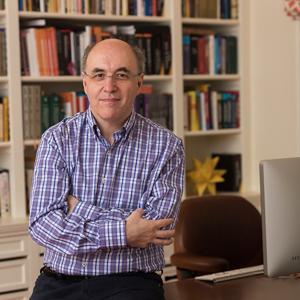


In this episode of "What We've Learned from NKS", Stephen Wolfram is counting down to the 20th anniversary of A New Kind of Science with a chapter retrospective in an ongoing livestream series, also available on YouTube here: https://wolfr.am/12aAqLklA
Stephen Wolfram answers questions from his viewers about business and innovation as part of an unscripted livestream series, also available on YouTube here: https://wolfr.am/youtube-sw-business-qa
Questions include: How do you track if people are working or not if they are not in the office? I personally do not really like the idea of NFT as just purely art, do you know of any special use cases for NFTs that you think are not considered enough, or have you thought of any special use cases of NFTs that others have not really considered? - Do you own any shares? What companies would you consider worth buy a share of? - What do you think would happen in society if we discovered the Genetic Fountain of Youth? Would you reverse your age if possible? - How much of your software do you understand? - At what level of technology do you think we humans are at, the peak? Not even close to the peak? Close to the peak? - Have you ever designed and/or sold hardware? What skillsets are the same / different for developing hardware vs. software? - Have you created a business applying cellular automata? Do you know someone who did it? Are today's nerds and their enterprises missing out on anything by leaving traditional managerial CEOs out, or do nerds simply produce better products/processes? - Have you seen the Google Primer app? business development info as flashcards in course form - How has your engagement with your company as CEO changed since the initial founding? Did you find it difficult to stop overseeing certain things as the company grew in size, for instance, and as the nature of your role changed?
In this episode of "What We've Learned from NKS", Stephen Wolfram is counting down to the 20th anniversary of A New Kind of Science with a chapter retrospective in an ongoing livestream series, also available on YouTube here: https://wolfr.am/12aAqLklA
Stephen Wolfram answers general questions from his viewers about science and technology as part of an unscripted livestream series, also available on YouTube here: https://wolfr.am/youtube-sw-qa
Questions include: Why do server farms consume so much power? And what advances are possible with parallel computing to reduce the power consumption or get more computations per the same power? - Have you ever had a situation where UUIDs collided and caused some sort of issue? - Why does bitcoin use so much power? - What is the correlation between sleep and weight loss? - side note , Wolfram|Alpha lists the "universe atom count" as 6x10^79 atoms, but a 256-bit UUID would have just 1.16x10^77 options, so we may have a problem labeling the universe's atoms. How was the "universe atom count" calculated? - How to convert black and white video to color - How much sleep do you get a night? - What kind of car do you drive? What's the difference between the technology that fascinates you vs. technology that you just see as utilitarian? - Can you explain the differences between DC and AC please? - If I walk into a very powerful solenoid, will the magnetic fields affect my nervous system, or have any other physical effect on me?
In this episode of "What We've Learned from NKS", Stephen Wolfram is counting down to the 20th anniversary of A New Kind of Science with a chapter retrospective in an ongoing livestream series, also available on YouTube here: https://wolfr.am/12aAqLklA
Stephen Wolfram answers questions from his viewers about the history of science and technology as part of an unscripted livestream series, also available on YouTube here: https://wolfr.am/youtube-sw-qa
In this episode of "What We've Learned from NKS", Stephen Wolfram is counting down to the 20th anniversary of A New Kind of Science with a chapter retrospective in an ongoing livestream series, also available on YouTube here: https://wolfr.am/12aAqLklA
Stephen Wolfram answers general questions from his viewers about science and technology as part of an unscripted livestream series, also available on YouTube here: https://wolfr.am/youtube-sw-qa
Questions include: Are research papers useful? How should I write them and when? - What do you think of research in engineering. Isn't it better to work in a company that specializes in a certain filed and knows it in and out and come up with something revolutionary instead of working at a university where everything is rather theoretical? - About 20 years ago I heard about holographic storage, what happened with this kind of technology that it didn't went forward? - Why do DVDs need to spin these days? Why not just scan top to bottom directly into memory? scanning optics aren't good enough for that? - How does DVD RW work? never understood that one - Follow up question to storing information, is there at present optical end to end computers "not storage" but work memory and the processing unit optical? And would it be easier or harder to have a multi-valued optical computer "not binary" then the electronic?computer "not binary" then the electronic?
In this episode of "What We've Learned from NKS", Stephen Wolfram is counting down to the 20th anniversary of A New Kind of Science with a chapter retrospective in an ongoing livestream series, also available on YouTube here: https://wolfr.am/12aAqLklA
Stephen Wolfram answers questions from his viewers about business and innovation as part of an unscripted livestream series, also available on YouTube here: https://wolfr.am/youtube-sw-business-qa
Questions include: How do you incentivize teams working on subcomponents of larger systems that don't directly impact p&l. - Are you optimistic about the economic future, medium, long term? - Do you think computers will ever be able to become more efficient allocators than free markets? - How would you go about mapping the EdTech industry? I know people building products, doing private equity deals, doing consulting, and teachers using products. Nobody knows what's out there! - Do you think a UBI based economy is coming soon? What are you thoughts about UBI? - How would the bot even evaluate value of the labor? seems super complicated -Why was bell labs so successful? Do you think it can be copied? - I've always wanted to know how to start an R&D lab with only starting out with ideas. For example, Xprize has a carbon capture prize. Looking at a whale's baleen. How feasible is it to have "baleen" filters on container ships that filter carbon from the oceans as the ship moves throughout the ocean. when the ships dock. filters can be swapped out and the carbon can be collected and turned into building materials or "goop" for 3d printers. just a quick thought. - Based on your experience leading a largely remote organization, how do you track and reward the value that team members contribute? - should have smashed 80% of the awards to increase the value of the 20% - How has your company evolved, relative to your expectations when you started it? And, how successful is it in achieving your goals, say out of 10? - Any thoughts on team building / a group becoming a team? - Have you had any failures after your PhD? - If we compare the UK to the US, why does the latter seem much better than the former in terms of developing business ideas from academia to industry? - Maybe time to reflect and present useful things to people, that they're not using after years&years and maybe not let them wait another 20years. - Your record keeping seems incredibly robust. Has that always been the case? What inspired its structure?
From the publisher's feed

31,931 Listeners

3,376 Listeners

4,271 Listeners

2,448 Listeners

1,095 Listeners

623 Listeners

542 Listeners
1,068 Listeners

4,168 Listeners

212 Listeners
503 Listeners

97 Listeners

553 Listeners

19 Listeners

5,566 Listeners