
Sign up to save your podcasts
Or

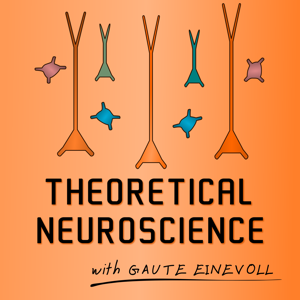


The observed variety of dendritic structures in the brains is striking. Why are they so different, and what determine the branching patterns?
Following the dictum "if you understand it, you can build it", the lab of the guest builds dendritic structures in a computer and explore the underlying principles.
Two key principles seem to be to minimize (i) the overall length of dendrites and (ii) the path length from the synapses to the soma.
The term "foundation model" refers to machine learning models that are trained on vast datasets and can be applied to a wide range of situations. The large language model GPT-4 is an example.
The group of the guest has recently presented a foundation model for optophysiological responses in mouse visual cortex trained on recordings from 135.000 neurons in mice watching movies.
We discuss the design, validation, use of this and future neuroscience foundation models.
A holy grail of the multiscale approach for physical brain modelling is to link the different scales from molecules, via cells and local neural networks, up to whole-brain models.
The goal of the Virtual Brain Twin project, lead by today's guest, is to use personalized human whole-brain models to aid clinicians in treating brain ailments.
The podcast discusses how such models are presently made using neural field models, starting with neuron population dynamics rather than molecular dynamics.
In 1982 John Hopfield published the paper "Neural networks and physical systems with emergent collective computational abilities" describing a simple network model functioning as an associative and content-addressable memory.
The paper started a new subfield in computational neuroscience and led to the influx of numerous theoretical scientists, in particular physicists, to the field.
The podcast guest wrote his PhD thesis on the model in the early 1990s, and we talk about the history and present impact of the model.
The leading theory for learning and memorization in the brain is that learning is provided by synaptic learning rules and memories stored in synaptic weights between neurons.
But this is for long-term memory. What about short-term, or working, memory where objects are kept in memory for only a few seconds?
The traditional theory held that here the mechanism is different, namely persistent firing of select neurons in areas such as prefrontal cortex. But this view is challenged by recent synapse-based models explored by today's guest and others.
In September Paul Middlebrooks, the producer of the podcast BrainInspired, and I were both on a neuro-AI workshop on a coast liner cruising the Norwegian fjords.
We decided to make two joint podcasts with some of the participants where we discuss the role of AI in neuroscience.
In this second part we discuss the topic with Cristina Savin and Tim Vogels and round off with a brief discussion with Mikkel Lepperød, the main organizer of the workshop, about what he learned from the workshop.
In September Paul Middlebrooks, the producer of the podcast BrainInspired, and I were both on a neuro-AI workshop on a coast liner cruising the Norwegian fjords.
We decided to make two joint podcasts with some of the participants where we discuss the role of AI in neuroscience.
In this first part we talk with Mikkel Lepperod, the main organizer about the goal of the workshop, and with Ken Harris and Andreas Tolias about how AI has affected their research neuroscientists and their thoughts about the future of neuro-AI.
Most of what we have learned about the functioning of the living brain has come from extracellular electrical recordings, like the measurement of spikes, LFP, ECoG and EEG signals.
And most analysis of these recordings has been statistical, looking for correlations between the recorded signals and what the animal/human is doing or being exposed to.
However, starting with the neuron rather than the data, these electrical brain signals can also be computed from biophysics-based forward models, and this is topic of this podcast.
The most prominent visual characteristic of neurons is their dendrites.
Even more than 100 years after their first observation by Cajal, their function is not fully understood. Biophysical modeling based on cable theory is a key research tool for exploring putative functions, and today's guest is one the leading researchers in this field.
We talk about of passive and active dendrites, the kind of filtering of synaptic inputs they support, the key role of synapse placements, and how the inclusion of dendrites may facilitate AI.
The greatest mystery of all is why a group of atoms, like the ones constituting me, can feel anything. The mind-brain problem has puzzled philosophers for millennia.
Thanks to pioneers like Christof Koch, consciousness studies have recently become a legitimate field of scientific inquiry.
In this vintage episode, recorded in February 2021, we discuss many aspects of the phenomenon, including an intriguing candidate theory: Integrated Information Theory.
From the publisher's feed
15,237 Listeners
764 Listeners

542 Listeners
304 Listeners

338 Listeners

265 Listeners
4,161 Listeners
204 Listeners

558 Listeners

18 Listeners
514 Listeners

5,549 Listeners

15,917 Listeners

593 Listeners
39 Listeners