
Sign up to save your podcasts
Or



This week we look at:
+ Summer ‘Spin’ Award Winner - so far
+ Howard University can’t catch a break
+ Perfect finances and a WASC Warning?
+ The market will dictate accreditation changes
Show Notes:
2026 College Majors Completion App for Academic Leaders
2026 College Viability App for Research and Media
Chatham University Prepares to Welcome Largest Undergraduate Class Ever
502 students lose spots at Howard University over tuition payments just weeks before classes start
Under pressure from its accreditor, University of Valley Forge offers students information on transferring
Albright College gets OK for tax-exempt bonds as it moves to restructure $42M in debt
3 Programmatic Accreditors Withdraw From Federal Recognition
A Perfect Federal Score, a Top-Tier Forbes Grade, and a WASC Warning
Lawmakers Seek Stronger College Accreditation Standards to Protect Student Loan Borrowers
In this podcast episode, I examine several important developments that illustrate the growing financial pressures facing higher education.
I begin by discussing three San Francisco Bay Area colleges that have received serious warnings from their accreditor to improve both their financial performance and student outcomes.
I also explore the story of Northland College in Wisconsin, where donor-restricted endowment funds were used to help keep the institution operating before it ultimately closed. While the actions may have been legal, I question the ethical implications and argue that financially distressed colleges often find themselves making increasingly difficult decisions simply to survive.
I also discuss several national issues that I believe will shape the future of higher education. I review proposed federal changes to accreditation and explain why I believe today's accreditation system already does too little to evaluate either academic quality or financial health. I highlight Moody's decision to downgrade Brown University's outlook to negative as evidence that even well-resourced institutions face significant financial challenges, and I review new research from Dr. Robert Kelchen that demonstrates how long-term operating losses, enrollment declines, and weakening financial trends can help identify colleges at greater risk.
Michael Hromadka is deeply interested in the connections between work, education, opportunities, and options - and the systems that control those things. He says: "At the end of the day, it'd be nice if those systems made our lives easier and better, instead of harder and worse."
We explore his unique perspective on college with questions like: What is the purpose of college? How do you de-risk the college decision? How can college improve career preparation? And more . . . .
Hromadka's website, Tenonprep.com, provides a series of video clips on improving higher education.
In this episode, I discuss the growing financial pressures facing colleges and universities across the country, highlighting another week filled with layoffs, hiring freezes, budget cuts, and program reductions. I examine institutions including LSU, UCLA, Rutgers, Temple, the University of Texas at Tyler, Albertus Magnus College, the University of Vermont, Defiance College, and Albright College, arguing that these stories are no longer isolated incidents but evidence of a higher education sector facing long-term structural decline.
I also explain why accreditation warnings—particularly those related to financial stability—should be viewed seriously by students and families, even if colleges insist they have turnaround plans in place. Throughout the episode, I encourage listeners to look beyond institutional messaging and focus instead on publicly available financial data, graduation rates, endowment strength, and long-term financial sustainability when evaluating colleges.
I also explore several broader trends that I believe will shape the future of higher education. I discuss a new U.S. Department of Education rule requiring specialized accreditors to justify degree inflation in fields such as pharmacy, physical therapy, and occupational therapy by proving additional educational requirements provide meaningful public benefit.
I close by reinforcing one of my core messages: too many colleges are enrolling students they know are unlikely to graduate simply to generate tuition revenue. I argue that colleges with persistently low four-year graduation rates are failing both students and families, and I preview two upcoming initiatives—My College Decision Lens and The College Outlook Letter—which are designed to help students, families, and higher education stakeholders make more informed, data-driven decisions about the future of colleges.
As a tie-in to the World Cup, if you want to appeal anything in today’s podcast show, send me 2 red cards and a yellow card.
+ Mary Baldwin University on probation for allegedly not meeting financial responsibility standards
+ Professional associations may be driving accreditation requirements too far.
+ Finally, Threats of more closings have colleges and students worrying about how to save themselves
+ Lead with price. Just like Walmart, Target, Costco and use car salesmen
+ Plus stories added just this morning.
Show notes and App links
College Viability Inspection Report
2026 College Viability Majors Completion App
Mary Baldwin University on probation for allegedly not meeting financial responsibility standards
U.S. Department of Education Issues Final Rule to Hold All Colleges and Universities Accountable for Low-Earning Programs
Trump Aims to Limit Outside Influence on College Accreditors
Threats of more closings have colleges and students worrying about how to save themselves
Virginia and Ohio join effort to design 3-year bachelor’s degrees
Can Price-First Admissions Improve College Access?
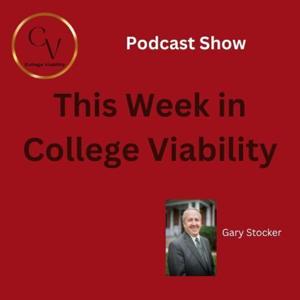
This episode of This Week in College Viability features a conversation between Gary Stocker and college admissions consultant Beth Wilner, founder of Rose Cliff College Consulting, about how families can make more informed college decisions in an increasingly uncertain higher education environment.
Wilner explains that her consulting process centers on three questions: What matters to the student and family? What information do they need to gather? And how should they respond? She emphasizes that successful college planning isn't about gaming admissions but about identifying a student's priorities, gathering meaningful information, and making decisions that align with both personal goals and long-term outcomes. Throughout the discussion, she argues that colleges are living, evolving organizations rather than static institutions, making it essential for families to look beyond brochures, rankings, and campus appearances when evaluating schools.
A major focus of the interview is the growing importance of college financial health as part of the admissions process. Stocker and Wilner discuss warning signs such as declining enrollment, deferred campus maintenance, aggressive tuition discounting, and heavy marketing campaigns that may indicate institutional financial stress.
They encourage parents to ask more probing questions during campus visits, including what has changed most dramatically at the college over the past year, while recognizing that many first-generation families may need guidance navigating those conversations. The interview also examines the confusion surrounding financial aid offers, the limitations of college rankings, and the idea that families should evaluate a college's financial stability before considering other factors.
Wilner concludes by encouraging families to focus first on what truly matters to them, recognize that colleges are businesses operating in a changing market, and seek information that helps them choose a college that will remain financially healthy throughout a student's education
This week on ‘This week’.
+ Johns Hopkins University laying off 110 workers
+ Massachusetts higher education is a mess. Same story different year.
+ Someone new to the College Viability party: Today’s college search requires a new kind of due diligence James Birge pres at Massachusetts College of Liberal Arts
+ Brooke Hauser at Boston Globe: Back-to-back college closures prompt demand for stronger consumer protection
Show links and notes:
College Viability Inspection Report
Johns Hopkins University laying off 110 workers as it deals with loss of federal funding
Unpaid stipends, missing state scholarships: Questions mount as Anna Maria College closes
NAU developing 2027 budget to respond to big decreases in enrollment and revenue
La Salle eyes largest capital campaign yet after record fundraising year
Today’s college search requires a new kind of due diligence
Back-to-back college closures prompt demand for stronger consumer protection
How Bad Is American Higher Education?
This Week:
A small college all but closes
What’s the matter with chemistry degrees?
Wheeling U sends out board chair to spin
Another college complains about its Forbes grade
Show notes and links:
College Viability Inspection Report
Podcast: Kitchen Table College Chat
Podcast: Beyond the College Brochure
This week:
+ University of Denver to close departments, merge schools as part of academic restructuring. (This is a good story. I will tell you why.)
+ A Regional College Laid Off All Its Librarians in 2024. Now It Has to Hire Them Back.
+ A couple of colleges in today’s show are whining about their Forbes grades. One sent two trustees out to respond.
+ Mass. passed a law to stop abrupt college closures. It’s not working. I will tell you what will work
Show notes and links:
Kitchen Table College Chats podcast
Beyond the College Brochure podcast
University of Denver to close departments, merge schools as part of academic restructuring
(Syracuse) U chancellor: School won't meet enrollment target for next fiscal year
A Regional College Laid Off All Its Librarians in 2024. Now It Has to Hire Them Back.
Iowa colleges say Forbes report misses full story
Dr. Joe Pizzorno Outlines What’s Next for Bastyr University and Clinics
Faculty group lashes out at University of Denver’s major restructuring
Columbia College’s finances raise red flags for higher education experts
Voices: We’re the trustees of Westminster University. Here’s the real story of the school’s financial health.
Mass. passed a law to stop abrupt college closures. So why are two schools shutting down?
From the publisher's feed

90,986 Listeners

78,354 Listeners

31,946 Listeners

38,718 Listeners

8,751 Listeners

2,814 Listeners

4,345 Listeners
5,438 Listeners

111,866 Listeners

56,429 Listeners

19,147 Listeners

369 Listeners
142 Listeners

5,549 Listeners

15,908 Listeners