
Sign up to save your podcasts
Or

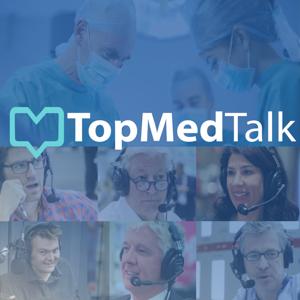


The annual TopMedTalk Holiday Special series this year takes a look back at COVID19 and the first year we had to live with it.
Listen to the full conversations used in this piece:
TopMedTalk | Henrik Kehlet and Nick Scott https://www.topmedtalk.com/topmedtalk-henrik-kehlet-and-nick-scott/
TopMedTalk | Silent pandemic of surgical complications https://www.topmedtalk.com/topmedtalk-silent-pandemic-of-surgical-complications/
COVID 19 | An update on patient, Professor Monty Mythen https://www.topmedtalk.com/8381-2/
COVID 19 | "You must learn the epidemiology" https://www.topmedtalk.com/covid-19-you-must-learn-the-epidemiology/
COVID 19 | Disruptive Innovation https://www.topmedtalk.com/covid-19-disruptive-innovation/
COVID 19 | Bring on the vaccine! https://www.topmedtalk.com/covid-19-bring-on-the-vaccine/
Presented by Monty Mythen and Desiree Chappell with producer Nick Margerrison.
"I cannot sleep. It's like, I wake up at 1am and my mind's going crazy ... if you had someone come to you and say; 'I'm really struggling right now, I'm having a lot of anxiety, with work with family, with kids with whatever'; what are some of the top things that you want to share with them?"
How can a regular yoga practice bring you into a deeper union with what you do and help improve your performance? Why is it that people in the caring profession sometimes leave self care at the bottom of their priority list? What resources can professional bodies offer you?
With special thanks to the American Association of Nurse Anesthetists (AANA) for their help with this piece, their excellent website is here: www.aana.com/covidwellness
The help number mentioned is: 1-800 654 5167
The Breathing App is here: https://eddiestern.com/the-breathing-app/
The book "Why we sleep" is here: https://www.amazon.co.uk/Why-We-Sleep-Science-Dreams/dp/0141983760
"Insight Timer" is here: https://insighttimer.com/
Presented by Desiree Chappell with her guests Bridget Petrillo, CRNA at The Mayo Clinic in Phoenix Arizona, volunteer member for the AANA Peer Assistance Advisors Committee, State Peer Advisor for the Arizona Association of Nurse Anesthetists (AZANA), member of the Wellness Committee for AZANA and Jessica Switzman, CRNA, MSN, Johns Hopkins, also served on the AANA Wellness Committee and AANA Peer Advisors Committee, State Peer Advisor for MANA and has been teaching Yoga since 2007.
This remarkably prescient conversation was recorded at an Australian National Summit in Adelaide regarding the 'hidden pandemic of postoperative complications'. The dangers presented by them certainly suggest this area needs to be taken more seriously. Although staged in Australia this conversation is of global concern, particularly at a time when the world is realising the benefits of proper perioperative care.
For more about the National Emergency Laparotomy Audit go here: https://www.topmedtalk.com/ebpom-2018-12-the-importance-of-cpet-and-nela/
The article mentioned in this piece is here: https://bjanaesthesia.org/article/S0007-0912(18)30654-8/abstract
There's a good piece about the summit here: http://theleadsouthaustralia.com.au/industries/health-and-medical/summit-targets-post-op-pandemic/
Presented by Monty Mythen and Mike Grocott with their guest Guy Ludbrook Professor of Anaesthesia at the University of Adelaide and Royal Adelaide Hospital.
"I think you're now famous in the CRNA community for being one of the first people in Fargo to receive the the COVID vaccine"
This piece sees us catching up with Certified Registered Nurse Anesthetists (CRNA's) who have just been vaccinated for COVID-19. Their story reminds us that even now some practitioners are facing their first real wave of the pandemic in their area: "We had a kind of trickle in, so to say, of COVID patients, and then this in this fall, the middle of November was really when it hit us pretty hard".
Presented by Desiree Chappell with Jordan Rohrich CRNA, Anesthesiology, Fargo, North Dakota and Jordi Idso MS, CRNA, Sanford Health in Fargo.
What happens when cutting edge computer game creators, fresh from working on top titles in their industry such as 'Hunger Games' and 'Mission Impossible', use their skills to simulate high stress moments from the real world of anesthesia and surgery? Using "the neuro-science of game design" to help accelerate learning within the profession:
"The motivation for starting Level Ex, what if we actually took the top game designers and developers in the industry? We're talking the executive producer of "Mortal Kombat", the creative director of "Call of Duty", the marketing director of "Words with Friends"; put them with top physicians from multiple specialties, to capture the challenges of the practice of medicine using video game mechanics".
"This doesn't recreate the mannequin, what this does replace is the five hundred live patients you need to train on in order to encounter those five to ten rare scenarios because we can recreate the rare and the difficult and then we can help you train your visualization skills, your recognition skills, your deductive reasoning skills, on those cases."
The key point here is not that motor function is being copied by a screen interactive experience but instead the aim is to "optimise cognitive load" and recreate the thought process alongside an emotional experience.
"We're not introducing you to how to do a fiber optic intubation, we're going to present dozens of rare difficult challenging once in a lifetime cases". Here computer games can currently excel in their teaching ability, "it's a cognitive skill, it's a decision making algorithm". As time ticks by in the simulation "you do get to a point where there's no return and you have like three minutes to do this successfully and so your algorithm and decision making is absolutely crucial". It's about taking in data and making decisions in a way that is not possible on a mannequin or ethical on a live patient.
"Everything that goes into the app is peer reviewed" and, with any computer game you can earn points as you go along; this game though gives you (Continuing Medical Education) CME points.
Google Play: https://play.google.com/store/apps/details?id=com.levelex.airwayex&hl=en_GB
Apple: https://apps.apple.com/us/app/airway-ex/id1154656060
Open Anesthesia is here: https://www.openanesthesia.org/
Presented by Desiree Chappell and Monty Mythen with their guests. Sam Glassenberg, CEO and Founder of Level Ex, before which he was CEO of the leading independent game publisher in Hollywood, releasing games based on popular films, including The Hunger Games and Mission: Impossible, he also led the DirectX graphics team at Microsoft, where he accepted a Technical Emmy on behalf of his team for advancing the visual realism of video games across the industry. His career began at LucasArts, creating Star Wars games for PlayStation and Xbox. Sam serves on numerous industry advisory boards and speaks internationally on video games in medicine. Robert H. Thiele, Associate Professor, Departments of Anesthesiology and Biomedical Engineering, Division Chief, Critical Care Anesthesiology, Board of Directors, University Physicians Group, University of Virginia School of Medicine. He has a background in engineering and has been using technology to improve education since his residency in 2008. He is co-founder of www.OpenAnesthesia.org which lead to the development of Self-Study, and also authored one of the first iBooks focused on cardiac and critical care ultrasound.
"You've given us all a lot to think about" - a randomized controlled trial regarding intravenous iron does not go 'as expected'.
"I mean, look, I've built my entire career on thinking this was the best thing since sliced bread, the silver bullet, the magic wand ..."
A great scientist follows accurate data to wherever it may lead, what now? More trials, more time, more questions? How common is anemia? Are there any nuggets of hope buried within these data? What have we learned?
Evidence Based Perioperative Medicine sticks to the facts and there's nothing more important than data; make sure you listen to the end, there are interesting details that give many a sense of optimism.
Preoperative intravenous iron to treat anaemia before major abdominal surgery (PREVENTT): a randomised, double-blind, controlled trial is here: https://www.thelancet.com/journals/lancet/article/PIIS0140-6736(20)31539-7/fulltext
Toby is a popular contributor to TopMedTalk - check out his earlier piece here: https://www.topmedtalk.com/prato-2019-toby-richards/
Presented by Monty Mythen and Mike Grocott with their guest Toby Richards, Professor, Anaesthesia Teaching & Research Faculty of Medicine, Nursing and Health Sciences Central Clinical School, Monash University.
How can we align personalised care with prehabilitation? "Personalised care is where people have more choice and control over how their health and care needs are met" where we recognise "people themselves can sometimes be the best integrators of health and care". In this context our role is to support them to "live as independently as they wish". With shared decision making and personal choice at the heart of this we allow patients to be "experts in their own lives, health and care".
The increase in life expectancy means more long term conditions and comorbidities in patients, what opportunities does this present? How do we hone in on what matters to patients and help them manage the cumulative burden of long term health difficulties? How comfortable are healthcare practitioners when talking about physical activity?
Is it possible that personalised care could eventually be business as usual?
The NHS Long Term Plan has a website which you can see here: https://www.longtermplan.nhs.uk/
The NHS website is here: www.england.nhs.uk
Presented by Anna Lowe, Programme manager, National Centre for Sport and Exercise Medicine, Lead Allied Health Physical Activity Clinical Champion at Public Health, England.
After working at a Veterans Affair Medical Center, hear how our guests moved into the field of emergence delirium: "upon emergence our patients were swinging and very aggressive ... there must be some way to prevent this".
This fascinating piece enjoys an engaging discussion about an important topic for both patients and practitioners; how important is it for you to know a patient may suffer from post traumatic stress disorder? Do different anesthetics promote or avoid emergence delirium? Can emergence delirium cause further long term trauma? How do we deal with US military veterans specifically?
Patient Health Questionnaire 9 (PHQ-9) is here: https://patient.info/doctor/patient-health-questionnaire-phq-9
The State Trait Anxiety Inventory is here: https://www.advancedassessments.co.uk/resources/Mental-Health-Test.pdf
Presented by Desiree Chappell and Monty Mythen with Kristen Roman, MSN, MFA, SRNA, Ignacio Diaz, BSN, SRNA and Jena Borgonia, BSN, SRNA, student registered nurse anesthetists (SRNAs) at The University of Southern California.
"It's useful to reflect on what SNAP-2 EPICCS might offer us in the brave new world that we find ourselves in with Coronavirus"
The 2nd Sprint National Anaesthesia Project: Epidemiology of Critical Care after Surgery (SNAP-2 - EPICCS) study launched in March 2017 around the UK. More than 2,200 investigators at more than 250 sites across the UK were signed up to take part. The observational study collected data on all patients undergoing inpatient surgery during a one-week period (21 March to 27 March) in UK NHS hospitals.
What is the scale of the problem; when it comes to cancellation of inpatient surgery surgery, with a specific lens on critical care capacity? What about the value of higher levels of post operative care for high risk surgical patients? What are the essential ingredients for higher intensity post operative care?
Also, learn about some of the organically developed solutions that have come around to capacity issues for high risk surgical patients in the NHS and overseas. As well as this hear how we might select patients to be admitted to higher levels of care; the methods that we might use for risk stratification of inpatient surgical patients and what we think the potential benefits of post operative high levels of care could be. Do we have any data to support the notion that critical care confers benefits on post surgical patients?
The website is here: https://www.niaa-hsrc.org.uk/SNAP-2-EpiCCS
More on SNAP-2 is here: https://www.topmedtalk.com/what-is-snap-2/
Presented by Ramani Moonesinghe, Professor of Perioperative Medicine at University College London (UCL), Hon Consultant in Anaesthesia, UCLH.
"Critical Care has a moment in time, a moment where we can make some big changes, a moment of opportunity"
This uncompromising and informative talk from the technical lead for critical care in the Getting It Right First Time (GIRFT) project takes us through how services can improve and work alongside perioperative care to improve standards and outcomes for patients.
Sharing best practice between trusts GIRFT identifies changes that help improve and change an institution's procedures and cost savings, this is a vital talk and one of the highlights of the hugely successful EBPOM London 2020 virtual conference. For more details on up coming events from Evidence Based Perioperative Medicine EBPOM at www.ebpom.org
The GIRFT website is here – https://gettingitrightfirsttime.co.uk/
Further listening regarding GIRFT can be found here: https://www.topmedtalk.com/rcoa-13-the-girft-getting-it-right-first-time-project/
Presented by Anna Batchelor, MB ChB, FRCA, FFICM, Consultant Anaesthetist - Intensive Care Medicine, Newcastle upon Tyne. She is the technical lead for critical care in the 'Getting It Right First Time' (GIRFT) programme.
From the publisher's feed
1,867 Listeners
499 Listeners

298 Listeners
893 Listeners
1,473 Listeners

87,051 Listeners
3,351 Listeners

111,874 Listeners

56,435 Listeners
1,160 Listeners

187 Listeners

429 Listeners
238 Listeners

15,917 Listeners
269 Listeners