
Sign up to save your podcasts
Or

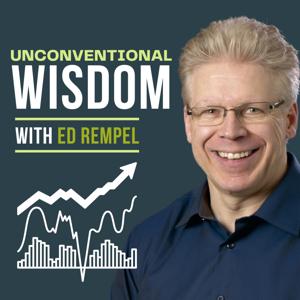


I was honoured to be invited by Ellen Roseman to speak with her Investment Club about the 6 key lessons I have learned as a fee-for-service financial planner.
They have had investment guest speakers, but never someone just talking about financial planning.
Ellen Roseman is a journalist who sticks up for ordinary Canadians.
Her personal finance & consumer columns appeared in the Toronto Star for 20 years, she was the Star's business editor, a columnist for the Globe and Mail, associate managing editor of the Globe's Report on Business, author of 4 books, has a podcast, and she's been teaching courses on investing and personal finance at the University of Toronto.
My views are common sense based on experience writing over 1,000 financial plans and making them work for the lives of our clients.
However, they are unconventional compared to the investment industry's normal practices.
In this podcast episode you'll learn:
Why dividend investing is a brain fart.
Why almost nobody can retire comfortably with a balanced or conservative portfolio.
Why risk tolerance is a learned skill.
How marginal tax brackets, including clawbacks of government programs, can change your financial plan completely.
Why taking advantage of leveraged investing, such as the Smith Manoeuvre, can be the best growth strategy for the right people done the right way over the long term.
The importance of having a financial plan, and why it's the road map to the life you want.
Do you own a business?
If yes, then you'll love my latest podcast episode. I cover the few things that you really need to know about corporations.
You'll learn:
If you should get a holding company.
Whether you should pay yourself a salary or dividend.
Common mistakes by business owners.
If you should invest in a corporation, RRSP or TFSA.
The most common question I get asked about the Canada Pension Plan (CPP) is: "Is it smart to take my CPP early?"
And what I say is - it depends, as the answer is contingent on five main factors.
How long do you expect to live?
How do you invest?
What will inflation be?
Are you still working?
When do you need the money?
In my latest podcast episode I get into more details on how to think about these questions and I give you examples from client case studies.
The answer is complex and CPP is only one piece of your retirement income. The best advice is to look at this as part of a professional retirement plan.
What will it take for you to become financially free?
To have enough money that you never have to work again?
This latest podcast episode is my insight into the few key ideas you really need to know.
It's an overview to give you the big picture of what really works.
Some of these ideas are not conventional wisdom. They are the ideas that give you results over time.
I learned these 6 steps from working with more than 1,000 families to create detailed, personal plans for them to become financially independent.
I am also a fee-for-service financial planner, tax accountant and expert in a few of the most effective strategies that might help you get there.
This podcast is the best 50 minutes of financial education.
Some key things you'll learn:
What is financial independence?
Why you need to understand your inner motivation.
Why it's important to get a professional, written Financial Plan.
What exactly is "effective investing".
What are effective investing strategies?
The best way to work with a planning-focused advisor.
It's easy to outperform robo-advisors.
Why?
Because they don't even try to outperform, they try for reasonable returns with less risk.
You would think robo-advisors would just invest in a few broad indexes, but often they don't. And they require you to invest in bonds no matter how high your risk tolerance.
Robo-advisors are big investment companies, not financial planners. They're more likely to lose a client because of a 30% one year decline, than 10 years of lagging the index, so they focus on market fluctuations and not your life goals.
This post is about performance. How to get the maximum reliable long-term return. It is not about risk-adjusted returns. It's about getting a high enough return to achieve your life goals in your Financial Plan.
In my latest podcast episode (under 4 minutes!), you'll learn exactly how to EASILY outperform robo-advisors.
The average Canadian wastes $22,000 after tax during their life for every $100,000 of their mortgage and takes 38 months longer to pay it off, according to a study by Moshe Milevsky.
This is because of taking 5-year fixed mortgages instead of variable.
They are marketed as being safe and a good protection against a sharp rise in interest rates.
The reality, though, is that they are nearly always a huge waste of money, because the interest rate is nearly always higher and you lose your negotiating power for five long years.
From 1975-2019, 1-year fixed mortgages saved money 100% of the time. 5-year fixed will probably save money for 5 years starting 2020-22, but it may be decades until next time.
That is why we call it the "5-Year Fixed Mortgage Trap".
Listen to my latest podcast episode to find out:
Why people take 5-year mortgages.
What you should do instead.
Why being aware of your negotiating power is key.
Smith Manoeuvre or Smith Maneuver?
Why the two spellings and which is correct?
This strategy (which I'm most known for), helps Canadian homeowners make their mortgages tax deductible in a simple way.
What's the proper spelling?
Who pioneered this legal strategy?
Does it work in Quebec?
Can you use it if you live in the United States?
All these questions you'll get answered in my latest podcast episode.
Listen to find out:
Why the Smith Manoeuvre is often misspelled.
How the Smith Manoeuvre works in Quebec.
The person who pioneered the Smith Manoeuvre.
Learn about the history of the Smith Manoeuvre.
Why I recommend this strategy to so many of my clients.
Asset Allocation Loss Ratio (AALR) – What Is It & How Does It Help You?
When you go to any investment firm in Canada, they require you to sign a risk tolerance questionnaire to prevent you from investing too aggressively.
However there are two important questions:
What prevents you from investing too conservatively?
Can you achieve your life goals with more conservative investments?
These are critical questions, since almost nobody can retire comfortably with a typical balanced portfolio with 40-50% in bonds.
This is where the AALR comes in. With any financial decision, it's important to understand how it affects your life – both the risk & the return.
The Asset Allocation Loss Ratio (AALR) estimates the effect of a more conservative portfolio or suboptimal asset allocation on your long-term investment returns.
In my latest podcast episode I give you examples of case studies, as well as the formula for asset allocation loss ratio, so you can determine exactly how you should invest for your future.
I recently did an interview with Bryn Griffiths from 630 CHED radio in Edmonton about how different things can affect people's credit ratings and how to avoid making common mistakes.
It's a quick, but important podcast episode, because even a $10 missed credit card bill can cost you hundreds of dollars in interest. Plus how to start or build your credit rating.
Enjoy!
Ed
Remember the show "Who wants to be a millionaire?"
Are you the kind of person that wants to build some serious wealth?
Live an exceptional life? Be financially free?
I don't mean just a comfortable amount. I mean a lot – like being a multi-millionaire.
The truth is, average people can become very wealthy just by managing their money for maximum growth.
In my latest podcast episode, I introduce you to The "Rempel Maximum" and the 5 steps to becoming a multi-millionaire.
This is a process to build as much wealth as you can in a solid, reliable way.
The Rempel Maximum is the quest to find the methods most likely to build wealth reliably.
It is best to think of it as a concept – a set of tools, not a recipe.
Do none of it, a bit, or the amount you are comfortable with and that will give you the life you want.
Enjoy!
Ed
From the publisher's feed
1,348 Listeners

3,231 Listeners

15 Listeners

948 Listeners

699 Listeners

3,058 Listeners
475 Listeners

2,140 Listeners

80 Listeners

7 Listeners

31 Listeners

16 Listeners

23 Listeners

55 Listeners

18 Listeners