
Sign up to save your podcasts
Or

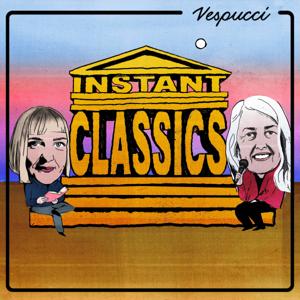

In case you haven’t noticed… the USA is celebrating a special anniversary. Mary and Charlotte talk to one of America’s leading scholars of ancient Rome and its modern reception, Joy Connolly, about why so much of the struggle for independence deployed the words, images and sometimes actual clothing of the Ancient Romans.
They discuss George Washington’s production of the tragedy of Cato in the revolutionary army and Joseph Warren’s donning of a toga to incite the rebels. They ask why the Declaration of Independence and Constitution drew so heavily on Roman writers like Cicero and Virgil, why Cincinnati was named after the authoritarian Cincinnatus, and to what extent the Republicans and Democrats resemble the classical ideologies they named themselves after. Most of all, the big question: did the Founders know that Virgil’s words e pluribus unum (out of many, one), which became a rallying cry for the merging of the colonies into one, actually came from a recipe for cheese spread?
Mary and Charlotte recommend some further reading:
Joy has written about the use of classics in the revolutionary period and later in: “Classical Education and the Early American Democratic Style” in S. Stephens and P. Vasunia (eds), Classics and National Cultures (Oxford UP, 2010) and “Past Sovereignty: Roman Freedom for Modern Revolutionaries” in Basil Duffalo (ed), Roman Error (Oxford UP, 2017). You can read more about her work at ACLS.
There are many useful introductions to different aspects of the Romanness of the American Revolution. We have enjoyed:
C. J. Richard, The Founders and the Classics (Harvard UP, pb, 1995)
M. Malamud, Ancient Rome and Modern America (Wiley Blackwell, pb, 2008)
M. N. S. Sellars, “The Roman Republic and the French and American Revolutions", in H. Flower (ed), The Cambridge Companion to the Roman Republic (Cambridge UP, pb, 2004)
More focussed on cultural influence than any directly political impact is W. L. Vance, America’s Rome (Yale UP, 1990)
An article on Joseph Warren’s toga.
A 1903 letter to the New York Times discussing the tracing of “e pluribus unum” to “Moretum”, the poem once attributed to Virgil that offers a recipe for herby, garlicky cheese spread.
@instaclassicpod for Insta, TikTok and YouTube
@insta_classics for X
email: [email protected]
Instant Classics handmade by Vespucci
Producer: Jonty Claypole
Video Editor: Jak Ford
Theme music: Casey Gibson
Learn more about your ad choices. Visit podcastchoices.com/adchoices
 View all episodes
 By Vespucci

4.9
153153 ratings
In case you haven’t noticed… the USA is celebrating a special anniversary. Mary and Charlotte talk to one of America’s leading scholars of ancient Rome and its modern reception, Joy Connolly, about why so much of the struggle for independence deployed the words, images and sometimes actual clothing of the Ancient Romans.
They discuss George Washington’s production of the tragedy of Cato in the revolutionary army and Joseph Warren’s donning of a toga to incite the rebels. They ask why the Declaration of Independence and Constitution drew so heavily on Roman writers like Cicero and Virgil, why Cincinnati was named after the authoritarian Cincinnatus, and to what extent the Republicans and Democrats resemble the classical ideologies they named themselves after. Most of all, the big question: did the Founders know that Virgil’s words e pluribus unum (out of many, one), which became a rallying cry for the merging of the colonies into one, actually came from a recipe for cheese spread?
Mary and Charlotte recommend some further reading:
Joy has written about the use of classics in the revolutionary period and later in: “Classical Education and the Early American Democratic Style” in S. Stephens and P. Vasunia (eds), Classics and National Cultures (Oxford UP, 2010) and “Past Sovereignty: Roman Freedom for Modern Revolutionaries” in Basil Duffalo (ed), Roman Error (Oxford UP, 2017). You can read more about her work at ACLS.
There are many useful introductions to different aspects of the Romanness of the American Revolution. We have enjoyed:
C. J. Richard, The Founders and the Classics (Harvard UP, pb, 1995)
M. Malamud, Ancient Rome and Modern America (Wiley Blackwell, pb, 2008)
M. N. S. Sellars, “The Roman Republic and the French and American Revolutions", in H. Flower (ed), The Cambridge Companion to the Roman Republic (Cambridge UP, pb, 2004)
More focussed on cultural influence than any directly political impact is W. L. Vance, America’s Rome (Yale UP, 1990)
An article on Joseph Warren’s toga.
A 1903 letter to the New York Times discussing the tracing of “e pluribus unum” to “Moretum”, the poem once attributed to Virgil that offers a recipe for herby, garlicky cheese spread.
@instaclassicpod for Insta, TikTok and YouTube
@insta_classics for X
email: [email protected]
Instant Classics handmade by Vespucci
Producer: Jonty Claypole
Video Editor: Jak Ford
Theme music: Casey Gibson
Learn more about your ad choices. Visit podcastchoices.com/adchoices

5,520 Listeners

3,223 Listeners

488 Listeners

393 Listeners

4,785 Listeners

1,425 Listeners

3,177 Listeners

139 Listeners
3,370 Listeners

15,592 Listeners
1,895 Listeners
2,062 Listeners

3,336 Listeners

1,092 Listeners

176 Listeners