
Sign up to save your podcasts
Or

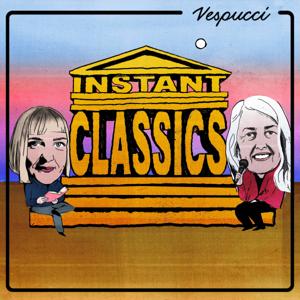

Mary and Charlotte welcome Professor Maria Wyke back on the show to talk about two of the most famous words in cinema: “I’m Spartacus!” Hollywood has always had an obsession with Ancient Rome. So much so, the Roman Epic - or sword-and-sandal - is a cinematic genre in its own right. Stanley Kubrick’s Spartacus, starring Kirk Douglas, Laurence Olivier and a host of other stars, is perhaps the towering achievement. But what is Spartacus really about?
It was adapted by Dalton Trumbo from Howard Fast’s 1951 novel. Both men had fallen foul of the House Un-American Activities Committee and were blacklisted from Hollywood. Their names were proudly displayed at the start of the film, marking the decline of the Committee’s influence on American culture. In some ways, the refusal by Spartacus’ slave army to betray their leader to the Roman authorities is a message about free speech and solidarity. The character of black slave Draba who defies white supremacist authority is also a statement on the Civil Rights movement. But the brilliance of Spartacus is that it defies easy interpretation and deliberately plays with themes and symbols - not least in the crucifixion scene at the end of the film.
Mary, Charlotte and Maria move forwards a few decades to Gladiator - and argue the power of that film is the way it similarly seems to, but doesn’t quite, push a moral message. Gladiator 2 on the other hand…
Further reading
Our wonderful guest Maria Wyke’s book Projecting the Past (Routlege, 1997) has a fascinating chapter on Spartacus
Howard Fast’s novel Spartacus, on which Kubrick’s film was based, is on the Internet Archive.
See also:
A. Futtrell, “Seeing Red”, in Sandra Joshel et al. (eds), Imperial Projections (Johns Hopkins UP, 2001)
Martin Winkler, Spartacus: Film and History (Wiley-Blackwell, 2007)
Martin Winkler, Gladiator: Film and History (Wiley-Blackwell, 2004)
@instaclassicpod for Insta, TikTok and YouTube
@insta_classics for X
email: [email protected]
Instant Classics handmade by Vespucci
Producer: Jonty Claypole
Video Editor: Jak Ford
Theme music: Casey Gibson
Learn more about your ad choices. Visit podcastchoices.com/adchoices
 View all episodes
 By Vespucci

4.9
153153 ratings
Mary and Charlotte welcome Professor Maria Wyke back on the show to talk about two of the most famous words in cinema: “I’m Spartacus!” Hollywood has always had an obsession with Ancient Rome. So much so, the Roman Epic - or sword-and-sandal - is a cinematic genre in its own right. Stanley Kubrick’s Spartacus, starring Kirk Douglas, Laurence Olivier and a host of other stars, is perhaps the towering achievement. But what is Spartacus really about?
It was adapted by Dalton Trumbo from Howard Fast’s 1951 novel. Both men had fallen foul of the House Un-American Activities Committee and were blacklisted from Hollywood. Their names were proudly displayed at the start of the film, marking the decline of the Committee’s influence on American culture. In some ways, the refusal by Spartacus’ slave army to betray their leader to the Roman authorities is a message about free speech and solidarity. The character of black slave Draba who defies white supremacist authority is also a statement on the Civil Rights movement. But the brilliance of Spartacus is that it defies easy interpretation and deliberately plays with themes and symbols - not least in the crucifixion scene at the end of the film.
Mary, Charlotte and Maria move forwards a few decades to Gladiator - and argue the power of that film is the way it similarly seems to, but doesn’t quite, push a moral message. Gladiator 2 on the other hand…
Further reading
Our wonderful guest Maria Wyke’s book Projecting the Past (Routlege, 1997) has a fascinating chapter on Spartacus
Howard Fast’s novel Spartacus, on which Kubrick’s film was based, is on the Internet Archive.
See also:
A. Futtrell, “Seeing Red”, in Sandra Joshel et al. (eds), Imperial Projections (Johns Hopkins UP, 2001)
Martin Winkler, Spartacus: Film and History (Wiley-Blackwell, 2007)
Martin Winkler, Gladiator: Film and History (Wiley-Blackwell, 2004)
@instaclassicpod for Insta, TikTok and YouTube
@insta_classics for X
email: [email protected]
Instant Classics handmade by Vespucci
Producer: Jonty Claypole
Video Editor: Jak Ford
Theme music: Casey Gibson
Learn more about your ad choices. Visit podcastchoices.com/adchoices

5,520 Listeners

3,223 Listeners

488 Listeners

393 Listeners

4,785 Listeners

1,425 Listeners

3,177 Listeners
139 Listeners
3,370 Listeners

15,592 Listeners
1,895 Listeners
2,062 Listeners
3,336 Listeners

1,092 Listeners

176 Listeners