
Sign up to save your podcasts
Or



Dan and Paul are thrilled to chat live with the master of fantasy, Michael Moorcock. What are his current thoughts on the legacy of his writing Elric, the Eternal Champion, critiques of Tolkien, and so much more?
Michael John Moorcock (born 18 December 1939) is an English–American writer, particularly of science fiction and fantasy, who has published a number of well-received literary novels as well as comic thrillers, graphic novels and non-fiction. He has worked as an editor and is also a successful musician. He is best known for his novels about the character Elric of Melniboné, which were a seminal influence on the field of fantasy in the 1960s and 1970s.
As editor of the British science fiction magazine New Worlds, from May 1964 until March 1971 and then again from 1976 to 1996, Moorcock fostered the development of the science fiction "New Wave" in the UK and indirectly in the United States, leading to the advent of cyberpunk. His publication of Bug Jack Barron (1969) by Norman Spinrad as a serial novel was notorious; in Parliament, some British MPs condemned the Arts Council of Great Britain for funding the magazine. He is also a recording musician; he has contributed to the music acts Hawkwind, Blue Öyster Cult, Robert Calvert and Spirits Burning, and to his own project, Michael Moorcock & The Deep Fix.
In 2008, The Times named Moorcock in its list of "The 50 greatest British writers since 1945".
This description uses material from the Wikipedia article "Michael Moorcock", which is released under the Creative Commons Attribution-Share-Alike License 3.0.
Dan and Paul reflect on what we think are the biggest mistakes and errors in the first publication of original D&D in 1974. What are the biggest blemishes that troubled the game for decades afterward? What are some of our top house rules to correct the largest problems?
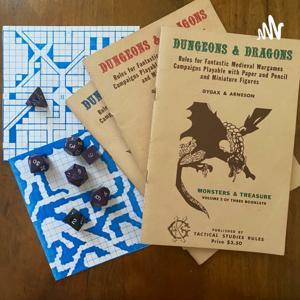
The original Dungeons & Dragons boxed set was the first published role-playing game, a fantasy game system modeled on medieval Europe. This set introduced elements which would become standard in later editions, including abilities (such as strength, intelligence, and dexterity); character classes (fighting-man, magic-user, cleric) and character levels; races (human, dwarf, elf, halfling); armor class; monsters and treasure; underground dungeons consisting of halls, rooms, and doors protected by tricks and traps; and magic items, such as intelligent swords. The set also presents rules for travelling through the wilderness by land and sea, hiring specialists as well as men-at-arms, constructing fortifications and establishing baronies. The set defines movement rates and areas are using inches, like that of the miniatures rules from which the system descended.
This description uses material from the Wikipedia article "Dungeons & Dragons (1974)", which is released under the Creative Commons Attribution-Share-Alike License 3.0.
Paul and Dan check in on their annual D&D mini-convention with friends in a house on the Massachusetts shore, now in its 15th year. What went well, what could go better, what lessons will feed into our future gaming?
This St. Patrick's Day, Paul and Dan discuss the rich history of Irish myths, legends, and stories in the D&D game. From Druids and Bards to the Banshees and Firbolg, what are some of the best ways to spice up your game with inspirations from the Emerald Isle?
Irish mythology is the body of myths indigenous to the island of Ireland. It was originally passed down orally in the prehistoric era. In the early medieval era, some myths were transcribed by Christian monks, who heavily altered and Christianised the myths. Irish mythology is the best-preserved branch of Celtic mythology.
The main supernatural beings in Irish mythology are the Túatha Dé Danann ("the folk of the goddess Danu"), also known by the earlier name Túath Dé ("god folk" or "tribe of the gods"). Early medieval Irish writers also called them the fir dé (god-men) and cenéla dé (god-kindreds), possibly to avoid calling them simply 'gods'. They are often depicted as kings, queens, bards, warriors, heroes, healers and craftsmen who have supernatural powers and are immortal. Prominent members include The Dagda ("the great god"); The Morrígan ("the great queen" or "phantom queen"); Lugh; Nuada; Aengus; Brigid; Manannán; Dian Cécht the healer; and Goibniu the smith. They are also said to control the fertility of the land; the tale De Gabáil in t-Sída says the first Gaels had to establish friendship with the Túath Dé before they could raise crops and herds.
They dwell in the Otherworld but interact with humans and the human world. Many are associated with specific places in the landscape, especially the sídhe: prominent ancient burial mounds such as Brú na Bóinne, which are entrances to Otherworld realms. The Túath Dé can hide themselves with a féth fíada ('magic mist'). They are said to have travelled from the north of the world, but then were forced to live underground in the sídhe after the coming of the Irish.
This description uses material from the Wikipedia article "Irish mythology", which is released under the Creative Commons Attribution-Share-Alike License 3.0.
How does one run a successful dungeons and dragons one shot game? Dan and Paul discuss how to condense the D&D experience to a single night of fun. They'll share techniques they've developed over the years behind the DM screen, discuss which scenarios fit the one-shot format best, and advise would-be DMs on the best road to one-shot success.
Dan & Paul discuss tips for embodying a character in body and voice when playing D&D at the table. When we compare ourselves to well-known D&D performers, what are simple simple tricks anyone can use, even if we aren't trained actors?
Acting involves a broad range of skills, including a well-developed imagination, emotional facility, physical expressivity, vocal projection, clarity of speech, and the ability to interpret drama. Acting also demands an ability to employ dialects, accents, improvisation, observation and emulation, mime, and stage combat. Many actors train at length in specialist programs or colleges to develop these skills. The vast majority of professional actors have undergone extensive training. Actors and actresses will often have many instructors and teachers for a full range of training involving singing, scene-work, audition techniques, and acting for camera.
One of the first known actors was an ancient Greek called Thespis of Icaria in Athens. Writing two centuries after the event, Aristotle in his Poetics (c. 335 BCE) suggests that Thespis stepped out of the dithyrambic chorus and addressed it as a separate character. Before Thespis, the chorus narrated (for example, "Dionysus did this, Dionysus said"). When Thespis stepped out from the chorus, he spoke as if he were the character (for example, "I am Dionysus, I did this"). To distinguish between these different modes of storytelling—enactment and narration—Aristotle uses the terms "mimesis" (via enactment) and "diegesis" (via narration). From Thespis' name derives the word "thespian".
This description uses material from the Wikipedia article "Acting", which is released under the Creative Commons Attribution-Share-Alike License 3.0.
For Valentine's Day, Dan and Paul take a look at how romantic love is portrayed in Dungeons and Dragons. From NPCs with love-based plot lines to the infamous philter of love, we'll cover ever instance we can think of in D&D in which love plays a part.
Love is considered to be both positive and negative, with its virtue representing human kindness, compassion, and affection—"the unselfish, loyal and benevolent concern for the good of another"—and its vice representing a human moral flaw akin to vanity, selfishness, amour-propre, and egotism, potentially leading people into a type of mania, obsessiveness, or codependency. It may also describe compassionate and affectionate actions towards other humans, oneself, or animals. In its various forms, love acts as a major facilitator of interpersonal relationships and, owing to its central psychological importance, is one of the most common themes in the creative arts.
In the Middle Ages, extracts from nightshades were used as hallucinogens, and to make supposed love potions and flying ointments. Such plants may have included belladonna, angel's trumpets, jimsonweed, black henbane, European scopolia or autumn mandrake, which contain alkaloids (atropine and scopolamine, which are hallucinogenic in higher doses) characterized by a narrow therapeutic index. Some attempts to create love potions have led to overdose or death where the preparations were not standardized for the content of potent compounds.
This description uses material from the Wikipedia articles "Love" and "Love potion", which are released under the Creative Commons Attribution-Share-Alike License 3.0.
Paul & Dan celebrate the Year of the Dragon in New Year's 2024! In this 50th anniversary year for original D&D, we'll look back to our best uses for dragons, new discoveries we've made, and how best to use unusual dragon types in your fantasy RPG.
The Dragon, also known as Loong, (simplified Chinese: 龙; traditional Chinese: 龍; pinyin: lóng; Jyutping: lung4; Cantonese Yale: lùhng) is the fifth of the 12-year cycle of animals which appear in the Chinese zodiac related to the Chinese calendar. The Year of the Dragon is associated with the Earthly Branch symbol 辰, pronounced chen.
It has been proposed by one academic researcher that the Earthly Branch character may have been associated with scorpions; it may have symbolized the star Antares. In the Buddhist calendar used in Thailand, Cambodia, Laos, Myanmar, and Sri Lanka, the Dragon is replaced by the nāga. In the Gurung zodiac, the Dragon is replaced by the eagle. In Old Turkic calendar it is replaced by the fish or crocodile. Early Persian translations of the medieval period change the dragon to a sea serpent although in current times it is generally referred to as whale.
There are typically marked spikes in the birth rates of countries that use the Chinese zodiac or places with substantial Overseas Chinese populations during the year of the Dragon, because such "Dragon babies" are considered to be lucky and have desirable characteristics that supposedly lead to better life outcomes.
This description uses material from the Wikipedia article "Dragon (zodiac)", which is released under the Creative Commons Attribution-Share-Alike License 3.0.
Dan & Paul analyze the -- sometimes surprising! -- list of recommended equipment in Original D&D. Sure, you should have dice, paper, and pencils. But is the 3-ring notebook and drafting equipment really needed for the referee and each player? How about the multiple other games you need, Chainmail and Outdoor Survival? And what does say about using miniature figures?
The original Dungeons & Dragons set, subtitled Rules for Fantastic Medieval Wargames Campaigns Playable with Paper and Pencil and Miniature Figures, was written by Gary Gygax and Dave Arneson, and was published by TSR in 1974 as a digest-sized boxed set in a brown wood-grain box. The set included three digest-sized books: the 36-page "Volume 1: Men & Magic", the 40-page "Volume 2: Monsters & Treasure", and the 36-page "Volume 3: The Underworld & Wilderness Adventures". The set also included six reference sheets of tables and charts. Advertisements for the game first started appearing in Spring 1974.
This set features only a handful of the elements for which the game is known today: just three character classes (fighting-man, magic-user, and cleric); four races (human, dwarf, elf, hobbit); and only three alignments (lawful, neutral, and chaotic). The rules assume that players have owned and have played the miniatures wargame Chainmail and that they have used its measurement and combat systems. An optional combat system is included within the rules that later developed into the sole combat system of later versions of the game. In addition, the rules presumed ownership of Outdoor Survival, an Avalon Hill board game for outdoor exploration and adventure.
This description uses material from the Wikipedia article "Dungeons & Dragons (1974)", which is released under the Creative Commons Attribution-Share-Alike License 3.0.
The Wandering DMs dig into the concept of anachronisms in D&D settings. They will explore the historic roots of D&D campaign settings, and where modern objects, events, or ideas have leaked in. Does the existence of anachronism break immersion, or is the very nature of the fantasy genre open to all forms of content? Where and how do we draw the line?
An anachronism is a chronological inconsistency in some arrangement, especially a juxtaposition of people, events, objects, language terms and customs from different time periods. The most common type of anachronism is an object misplaced in time, but it may be a verbal expression, a technology, a philosophical idea, a musical style, a material, a plant or animal, a custom, or anything else associated with a particular period that is placed outside its proper temporal domain.
Fantasy literature is literature set in an imaginary universe, often but not always without any locations, events, or people from the real world. The fantasy genre predominantly features settings that emulate Earth, but with a sense of otherness. Fantasy is distinguished from science fiction by the plausibility of the narrative elements. A science fiction narrative is unlikely, though seemingly possible through logical scientific or technological extrapolation, where fantasy narratives do not need to be scientifically possible. Authors have to rely on the readers' suspension of disbelief, an acceptance of the unbelievable or impossible for the sake of enjoyment, in order to write effective fantasies.
This description uses material from the Wikipedia articles "Fantasy literature" and "Anachronism", which are released under the Creative Commons Attribution-Share-Alike License 3.0.
From the publisher's feed
176 Listeners

76 Listeners
241 Listeners
12 Listeners
16 Listeners
182 Listeners

7 Listeners
5 Listeners
5 Listeners
6 Listeners
3 Listeners
102 Listeners
90 Listeners
31 Listeners
18 Listeners