
Sign up to save your podcasts
Or



In this last-minute, condensed episdoe of Wandering DMs, Dan and Paul discuss using real world time elements in games. From timers in D&D adventures to board games that include a ticking clock, they'll cover everything in under 45 minutes. They even manage to fit in an actual play of 5 Minute Dungeon!
One of our all-time favorite guests, Jon Peterson, D&D historian extraordinaire, returns to talk all things about the 50th anniversary of D&D. From his official "Making of Original Dungeons & Dragons 1970-1977", participation in Gen Con 50th anniversary celebrations, inclusion in the MIT Press "Fifty Years of Dungeons & Dragons" book, and the hotly-anticipated re-release of his seminal "Playing at the World", he's been super busy this year! Dan & Paul will catch up with him and find out what the highlights and new discoveries have been.
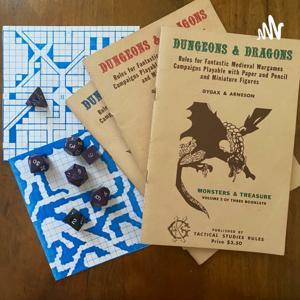
The original Dungeons & Dragons (commonly abbreviated D&D) boxed set by Gary Gygax and Dave Arneson was published by TSR, Inc. in 1974. It included the original edition of the Dungeons & Dragons fantasy role-playing game.
The original Dungeons & Dragons boxed set was the first published role-playing game, a fantasy game system modeled on medieval Europe. This set introduced elements which would become standard in later editions, including abilities (such as strength, intelligence, and dexterity); character classes (fighting-man, magic-user, cleric) and character levels; races (human, dwarf, elf, halfling); armor class; monsters and treasure; underground dungeons consisting of halls, rooms, and doors protected by tricks and traps; and magic items, such as intelligent swords. The set also presents rules for travelling through the wilderness by land and sea, hiring specialists as well as men-at-arms, constructing fortifications and establishing baronies. The set defines movement rates and areas are using inches, like that of the miniatures rules from which the system descended.
This description uses material from the Wikipedia article "Dungeons & Dragons (1974)", which is released under the Creative Commons Attribution-Share-Alike License 3.0.
Dan and Paul discuss the presence of drugs and alcohol in D&D and other tabletop roleplaying games. They'll touch on how state alterning substandces are represented in the fiction, rules for handling characters under the influence, and even what happens when the players themselves partake!
According to addiction researcher Martin A. Plant, some people go through a period of self-redefinition before initiating recreational drug use. They tend to view using drugs as part of a general lifestyle that involves belonging to a subculture that they associate with heightened status and the challenging of social norms. Plant states: "From the user's point of view there are many positive reasons to become part of the milieu of drug taking. The reasons for drug use appear to have as much to do with needs for friendship, pleasure and status as they do with unhappiness or poverty. Becoming a drug taker, to many people, is a positive affirmation rather than a negative experience".
The prevalence of recreational drugs in human societies is widely reflected in fiction, entertainment, and the arts, subject to prevailing laws and social conventions. In video games, for example, drugs are portrayed in a variety of ways: including power-ups (cocaine gum replenishes stamina in Red Dead Redemption 2), obstacles to be avoided (such as the Fuzzies in Super Mario World 2: Yoshi's Island that distort the player's view when accidentally consumed), items to be bought and sold for in-game currency (coke dealing is a big part of Scarface: The World Is Yours). In the Fallout video game franchise, drugs ("chems" in the game) can fill the role of any above mentioned. Drug trafficking, gang rivalries, and their related criminal underworld also play a big part in the Grand Theft Auto video game franchise.
This description uses material from the Wikipedia article "Recreational drug use", which is released under the Creative Commons Attribution-Share-Alike License 3.0.
Dan & Paul discuss experiences in TRPGs when players don't know the rules. Is it fundamentally fair or unfair? Does it add to the immersion of the roleplay? What added flexibility dos it give to the GM? Is exploring the rules of a new world an essential part of roleplaying games, that we've lost along the way?
Games with concealed rules are games where the rules are intentionally concealed from new players, either because their discovery is part of the game itself, or because the game is a hoax and the rules do not exist. In fiction, the counterpart of the first category are games that supposedly do have a rule set, but that rule set is not disclosed.
For example: Paranoia is a tabletop role-playing game in which the rules are considered "classified". Only the Gamemaster has full knowledge of the rules, while other players must deduce them by trial and error as they proceed through the game. The game acknowledges that players may read the gamemaster section, but demonstrating knowledge of the rules is considered treasonous, and the gamemaster may also make arbitrary changes.
This description uses material from the Wikipedia article "List of games with concealed rules", which is released under the Creative Commons Attribution-Share-Alike License 3.0.
The Wandering DMs tackle employment in D&D. Do adventurers need day jobs? Does starting a business or pursuing a craft undermine the motiviation to go out treasure hunting? What of systems that define prior careers as part of characgter creation? It's time for Dan and Paul to get to work!
Employment is a relationship between two parties regulating the provision of paid labour services. Usually based on a contract, one party, the employer, which might be a corporation, a not-for-profit organization, a co-operative, or any other entity, pays the other, the employee, in return for carrying out assigned work. Employees work in return for wages, which can be paid on the basis of an hourly rate, by piecework or an annual salary, depending on the type of work an employee does, the prevailing conditions of the sector and the bargaining power between the parties.
Researchers have also explored the relationship between employment and illicit activities. Using evidence from Africa, a research team found that a program for Liberian ex-fighters reduced work hours on illicit activities. The employment program also reduced interest in mercenary work in nearby wars. The study concludes that while the use of capital inputs or cash payments for peaceful work created a reduction in illicit activities, the impact of training alone is rather low.
This description uses material from the Wikipedia article "Employment", which is released under the Creative Commons Attribution-Share-Alike License 3.0.
Dan & Paul discuss the role of skill systems in D&D and other tabletop RPGs. Not part of the initial Original D&D ruleset, they give PCs an opportunity to master individual skills in a fine-grained manner. Have they been beneficial to D&D, or a distraction? Do they work better in other games, like sci-fi or horror?
A skill represents the learned knowledge and abilities of a character. Skills are known by various names, including proficiencies, abilities, powers, talents and knacks.
During character creation, a player character's skills are generally chosen from a long list. A character may have a fixed number of starting skills, or they may be paid for using character points. In contrast to attributes, very few games fix a player's skills at the start of the game, instead allowing players to increase them by spending experience points or during "levelling up". Since some skills are likely to be more useful than others, different skills often have different costs.
Skills usually influence a character's chance to succeed by adding to the relevant attribute. In some games (such as GURPS), each skill has a specific base attribute to which it is always added; in others (such as Ars Magica), a skill can be added to different attributes depending on how the skill is being used. Some games (such as Feng Shui) add the base attribute to the skill at character creation time; after that, it is independent of the attribute and is used instead of the attribute rather than adding to it. Most games have a fixed penalty for attempting a task without a relevant skill; older editions of Shadowrun gave a complex network of penalties for using similar skills (such as attempting to pick an electronic lock by using the Computer skill instead of the Electronics skill). The text-based roleplaying game Avalon: The Legend Lives is noted for being the first text based multi user role-playing game to offer a developed profession and skills system.
This description uses material from the Wikipedia article "Statistic (role-playing games)", which is released under the Creative Commons Attribution-Share-Alike License 3.0.
The Wandering DMs take on rats and other vermin in D&D. From swarm enemies to wizard's familiars, Dan and Paul will explore every way to delight and torment your players with everyday pests.
The term "vermin" is used to refer to a wide scope of organisms, including rodents (such as rats), cockroaches, termites, bed bugs, ferrets, stoats, sables. Disease-carrying rodents and insects are the usual case, but the term is also applied to larger animals—especially small predators—typically because they consume resources which humans consider theirs, such as livestock and crops.
Any species can develop into vermin if introduced into a region where there are favorable living conditions and few natural predators. In such cases, they are seen as an invasive species and humans often choose to fill the role of the predator to limit the danger to the environment.
This description uses material from the Wikipedia article "Vermin", which is released under the Creative Commons Attribution-Share-Alike License 3.0.
This Mother's Day, Paul and Dan discuss the role of mothers in D&D and mythology. From troll wives to Grendel's mother to the spawn of all monsters, Tiamat herself, moms make an impact in our lives!
Throughout history, mothers have been depicted in a variety of art works, including paintings, sculptures and written texts, that have helped define the cultural meaning of 'mother', as well as ideals and taboos of motherhood.
The institution of motherhood in western art is often depicted through "the myth of the all-loving, all-forgiving and all-sacrificing mother" and related ideals. Examples include works featuring the Virgin Mary, an archetypal mother and a key historical basis for depictions of mothers in western art from the European Renaissance onwards. Mothers depicted in dominant art works are also primarily white, heterosexual, middle class and young or attractive.
These ideals of motherhood have been challenged by artists with lived experience as mothers. An example in western contemporary art is Mary Kelly's Post-Partum Document. Bypassing typical themes of tenderness or nostalgia, this work documents in extensive detail the challenges, complexities and day-to-day realities of the mother-child relationship. Other artists have addressed similar aspects of motherhood that fall outside dominant ideals, including maternal ambivalence, desire, and the pursuit of self-fulfillment.
This description uses material from the Wikipedia article "Mother", which is released under the Creative Commons Attribution-Share-Alike License 3.0.
Dan and Paul discuss how to play a character in an RPG with a dramatic secret. How can we include the rest of the players in the fun without giving away too much? When do we reveal the secret to create the most satisfying dramatic moment?
Humans attempt to consciously conceal aspects of themselves from others due to shame, or from fear of violence, rejection, harassment, loss of acceptance, or loss of employment. Humans may also attempt to conceal aspects of their own self which they are not capable of incorporating psychologically into their conscious being. Excessive secrecy is often cited as a source of much human conflict. One may have to lie in order to hold a secret, which might lead to psychological repercussions. The alternative, declining to answer when asked something, may suggest the answer and may therefore not always be suitable for keeping a secret.
Anagnorisis is a moment in a play or other work when a character makes a critical discovery. Aristotle was the first writer to discuss the uses of anagnorisis, with peripeteia caused by it. He considered it the mark of a superior tragedy, as when Oedipus killed his father and married his mother in ignorance, and later learned the truth, or when Iphigeneia in Tauris realizes in time that the strangers she is to sacrifice are her brother and his friend, and refrains from sacrificing them. Aristotle considered these complex plots superior to simple plots without anagnorisis or peripeteia, such as when Medea resolves to kill her children, knowing they are her children, and does so.
This description uses material from the Wikipedia articles "Secrecy" and "Anagnorisis", which are released under the Creative Commons Attribution-Share-Alike License 3.0.
Paul and Dan get to bring back OSR guru Matt Finch to talk about his new Swords & Wizardry: Expansions, Monsters, and More!, currently on Kickstarter. What new things has Matt cooked up? And what updates has he finally made to the revered Quick Primer for Old School Gaming?
Swords & Wizardry is the longest-standing retro-clone of Original D&D, first published in 2008, and now there's a whole set of expansions to make your game wilder, weirder, and more flexible!
The Book of Options gives you 11 new optional character classes, new spells, new magic items, and much more. Now you can play a wily demon-hunter, a bard, a troubadour, an illusionist, and many others. Gnomes and Stygians are now playable ancestries in Swords & Wizardry for the first time in a 16 years!
Fiends and Foes offers more than 300 monsters (and doesn't repeat the ones from the Complete Revised Rulebook). Encounter the bizarre plant-animal Ultharians on their plane-shifting flamingoes, the giant, foul-mouthed fey cats known as Bulgrimalkins, along with many old favorites from Monstrosities such as the Artificers of Yothri. All are updated with morale numbers and revisions to the Swords & Wizardry Complete Revised rules.
Back the Swords & Wizardry Expanded Kickstarter
From the publisher's feed
176 Listeners

76 Listeners
241 Listeners
12 Listeners
16 Listeners
182 Listeners

7 Listeners
5 Listeners

5 Listeners
6 Listeners
3 Listeners
102 Listeners
90 Listeners
31 Listeners
18 Listeners