
Sign up to save your podcasts
Or



Dan & Paul chat about the role of critical failure and fumble systems in TTRPG systems. Do they add appropriate surprise, unpredictability, realism, and danger to the adventure? Are they more punishing to the players or their opponents? Or are they just more trouble than they're worth?
Paul & Dan are back for Season 7, this time diving into the age-old debate: splitting the party. When is it a clever strategy? When is it a recipe for disaster? And what can DMs do to keep the game running smoothly when the group goes their separate ways?
Paul & Dan look back on the year 2024 for the Wandering DMs. It's been a momentous year: The 50th anniversary of Dungeons & Dragons, a new version of the D&D game, the Chinese Year of the Dragon, in-depth looks at Original vs. Basic D&D, and special guests like Michael Moorcock, Luke Gygax, Jon Peterson, an Matt Finch. Share your high and low points, and we'll share ours!
A year-in-review is any sort of publication which is traditionally released on an annual basis to cover the events of the past year from the perspective of the contributors to the publication. Years-in-review are often intended to highlight the highs and lows of the events which occurred throughout the year, and often include select works published during the year which are considered by the editors of the year-in-review to be the most memorable works of the year. Years-in-review are often used to list "Top Ten" lists voted upon by hired critics and reviewers of other media. So let's commemorate the last time we'll do this added bit of text!
This description uses material from the Wikipedia article "Year-in-review", which is released under the Creative Commons Attribution-Share-Alike License 3.0.
Dan and Paul discuss ways to create satisfying recurring villains in your D&D campaign. How do you balance the desire for epic, climactic showdowns with the unpredictable, open-ended nature of a TTRPG campaign? Should your villain be the untouchable mastermind pulling strings from the shadows, or someone your players can engage with directly throughout the story? Join us as we share tips, pitfalls, and our favorite examples of how to keep your players on the edge of their seats with antagonists they’ll love to hate.
Dan & Paul revisit the Original vs. Basic Dungeon & Dragons collision. This time: As similar as the early editions are, a fundamental place where they differ is the combat turn sequence. Moldvay's B/X rules have a unique turn sequence not seen in other versions of D&D. And for Original D&D (1974), can you even find the turn sequence, anyway? Plus other acts of critical violence.
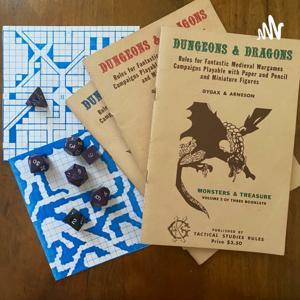
The original Dungeons & Dragons (commonly abbreviated D&D) boxed set by Gary Gygax and Dave Arneson was published by TSR, Inc. in 1974. It included the original edition of the Dungeons & Dragons fantasy role-playing game. The original Dungeons & Dragons boxed set was the first published role-playing game, a fantasy game system modeled on medieval Europe. This set introduced elements which would become standard in later editions, including abilities (such as strength, intelligence, and dexterity); character classes (fighting-man, magic-user, cleric) and character levels; races (human, dwarf, elf, halfling); armor class; monsters and treasure; underground dungeons consisting of halls, rooms, and doors protected by tricks and traps; and magic items, such as intelligent swords.
After the release of the AD&D game, the Basic Set saw a major revision in 1981 by editor Tom Moldvay. The game was not brought in line with AD&D but instead further away from that ruleset, and thus the basic D&D game became a separate and distinct product line from AD&D. The former was promoted as a continuation of the tone of original D&D, while AD&D was an advancement of the mechanics. The revised version of the set included a larger, sixty-four page rule book with a red border and a color cover by Erol Otus, the module B2 The Keep on the Borderlands, six polyhedral dice, and a marking crayon. The book came drilled with holes so that it could be used in a three-ringed binder, and the full set of off-white polyhedral dice came in a heat-sealed bag with a small wax crayon for coloring the numbers on the dice.
This description uses material from the Wikipedia articles "Dungeons & Dragons (1974)" and "Dungeons & Dragons Basic Set", which is released under the Creative Commons Attribution-Share-Alike License 3.0.
Dan and Paul return to complete the dungeon design dash for the "Infested Perch of the Mammoth Egg". Unfortunately one hour was just not enough this time around, so they're coming back to complete the adventure, and reveal some of the extra editing passes that go into publishing these adventures. Once complete, this adventure will be posted for sale on DriveThruRPG, and a free copy sent to every active patron. Now is a great time to become a patron - get all the benefits PLUS a free adventure!
Dan and Paul are back at it again, creating an entire D&D adventure in just one hour! Armed with only their D&D source books, Matt Finch's excellent Tome of Adventure Design, and the input from live viewers, they'll create a fully stocked and playable D&D dungeon adventure right in front of your eyes. Once it's complete, adventure WDM05 will be posted on DriveThruRPG and free copies distributed to all our faithful patrons!
Dan and Paul reflect on the many changing faces of ghouls in D&D and fantasy literature. How did they become one of the most feared monster types? What flavor is best: the one from Lovecraft, Howard, Leiber, Gygax, or Romero? Should they be unthinking undead, or a sentient organized race? What's the best way to skin (or unskin) them in your D&D game?
In Arabic folklore, the ghul is said to dwell in cemeteries and other uninhabited places. A male ghoul is referred to as ghul while the female is called ghulah. A source identified the Arabic ghoul as a female creature who is sometimes called Mother Ghoul (ʾUmm Ghulah) or a relational term such as Aunt Ghoul. She is portrayed in many tales luring hapless characters, who are usually men, into her home where she can eat them.
Some state[who?] that a ghoul is a desert-dwelling, shapeshifting demon that can assume the guise of an animal, especially a hyena. It lures unwary people into the desert wastes or abandoned places to slay and devour them. The creature also preys on young children, drinks blood, steals coins, and eats the dead, then taking the form of the person most recently eaten. One of the narratives identified a ghoul named Ghul-e Biyaban, a particularly monstrous character believed to be inhabiting the wilderness of Afghanistan and Iran.
In "Pickman's Model", a short story by H. P. Lovecraft, ghouls are members of a subterranean race. Their diet of dead human flesh mutated them into bestial humanoids able to carry on intelligent conversations with the living. The story has ghouls set underground with ghoul tunnels that connect ancient human ruins with deep underworlds. Lovecraft hints that the ghouls emerge in subway tunnels to feed on train wreck victims.
Lovecraft's vision of the ghoul, shared by associated authors Clark Ashton-Smith and Robert E. Howard, has heavily influenced the collective idea of the ghoul in American culture. Ghouls as described by Lovecraft are dog-faced and hideous creatures but not necessarily malicious. Though their primary (perhaps only) food source is human flesh, they do not seek out or hunt living people. They are able to travel back and forth through the wall of sleep. This is demonstrated in Lovecraft's "The Dream Quest of Unknown Kadath" in which Randolph Carter encounters Pickman in the dream world after his complete transition into a mature ghoul.
This description uses material from the Wikipedia article "Ghoul", which is released under the Creative Commons Attribution-Share-Alike License 3.0.
This week on Wandering DMs, Paul Siegel and Dan “Delta” Collins dive into one of the most common challenges DMs face: scaling D&D adventures when the number of players doesn’t match what the adventure was designed for. Whether you're running a session for fewer players than expected or you suddenly have a larger group to accommodate, adjusting on the fly can be tricky. Paul and Dan will break down strategies for tweaking encounters, managing balance, and ensuring every player stays engaged, even when the group size shifts unexpectedly.
Without time to prepare in advance, making adjustments on the fly requires quick thinking and flexibility. How do you rebalance combat encounters without losing the tension or excitement of the adventure? What do you do when a critical puzzle or social encounter suddenly becomes too easy or too hard because of the group size? Paul and Dan will explore these challenges and offer real-world examples from their years of experience running games, helping DMs make smart adjustments in the heat of the moment.
They’ll also discuss how to write adventures that are easier to adjust to variable group sizes and what kind of guidance adventure authors can include to help DMs handle these situations. Whether you're a seasoned Dungeon Master or new to running games, join the conversation and get tips you can apply right away! As always, they’ll be live and taking your questions and comments in real time. Don’t miss it — Sunday at 1 PM Eastern on YouTube and Twitch!
Dan and Paul chat with Matt Finch, the ENNIE-award winning designer of the Swords & Wizardry game, and who also created OSRIC, and the Quick Primer for Old School Gaming. Plus he made our favorite Tome of Adventure Design, as seen in use in the Wandering DMs Dungeon Design Dashes. Next up on Kickstarter is Matt's Tome of Wordbuilding Design. Is this just in time for all our fantasy worldbuilding needs?
The Tome of World Building is written by ENNIE-award winning author Matt Finch, author of the critically-acclaimed Tome of Adventure Design. Using the Tome of World Building, you can create fantasy worlds quickly and fill them out with a wealth of detail from the random-generation tables in this book.
This Kickstarter offers two high quality hardcover books to create a trilogy of creative power with the Tome of Adventure Design. The first is the Tome of World Building, allowing you to create maps, cultures, countries, wilderness regions, and all the history and backstabbing politics of a fantasy world. The second is the Nomicon, with tables to invent fantasy names for everything you'll generate using the Tome of World Building.
From the publisher's feed

176 Listeners

76 Listeners
241 Listeners
12 Listeners
16 Listeners
182 Listeners

7 Listeners

5 Listeners

5 Listeners
6 Listeners
3 Listeners
102 Listeners
90 Listeners
31 Listeners
18 Listeners