
Sign up to save your podcasts
Or

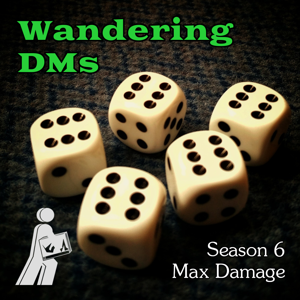


Paul and Dan pull back the veil on GM screens — what they're good for, when they're essential, and when to ditch them entirely. They compare the old-school cardboard panels, DIY screens with swappable inserts, GMing from behind a laptop, and more.
What belongs on the GM side? What’s worth showing to players? From reference tables and monster art to clipped-on initiative trackers and Paranoia’s player-facing gadgets, there’s more than one way to use that cardboard shield.
And what about the game itself - can you even run Paranoia without a screen? Do GM-less games use screens at all? Tune in live to join the discussion and share your own screen stories.
Paul & Dan wade deep into the swamp to uncover the shifting role of lizardfolk across Dungeons & Dragons editions. From their earliest days as faceless wilderness threats to complex cultures with alien worldviews, how has D&D's portrayal of these scaled humanoids evolved?
We’ll dive into classic modules like Danger at Dunwater and Tomb of the Lizard King, trace their pulp fantasy roots, and even compare how video games like Pool of Radiance handled their moral ambiguity. Were they ever really "monsters", or were we just too quick to draw our swords?
Join us as we explore what makes lizardfolk one of D&D's most misunderstood creatures - and maybe one of its most revealing.
Dan and Paul coach you in how to disrupt an enemy wizard's spells in D&D. And it varies a lot by what edition you play! From classic editions where casting in combat is strictly prohibited, to those where initiative tells the tale, to later editions where skills and counter-skills try to one-up each other. For house-ruling DMs, what's the fairest mechanic to use?
Paul and Dan tackle the age-old question of initiative in tabletop RPGs. From the simplicity of group initiative to the complexity of individual modifiers and segment counting, initiative rules can shape the entire feel of combat.
We'll explore how different editions and indie games handle turn order, what those choices say about their design philosophies, and how your own table might benefit from mixing it up. Is rolling every round more dynamic or just more bookkeeping? Should initiative reflect a character's reflexes, or just be a way to get the action moving?
Along the way, we'll share our own stories of initiative chaos, house rules that worked (or didn't), and some truly oddball systems that tried to rethink the whole idea.
Dan and Paul do a deep dive on the "Magic Jar" spell that's been in every edition of D&D to date. First edition said, "Magic jar is a very unusual spell" and gave it a completely unique school of magic. Put your soul in an object and you can possess any other creature's body you desire. Total safety from destruction, right? But detail vary wildly by edition: Should it be eternal duration, or more limited? Infinite range, or something less? And how will it reshape the tone of your whole campaign?
Read Dan's blog on Spells Through the Ages: Magic Jar
Paul and Dan get to chat with father of the OSR Matt Finch, about the 20th anniversary of OSRIC, his ground-breaking retroclone of 1st Edition Advanced D&D. Plus: the new 3.0 version of OSRIC, currently crowdfunding on Backerkit. What's prompted a new version? What's new and good for new players? How can GMs write official adventures for OSRIC? Plus a whole lot more!
Back Matt's OSRIC 3.0 on Backerkit
Dan and Paul return from the Rising Phoenix Game Con with tales from the front lines of fast-paced dungeon creation! In this episode, they break down their latest Dungeon Design Dash, crafted live in front of a seminar audience and then playtested at the convention just two days later. What worked? What didn’t? And what did the players do that nobody expected?
Whether you’re a dungeon designer looking to sharpen your tools or just love a behind-the-scenes look at live convention play, you won’t want to miss this one!
Want to join us next year? Check out the convention here!
Dan & Paul get to chat with R. Alex Murray, one of the cast members of Twenty-Sided Tavern, a live theatrical D&D stage production! TST has had a smash year off-Broadway in New York City, and now they're about to take the show across the country. What's the difference between playing D&D at home with friends, versus entertaining hundreds of audience members every night? What elements of D&D cut across those lines and what needs to be cut or changed?
Check out D&D Twenty-Sided Tavern on your favorite social media
Paul & Dan chat with the legendary Bill Webb, founder of Necromancer Games and Frog God Games. Bill's back with a new, even-more-old-school TTRPG ruleset -- the Necromancer's Game, naturally! We find out how "wild man" Bill Webb runs his own regular home games, and what "First Edition Feel" means in 2025. Plus more surprises!
Join the Kickstarter for Bill's Necromancer's Game here
Should the DM keep their D&D adventure map hidden, or reveal it to the players at the outset? Dan & Paul discuss the sometimes-surprising benefits of giving your players more information instead of less. From partial dungeon maps as treasure, to visualizing the layout of the wilderness, to games where the map's the thing, we'll share everything we know.
From the publisher's feed
176 Listeners

76 Listeners
241 Listeners
12 Listeners

16 Listeners
182 Listeners

7 Listeners
5 Listeners
5 Listeners
6 Listeners
3 Listeners
102 Listeners
90 Listeners
31 Listeners
18 Listeners