
Sign up to save your podcasts
Or



One of the major stories of the past year was the death of George Floyd in May, following his arrest outside a store in Minneapolis, Minnesota. The whole world saw the video of police officer Derek Chauvin kneeling on Floyd's neck, pinning him to the ground for more than 8 minutes. Chauvin has now been charged with murder - one of only a few American police officers to be charged with murdering a civilian.
George Floyd’s death was the result of a standard encounter between police officers and a member of the public, which unnecessarily spiralled out of control - a tragically familiar tale when it to comes to the police and minority communities.
What can America do to better tackle the problem of police brutality, and why does it seem so hard to bring bad cops to account?
Guests:
Leon Ford, a social justice campaigner from Pittsburgh who was paralysed after being shot by police during a traffic stop in 2012
Chief Art Acevedo, City of Houston Police Department
Redditt Hudson, former St Louis police officer, and co-founder of the National Coalition of Law Enforcement Officers for Justice Reform and Accountability
Editor: Hugh Levinson
Covid-19 has dramatically changed the way we live our lives, exposing fractures in our communities - but what's America's exit plan from the pandemic?
Carlos Watson and Philippa Thomas (standing in for Katty Kay) speak to journalist and author Fareed Zakaria about the dramatic and sudden shift in society this year. What are the lessons we need to learn to cope better in the future?
Carlos and Philippa also explore how President-elect Biden may tackle the pandemic, speaking to Dr Nicole Lurie, a public health expert who was an advisor to Joe Biden during his election campaign. Working under President Obama as assistant secretary for preparedness and response at the United States Department of Health, Dr Lurie planned for public health emergencies like the one we are living through right now. What does she think needs to be done to bring the pandemic under control?
Editor: Penny Murphy
Joe Biden says he will immediately re-join the Paris agreement on climate change, which Donald Trump withdrew from. Donald Trump has also repealed many of President Obama’s environmental laws. In the meantime, cities and States across the US have been taking their own action on the environment and climate change, irrespective of what’s been happening in Washington. President-elect Biden has said that climate change is the number one issue for humanity and for him. But will he be able to change much?
Carlos Watson and Ritula Shah (standing in for Katty Kay this week) speak to Wisconsin’s Lieutenant Governor, Mandela Barnes, about what his state has been doing and what obstacles it faces. They’ll also be speaking to Jody Freeman, professor of environmental law at Harvard, who was an advisor to the Obama administration, about the difficulties Biden could have getting his climate agenda passed. Also taking part will be the mayor of Carmel, Indiana, Jim Brainard, who describes how being a Republican does not conflict with taking action on climate change.
America’s turbulent 2020 election has highlighted how divided the United States is. President-elect Joe Biden has promised to bring the country together, and this may become one of the biggest challenges of his presidency. Katty Kay and Carlos Watson discuss what politicians, leaders and communities can do to bridge divides in this polarised nation. They’re joined by veteran civil rights leader Reverend Al Sharpton and former Governor of Ohio John Kasich.
It took a while, and President Trump still hasn’t conceded defeat, but there’s a new President-elect on the scene, and Joe Biden is pressing ahead with his plans to take over the White House. So what happens next during this transition period?
Katty and Carlos take the story on with author, journalist and member of the John Hopkins School of Advanced International Studies, James Mann.
Editor: Penny Murphy
Katty, Carlos and guests react to the astonishing 2020 US election. Bryan Lanza, Republican strategist and former member of Donald Trump’s 2016 transition team, weighs in on what the President will do next. We get a Democrat insider’s take from political consultant Minyon Moore, who was a senior adviser to Hillary Clinton’s campaign. Plus, we hear from Professor Allan Lichtman, the historian famous for accurately predicting election outcomes since 1984.
Editor: Penny Murphy
Women will play a critical role in who wins the U.S. presidential election. Pollsters are keeping a close eye on this important voting bloc, and there is data to suggest that no nominee for either party has ever garnered as much female support as the Democratic nominee, Joe Biden. So what do women voters want? Katty and Carlos are joined by Carrie Lukas, president of the conservative-leaning Independent Women’s Forum, and Christian Nunes, president of the National Organisation for Women, a feminist activist group founded in the 1960s.
Editor: Penny Murphy
This week, Katty Kay and Carlos Watson turn their attention to American foreign policy. The Trump administration made radical changes to the United States’ role on the world stage with its America First doctrine. Some say he spoke truth to power; others lament the upending of norms which guided international relations for decades. Katty and Carlos are joined by former UN Ambassador and Pulitzer Prize-winning author Samantha Power, and American Enterprise Institute senior fellow Danielle Pletka, to ask if historians will look on the Trump administration more favourably in the future than in the present, and what a possible Biden presidency might mean for America’s relationships around the world.
Editor: Penny Murphy
Katty and Carlos discuss America’s economy and why one of the world’s wealthiest countries is home to such extremes of inequality and poverty.
They are joined by Stephanie Kelton, a senior economic adviser to Bernie Sanders, and Professor of Economics and Public Policy at Stony Brook University in New York. Stephanie is a proponent of modern monetary theory (MMT), an economic school of thought that’s gaining popularity with some American thinkers and politicians. She argues that MMT could help America to build a bigger social safety net. Also joining the discussion is Teva Sienicki, CEO of Metro Caring, a non-profit organisation in Denver that serves 75,000 people per year. Teva shares the difficult stories of some of the people her charity helps, and reflects upon whether the ideal of the American Dream has contributed to the widespread belief that poverty is solely the fault of the poor.
Editor: Penny Murphy
President Trump’s hospitalisation for Covid-19 prompted many Americans to also worry about the health of the election process, and democracy itself. Katty Kay and Carlos Watson discuss whether American democracy is in crisis, and what its future may hold. They are joined by Julius Krein, of the journal American Affairs, and award-winning Venezuelan-American journalist Mariana Atencio. Mariana argues that America risks descending into a crisis similar to that of her native Venezuela if its democracy is not shored up and valued by its citizens. Julius outlines how the nation’s widening polarisation is damaging for its democracy.
Editor: Penny Murphy
From the publisher's feed
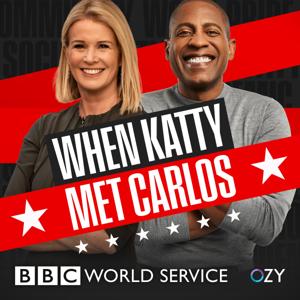
A BBC World Service and OZY Media co-production, presented by the BBC’s Katty Kay from World News America, and journalist and OZY co-founder Carlos Watson. When Katty Met Carlos looks at the issues…

7,611 Listeners
1,044 Listeners

5,481 Listeners

1,794 Listeners

1,825 Listeners

1,028 Listeners

751 Listeners

3,218 Listeners

713 Listeners

1,594 Listeners