
Sign up to save your podcasts
Or

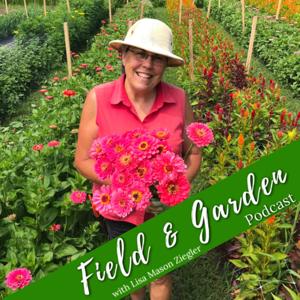

Whether you're a flower enthusiast home gardener or a commercial cut-flower grower, you know that you want your cut flowers to last as long as possible. In this episode, I cover post-harvest care for cut flowers in lots of different scenarios, and the practices that I recommend if you're selling to florists, at supermarkets, at the farmers' market, or at your farm stand. There are 5 general steps that both commercial growers and home gardeners should strive to follow to maximize vase life:
1. Harvest flowers at the proper stage. Each flower has its own ideal cutting stage. Some flowers continue to develop after you cut them (Sunflowers, Snapdragons), but some don't (Zinnias, Cockscomb). Do not harvest wet flowers.
2. After cutting, allow flowers to rest and rehydrate before arranging. Learn the ideal temperature for resting (conditioning) each type of flower.
3. Treatments can be added to the water that freshly-cut flowers are conditioned in to improve water uptake, hold color, and improve vase life.
4. Harvest buckets and vases should be washed and sanitized between uses, otherwise bacteria grows in them that will diminish flower vase life. My saying is that if you wouldn't be willing to drink out of your harvest buckets and vases then they're not clean enough!
5. Harvest at the ideal time of day (when flowers are more hydrated) to prevent wilting problems - typically early morning after the dew dries.
Amy Stewart’s Book Flower Confidential: The Good, the Bad, and the Beautiful
The Field and Garden Podcast is produced by Lisa Mason Ziegler, award-wining author of Vegetables Love Flowers and Cool Flowers, owner of The Gardener’s Workshop, Flower Farming School Online, and the publisher of Farmer-Florist School Online and Florist School Online. Watch Lisa’s Story and connect with Lisa on social!
 View all episodes
 By Lisa Mason Ziegler

4.9
380380 ratings
Whether you're a flower enthusiast home gardener or a commercial cut-flower grower, you know that you want your cut flowers to last as long as possible. In this episode, I cover post-harvest care for cut flowers in lots of different scenarios, and the practices that I recommend if you're selling to florists, at supermarkets, at the farmers' market, or at your farm stand. There are 5 general steps that both commercial growers and home gardeners should strive to follow to maximize vase life:
1. Harvest flowers at the proper stage. Each flower has its own ideal cutting stage. Some flowers continue to develop after you cut them (Sunflowers, Snapdragons), but some don't (Zinnias, Cockscomb). Do not harvest wet flowers.
2. After cutting, allow flowers to rest and rehydrate before arranging. Learn the ideal temperature for resting (conditioning) each type of flower.
3. Treatments can be added to the water that freshly-cut flowers are conditioned in to improve water uptake, hold color, and improve vase life.
4. Harvest buckets and vases should be washed and sanitized between uses, otherwise bacteria grows in them that will diminish flower vase life. My saying is that if you wouldn't be willing to drink out of your harvest buckets and vases then they're not clean enough!
5. Harvest at the ideal time of day (when flowers are more hydrated) to prevent wilting problems - typically early morning after the dew dries.
Amy Stewart’s Book Flower Confidential: The Good, the Bad, and the Beautiful
The Field and Garden Podcast is produced by Lisa Mason Ziegler, award-wining author of Vegetables Love Flowers and Cool Flowers, owner of The Gardener’s Workshop, Flower Farming School Online, and the publisher of Farmer-Florist School Online and Florist School Online. Watch Lisa’s Story and connect with Lisa on social!
189 Listeners
801 Listeners

1,578 Listeners

1,837 Listeners
248 Listeners

400 Listeners
332 Listeners
22 Listeners
298 Listeners
208 Listeners
334 Listeners
153 Listeners
108 Listeners

91 Listeners

162 Listeners