
Sign up to save your podcasts
Or



As artificial intelligence becomes increasingly embedded in our lives, are we building systems that enhance human flourishing—or undermine it?
In this episode of Age of AI, we speak with Erika Anderson, founder of Building Humane Tech and co-creator of HumaneBench, about what it means to design AI around human well-being. We explore the impact of AI on human relationships, autonomy, and trust; the challenge of measuring whether AI systems are genuinely humane; and the role of governments, technology companies, and communities in shaping a more human-centered future. We also discuss whether AI can help cultivate awe, curiosity, and deeper human connection.
Links:
• The People's AI Bill of Rights
• Wonder Lab, our awe research
• Building Humane Tech
• HumaneBench
• Awe
In this episode of Age of AI, Jean Garcia Periche of the Center for Public Intelligence joins Medlir to explore how artificial intelligence could fundamentally transform public institutions. We discuss why traditional government structures struggle with today's complex challenges, how AI agents and digital public infrastructure could enable a shift from digital to agentic government, and what technologies like GovOS and Agent ID might mean for public services.
The conversation also tackles the larger questions: Should access to AI-powered intelligence become a social right? How can governments ensure accountability and protect citizens from surveillance? And what does the AI revolution mean for national sovereignty, particularly in the Global South?
Links:
Who decides how our data is collected and used?
In the first episode of Season 15 of Age of AI, Medlir is joined by Daniel Cochrane to discuss a new proposal from the Institute for Family Studies: “associational data rights.”
The report argues that data is not simply an individual asset. Much of it is created through families, workplaces, churches, schools, communities, and other relationships. Daniel explains how Data Rights Associations (DRAs) could give those communities a collective voice in negotiating with technology companies.
Links:
What if one of the oldest stories in Western literature is also one of the earliest stories about artificial intelligence?
Christopher Nolan's The Odyssey has brought new attention to Homer's epics — but they're only the beginning of a much longer story about intelligent machines.
In this Season 14 finale, historian of science Professor Elly R. Truitt (University of Pennsylvania) traces that story from Homer's self-navigating ships and golden handmaidens, through the bronze giant Talos of wider Greek myth, to the mechanical courts of Baghdad and Byzantium, medieval Europe, and today's anxieties about AI. Along the way: what these machines reveal about slavery and servitude in the societies that imagined them, and why — as Truitt argues — a technology that further concentrates power in the hands of people who already have it was never actually revolutionary.
In this episode of Age of AI, we speak with Branka Panic about the first-ever UN Global Dialogue on AI Governance, where representatives from nearly 170 countries gathered in Geneva to discuss the future of global AI policy. Drawing on her firsthand experience at the conference, Branka explains what happened beyond the official speeches, why many participants questioned whether the event truly fostered dialogue, and what the discussions revealed about the growing divide between AI leaders and the Global South.
We explore the challenges of building international consensus, the findings of the UN's new Scientific Panel on AI, and whether global institutions can keep pace with one of the fastest-moving technologies in history. If AI is reshaping the world, who gets to write the rules?
Links:
AI may appear immaterial, but the cloud has a physical footprint. In this episode of Age of AI, Ford Copple joins us to discuss the data centers behind artificial intelligence, including their economic benefits, energy and water demands, local impacts, and the policy choices communities face as AI infrastructure expands.
Links:
In this episode, Medlir is joined by Clara Long, a human rights lawyer turned democracy strategist and co-lead of BLOOM. We discuss why public deliberation matters in an age of polarization and disinformation, how technology can support rather than replace civic judgment, and what it takes to help communities reason and decide together across difference.
In this episode, host Medlir Mema sits down with Adam Billen, Co-Executive Director of Encode, to examine a surprising shift in U.S. AI policy. They discuss the Trump administration's recent efforts to establish a federal framework for frontier AI models, expand AI's role in national security, and limit state-level regulation. The conversation explores what these developments reveal about Washington's evolving approach to artificial intelligence, the changing relationship between government and AI companies, and the challenges of balancing innovation and security in the age of AI.
Links:
Michael Toscano joins Age of AI to discuss Pope Leo XIV’s first AI encyclical, Magnifica Humanitas. The conversation explores human dignity, digital dependency, family life, AI personhood, and why the Vatican believes the future of artificial intelligence is ultimately a question about what it means to be human.
Links:
AI is supposed to make marketing easier. So why are so many companies more confused about their messaging than ever? In this episode, Medlir talks with Josh Porter — author of The Last Human Marketer — about what he calls "drowning in automation": the paradox where scaling content and tools produces less clarity, not more. Josh makes the case that human judgment in positioning isn't a legacy constraint — it's a competitive edge. He also introduces the "Customer Connect Code," his framework for translating complex AI products into language that actually lands with buyers.
Link:
From the publisher's feed
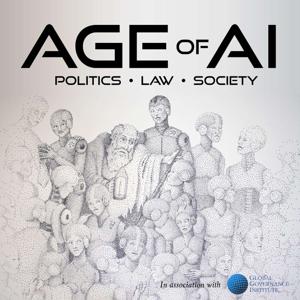
A podcast on the impact of emerging technologies in transforming politics, law, and society. Hosted by Medlir Mema, Chris Lamont, and Young Diogenes.
Website: …

31,916 Listeners

1,716 Listeners
1,613 Listeners

3,921 Listeners

551 Listeners

15,577 Listeners

10,681 Listeners

15,957 Listeners

389 Listeners

2,014 Listeners

4,218 Listeners

1,147 Listeners