
Sign up to save your podcasts
Or

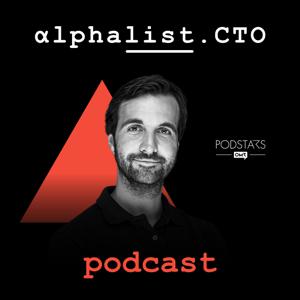


Charles Guillemet started hacking at 12. He sold his piano to buy his first computer. Nine years ago, he built Ledger's offensive security team from scratch; today, he's CTO of a company protecting a fifth of the world's crypto, and he just watched AI find vulnerabilities his team spent almost a decade not finding.
Topics covered:
Timestamps:
What you'll learn:
Quotes:
Links:
Want to keep talking about this with other CTOs? Join over 600 tech leaders in our Slack community — go to alphalist.com to apply.
BROUGHT TO YOU BY: Blocks
David Soria Parra co-created MCP, used to help write Mercurial, and now works alongside the people building Claude at Anthropic — so when he says building your own AI agent harness isn't actually that hard (but probably isn't worth doing anyway), it's worth sitting with. This one's a grounded, unhyped look at what to actually build versus configure.
Topics covered:
Timestamps:
What you'll learn:
Quotes:
"You don't need only MCP. You need also MCP, but you also need CLIs… Enterprises in particular love centralized things they can control via gateways in the middle. MCP is great if you need to govern the whole thing. But if you're running a local harness for your own development, running CLIs is perfectly fine. They both will be needed — they're just different for different use cases." — [01:02:42]
"Harness writing is not hard. It gives it a bunch of tools, gives it a bunch of execution steps, be a little smarter about context selection, and go for it. It turns out the model does 90% of the work." — [00:50:00] (cleaned of stutters — verify against audio)
"The main recommendation is not to over-focus on optimizing your setup. This is a very fast-moving technology — you don't need to fiddle with everything. Pick one or two things you find useful, be it Claude Code, be it Claude Tag, and just focus on using it quickly, optimizing for as little downtime as possible so you can get stuff going." — [01:10:53]
Relevant links:
Join the conversation with 600+ CTOs sharing insights on technical leadership and tech trends in the alphalist Slack. Visit alphalist.com to apply.
OUR SPONSORS
Sponsored by Blocks: Save at least 20% on your AWS costs with AI-powered optimization and enterprise discounts. Get your free Cloud Check at https://blocks.cloud/alphalist?utm_source=alphalist&utm_medium=podcast&utm_campaign=blocks-podcast-2026
Dana Lawson, CTO at Netlify, joins Tobi for a candid conversation about the changing role of software engineers in the age of AI agents.
Dana's path into technology began in the US Army in the late 1990s. She started by managing backup tapes and automating manual workflows before moving on to engineering leadership roles at GitHub and Netlify.
Topics covered
Dana's path from the US Army to GitHub and Netlify
Timestamps
[00:00:51] Introduction and Dana's background
What you'll learn
About Dana Lawson
Relevant links
Join alphalist
Sponsored by Blocks: Save at least 20% on your AWS costs with AI-powered optimization and enterprise discounts. Get your free Cloud Check at https://blocks.cloud/alphalist?utm_source=alphalist&utm_medium=podcast&utm_campaign=blocks-podcast-2026
BROUGHT TO YOU BY: Blocks
Save at least 20% on your AWS costs with AI-powered optimization and enterprise discounts. Get your free Cloud Check at https://blocks.cloud/alphalist?utm_source=alphalist&utm_medium=podcast&utm_campaign=blocks-podcast-2026
Two failed startups, a Y Combinator batch, and a $25M Series A later, Aike Hillbrands and his co-founders built Kombo into a $10M+ ARR HR integration platform, and then, almost by accident, built a company-wide AI brain out of a GitHub repo and a Cursor agent. Aike joins Tobi to explain why files and grep beat MCP tools for agent reliability, what the "lethal trifecta" of AI security actually means in practice, and why he doesn't think AI will commoditize his own business anytime soon.
chapters:
00:00:00 — Intro
Quotes:
00:17:29 – "The agent will just run a grep command and find 200 files where something is discussed, and it will actually look at 50 or so of them. It's not stopping too early." (verbatim)
BROUGHT TO YOU BY: Blocks
A decade building computer vision and writing assembly at Microsoft (HoloLens), Google, and D.E. Shaw, then a from-scratch bet on a programming language built for LLMs. Vaibhav Gupta joins Tobi to explain why probabilistic compute needs its own tooling, what "shipping at agent speed" actually requires, and why the world's appetite for software is mathematically infinite.
Chapters:
Quotes:
--
Blocks
Intro
Key topics
Chapters
Quotes
[00:41:30] "You should not trust an LLM more than you trust a human being. Modern business processes were designed on the assumption that human beings are a little bit untrustworthy." (fillers removed — verify against audio)
Show Notes
Anurag Goel joined Stripe as its fifth engineer in 2011 and later ran risk. He left to solve a big problem and landed on the one he'd watched eat Stripe's engineering time: making infrastructure disappear. This conversation is about what Render learned on the way to millions of developers and what changes now that a lot of what gets deployed isn't a website, it's an agent.
From Stripe's fifth engineer to founding Render
Timestamps
[00:00:00] Intro and the pitch
Max Deichmann didn't set out to build the observability layer for the AI era. He started with mobile apps, taught himself to code via Harvard's CS50, and ended up in Y Combinator with a SaaS product he wasn't excited about. Then ChatGPT launched, and on a Sunday night at 10 pm, his co-founder asked: "If you just had time, what would you build?" The answer became Langfuse and eventually led to an acquisition by ClickHouse.
Key topics:
Timestamps:
[00:00:00] Intro & guest welcome
Best quotes:
"We didn't initially jump on the topic because we thought all the PhD AI people, they are much better at this. We have no idea what's going on, until we figured out nobody has a clue what's going on." — [00:05:00–00:06:00]
"We have two guys doing customer support, and we have basically an agent that is doing first-level customer support for us, and I think it's about doing about 10,000 conversations a week. We would never be able to do this type of support with two people." — [00:38:00]
"The alert comes in, I wake up at the night, I just take the alert from our Slack, copy paste it into Codex, and we have a skill there with all the context, and then it's just going." — [00:29:00–00:30:00]
"I currently think of an email/Linear inbox where an agent tells me, 'Hey Max, we needed to fix this here because this broke.' And then if I want to, I can just dive into it and see all the context within this notification and also take a corrective course, or I just let it go." — [00:41:00]
From the publisher's feed

543 Listeners

1,090 Listeners

34 Listeners

220 Listeners

3 Listeners

3 Listeners

2 Listeners

9 Listeners

15 Listeners

98 Listeners
12 Listeners
12 Listeners

21 Listeners

0 Listeners

23 Listeners

117 Listeners

0 Listeners

325 Listeners

55 Listeners

145 Listeners

7 Listeners

0 Listeners