
Sign up to save your podcasts
Or



This week on Off the Grid on the Record, I sit down with Andrew Barrow, founder of Revenue Arc, a white-label programmatic ad agency running campaigns for household names—and flipping the traditional agency model on its head with a 50% gross revenue share back to partners and lifetime referral commissions.
Andrew pulls back the curtain on how programmatic really works (CTV, display, audio, premium publishers), why most brands overspend on fees, and how Revenue Arc’s model lets agencies earn from media instead of getting drained by it. We also cover the playbook behind consistent 5–8× ROAS (and a standout case that raised $145M on ~$2M ad spend), plus the AI systems that now spin up media plans in minutes.
What we cover:
If you’ve ever wondered how the ads you see on Hulu, top news sites, Spotify, and mobile apps actually get there—and how to run them profitably—this episode is your blueprint.
🔗 Connect with Andrew & Revenue Arc:
👉 More episodes: youtube.com/@yarekmatacz
This week on Off the Grid on the Record, I sit down with Sebastian Mourra, founder of Alphana.ai — a platform built to help creators, businesses, and even record labels turn one piece of content into 30.
We dive into how Alphana is building the future of content repurposing, going beyond short clips to power blogs, LinkedIn posts, newsletters, quizzes, eBooks, and even music marketing assets like Spotify canvases and lyric videos. Sebastian explains why workflows are the missing link for scaling creators and how his background at Universal Music shaped Alphana’s newest product, Visuals, which is already shaking up how artists and labels handle releases.
What we cover in this episode:
Whether you’re a podcaster, a coach, or an artist, this episode shows how one video can become the fuel for an entire content machine.
🔗 Connect with Sebastian & Alphana:
👉 For more episodes, visit: http://www.youtube.com/@yarekmatacz
This week on Off the Grid on the Record, I sit down with Lily Yeoh, co-founder and CEO of C1Risk, to explore how her company is reshaping compliance and risk management with automation and AI.
With over two decades in cybersecurity—from cryptography at Texas Instruments to consulting at Deloitte—Lily brings deep experience in helping Fortune 500 companies navigate evolving regulations, security threats, and governance challenges. But instead of stopping there, she built C1Risk to bring automation, scalability, and accessibility to organizations of all sizes.
We cover everything from:
Whether you’re in tech, finance, law, or government, Lily’s story is packed with lessons about resilience, scaling, and how AI is changing compliance forever.
🔗 Connect with Lily & C1Risk:
👉 For more episodes, visit: http://www.youtube.com/@yarekmatacz
This week on Off the Grid on the Record, I sit down with Simon Groom, CEO and co-founder of Magnify B, to unpack how he and his co-founder, David, turned decades of consulting experience into a SaaS platform that’s now helping thousands of small businesses save time, cut costs, and scale smarter.
Born out of COVID lockdowns, Magnify B started as a consulting pivot and has already grown into what Simon calls “mission control for business success.” The platform integrates with tools like Xero and QuickBooks, benchmarks performance against peers, and even offers what-if scenario planning to help founders see the impact of every small decision.
Simon explains how Magnify B differentiates itself from traditional consulting, what feedback they’re hearing from early adopters like Action Coach, and why accounting firms with hundreds of thousands of clients are calling the platform “groundbreaking” and “game-changing.” We also dive into the challenges of UK fundraising, why scalability was baked in from day one, and why North America may be the next big move for the company.
🔗 Connect with Simon & Magnify B:
👉 For more episodes, visit: http://www.youtube.com/@yarekmatacz
🎙️ Show Notes & Highlights
00:00 – Intro Welcoming Simon Groom, CEO of Magnify B
01:00 – Origin Story How Simon and David built Magnify B during COVID after decades in consulting
02:00 – Non-Tech Founders Building SaaS Why coming from consulting (not tech) gave them a real advantage
03:20 – Explaining Magnify B Simply “Mission control for business success” → dashboards, benchmarking, learning, and what-if planning
05:10 – How It Differs from Consulting Bringing large company methodologies to small businesses affordably
06:45 – Shifts in Small Business Tech Adoption From fear of AI to increasing curiosity and adoption across Europe
08:30 – Industries Adopting Fastest Professional services like accounting and law firms surprising Simon with early interest
09:40 – How AI Reshapes Advisors’ Roles Why accountants and consultants now see Magnify B as a client attractor
10:50 – Feedback on Version 1.1 Users say: “I wish I had this years ago.”
12:30 – Partnerships with Coaches & Accountants Action Coach + major UK firms calling the platform “game-changing”
14:50 – Early Market Entry Strategy 60+ firms in the pipeline, from small practices to those with 200,000+ clients
16:50 – Scaling Vision & Bottlenecks Built for global scale, but UK fundraising remains the biggest hurdle
19:40 – Magic Wand Fix Overcoming mistakes with outsourced tech development
21:00 – Key Metrics That Matter 5,000–10,000 users in year one → exponential growth beyond year two
22:40 – 12–18 Month Plan Internationalization with North America, Singapore, and Europe on the roadmap
This week on Off the Grid on the Record, I sit down with Dan Gudkov, founder of DoDocs AI, to unpack the journey from legal tech to a global automation solution that’s helping companies eliminate manual data entry and double their client capacity.
Dan shares how DoDocs pivoted after customer feedback, the unexpected industries now reaching out (including a central bank in South America), and why staying open-minded has been his biggest entrepreneurial lesson.
🔗 Connect with Dan:
👉 For more episodes, visit: http://www.youtube.com/@yarekmatacz
🎙️ Show Notes & Highlights
00:00 – Intro Welcoming Dan Gudkov, founder of DoDocs AI
01:10 – Relocating to Vancouver Moving from Dubai to Canada and what the transition has been like
01:40 – Dan’s Backstory From six startups (AR, VR, and beyond) to discovering AI’s potential in document automation
04:00 – Pivoting Beyond Legal Docs Why customer feedback pushed DoDocs toward accounting and procurement automation
07:20 – Explaining DoDocs Simply Snap a photo → data instantly entered into accounting or ERP systems
08:40 – Customer Success Story How integrating with Sol.A Online increased customer capacity by 100%
09:30 – The Big Problem They Solve Removing scaling limitations in accounting with automation
12:00 – Explaining Value to Prospects How DoDocs tailors solutions for accounting firms, POS systems, and hospitality
16:45 – Unexpected Opportunities Hardware giants and central banks exploring automation with DoDocs
18:30 – Best Marketing Channel So Far Why Substack outperforms LinkedIn and Apollo for leads
20:00 – Ideal Customers (ICP) Accounting platforms, POS systems, and large enterprises with 1000+ employees
22:00 – What’s Next for DoDocs AI Building agentic AI features: voice agents, WhatsApp automation, and full-cycle integrations
24:00 – Staying Ahead of Competitors Why API-first integration makes DoDocs hard to replace
27:00 – Lessons for Founders Why staying open and adaptable is Dan’s biggest takeaway
29:00 – Wrap-Up & Where to Find DoDocs LinkedIn, Substack, YouTube, Instagram, and DoDocs.ai
In this episode, I talk with Jeremy Nielsen, founder of Sally.co, the all-in-one platform that makes Special Purpose Vehicles (SPVs) simple, clean, and headache-free. Jeremy has overseen more than 9,000 SPVs and took all that experience to build Sally — the first system that puts everything in one place instead of juggling spreadsheets, emails, and off-platform tasks.
We dig into:
If you’ve ever run (or thought about running) an SPV, this episode is a must-listen. Jeremy shares both the scars and solutions from building five generations of SPV software — and why Sally is the one that finally fixes it.
Find out more about Sally: https://sally.co
Listen to more episodes here: http://www.youtube.com/@yarekmatacz
In this episode, I talk with James from Nimblo — a 20+ year tech veteran who’s worked on everything from World of Warcraft and Red Dead Redemption 2 to United Healthcare. Now he’s using that same expertise to save small businesses millions by cutting out wasted time and automating repetitive work.
We dig into:
If you run a business that feels like it’s “just surviving,” this episode will show you how the right systems can completely flip the script.
Find out more about James and Nimblo: https://nimblo.aiFree
Audit: https://nimblo.ai/free-audit
Listen to more episodes here: http://www.youtube.com/@yarekmatacz
In this episode of Off the Grid on the Record, I sit down with Jace Lander, founder of ONEX Technology, who went from running a structural steel company to building some of the wildest tech I’ve seen yet. We talk about Whale Tank—a crypto “Shark Tank” style launchpad for vetted projects—and OKX, an autonomous AI red team agent that can run full-scale cyber ops on its own.
This was one of the most eye-opening conversations I’ve had on where AI, cybersecurity, and crypto are all colliding.
Show Notes
If you want a real look at the bleeding edge of tech—crypto, AI, and cybersecurity—this is an episode you don’t want to miss.
🎧 Find more episodes here: youtube.com/@yarekmatacz
What happens when solar becomes a get-rich-quick scheme? Luke Pollinger, founder of PVCA (Photovoltaics California), has spent the last 20+ years fixing the mess others leave behind. From abandoned utility projects to broken microgrids, PVCA steps in where others walk away. In this episode, we break down how the industry lost its way—and what it’ll take to bring trust and technical excellence back to the forefront of clean energy.
You’ll hear about:
🛠️ Whether you’re a commercial property owner, facility manager, or just someone curious about how solar should be done—this one’s a must-listen.
🔗 Learn more about PVCA: https://pvca.com 🌐 Powered by JPM Media: www.jpmmedia.ca 🎥 More episodes here: http://www.youtube.com/@yarekmatacz
⏱️ Show Notes + Timestamps:
00:00 – Intro to Luke Pollinger & PVCA
01:00 – Why he left residential solar for commercial and utility 02:00 – "Solar Bros," scams, and the flood of bad installs
04:30 – What shady sales tactics are doing to solar’s reputation
06:00 – PVCA’s business model: 70% service, 30% new installs
07:30 – Taking on the jobs no one else will touch
09:00 – The Palm Springs project: 5% production to 100%
10:30 – Heat, wind, stress—and fixing a system no one thought could be fixed
12:00 – The power of trust in solar and how one client helped him launch
14:00 – What tech actually moves the needle (and what doesn’t)
17:00 – Why newer isn’t always better in solar hardware
18:00 – Panasonic vs everyone else (and why warranty matters)
19:00 – Real-world use cases for AI in solar 21:00 – How PVCA does sales (hint: no ads, no cold calls) 24:00 – Educating clients that service beats full replacement
27:00 – Empowering clients to self-maintain and save
29:00 – Why service work should pay for itself—or you’re doing it wrong
30:00 – What’s next: PVCA’s new monitoring system & buying broken solar sites
33:00 – Ending the subscription trap and owning solar performance
34:00 – Luke’s final thoughts on long-term trust in solar
From cranberry bogs to clean power—this episode is a deep dive into how agrivoltaics could change the solar industry forever.
Yarek Matacz sits down with Iain Ward, founder of Solar Agricultural Services (SolAg), to explore how thoughtful solar development can preserve farmland, support farmers, and push the renewable revolution forward. They discuss soil health, developer responsibility, and how projects can be designed to benefit both people and the planet.
If you care about sustainability, land stewardship, or where your energy comes from—this one’s a must-listen.
🎧 Subscribe for more: http://www.youtube.com/@yarekmatacz
🌱 Learn more about Iain & SolAg: https://solaragservices.com
Show Notes:
00:00 – Welcome + Intro to Agrivoltaics
01:10 – Iain’s farming roots & the dream of goat-pulled wagons
02:35 – Buying a cranberry bog and getting into soil conservation
04:20 – Why solar development was getting it wrong
06:15 – The real environmental impact of dual-use projects
07:30 – Incentives in Massachusetts and New Jersey
08:40 – Fencing, livestock, and redefining project optics
11:00 – Agri-solar as a legacy and a bridge for the next generation
17:00 – What solar developers can learn from farmers
21:00 – Cost trade-offs: grading, fencing, and maintenance 24:30 – Why farmers and landowners trust SolAg
26:00 – Advocacy: Why now is the time to speak up
28:00 – Final thoughts + where to learn more
From the publisher's feed
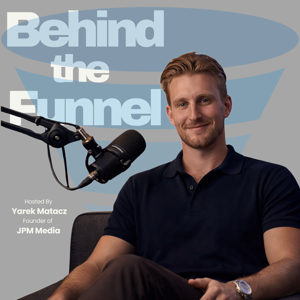
Most companies don’t have a lead problem — they have a funnel problem.
Behind the Funnel is a business podcast that breaks down how B2B companies actually…
Each episode features conversations with SaaS founders, operators, consultants, and B2B leaders who are actively building and scaling companies. Instead of theory or generic “growth hacks,” these discussions unpack the acquisition engines behind real businesses — from outbound systems and paid acquisition to funnel architecture, offer design, and sales processes.
Listeners will hear what worked, what failed, and what ultimately helped companies build consistent pipelines and sustainable growth.
Behind the Funnel is designed for founders, consultants, and operators who want to understand how modern B2B companies turn attention into revenue. If you're building a SaaS product, scaling a consulting business, or developing a go-to-market strategy, this podcast offers a practical look at how growth actually happens behind the scenes.
Expect thoughtful conversations, tactical insights, and honest breakdowns of the systems that power real businesses.
New episodes feature founders, marketers, and operators sharing what it really takes to turn leads into customers and ideas into scalable companies.