
Sign up to save your podcasts
Or

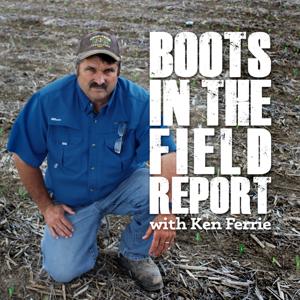


Ken recaps how the heat and water over the last couple of weeks have affected crops in central IL in this Boots In The Field Report. He informs of incoming scouting reports and advises which pests and diseases might still have value in going after and what ones may not.
In this week’s Boots In The Field Report Ken Ferrie covers: Field day recap, increase in beetle pressure, why fields are turning yellow at pollination, delays in getting air planes and what are other spraying options, how the haze/smoke from last week has affected the crops and what he is seeing for pollination issues, early season wind damage, and truncated/beer can ears.
In this week’s Boot’s in The Field Report Ken covers why wet weather has hampered pollination and what pests to be on the lookout for. He also warns if growers are having to spray for rootworm beetles now, they need to note the current treatment plan didn’t work to manage the larvae and the plan needs to be adjusted for that field in the future. Ken reminds growers that a lot of the early planted beans are short and to make sure to check the growth stages for spraying, even though the rows aren’t closed some fields are have reached R3. With the excess moisture and predicted low temps next week, he advises to keep an eye on disease pressure, especially white mold, northern leaf blight, gray leaf spot and tar spot.
In this week’s Boots In The Field Report Ken Ferrie covers: replant populations for weed control, where nitrates are showing the nitrogen to be after the massive amounts of water, and what insects and disease to be on the lookout for when scouting pollinating fields.
Ken covers what the massive amounts of rain in central IL means for growers and what to be on the lookout for. He uses the experiences in 2015 to give guidelines for how long the crops can survive underwater and in standing water, mapping out gulley’s while still visible, and warns about letting the ponded-out areas going to weeds. Some of the premium of early planted soybeans has been lost with this water stress and Ken advises that iron chlorosis, Rhizoctonia, Phytophthora can start to cause issues in the saturated areas. Ken also covers Nitrogen loss in corn, high risk zones, and uneven pollination.
From the publisher's feed
One of the founding pillars of Crop-Tech Consulting is integrating a systems approach to farming. Crop-Tech is continually adding to their expertise and services. To aid in this process, CTC…
148 Listeners

128 Listeners

223 Listeners
19 Listeners
360 Listeners

124 Listeners
385 Listeners

51 Listeners
114 Listeners

354 Listeners

4 Listeners

26 Listeners
1,698 Listeners
24 Listeners