
Sign up to save your podcasts
Or

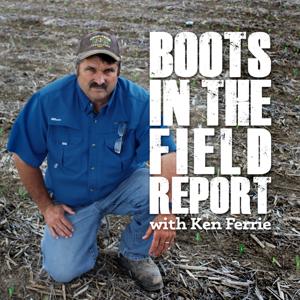


As growers are finally able to get back into fields locally, Ken does this week’s Boots In The Field Report from the tractor cab. Growers are doing everything they can to drag Harvest 21 across the finish line. Including cleaning out bins to dry beans, adjusting harvest order to get bean fields before the pods split open, changing heads throughout the day as to not lose an hour of harvest, and keeping their eye on their harvest loss.
After the 2-5 inches of rain Ken recommends using the floatation of your harvest equipment wisely to reduce compaction and reminds growers to keep records of the fields that are getting rutted up to make a plan to fix after harvest. In this week’s Boots In The Field Report he also advises that fields with bean pods opening move up the harvest list and shares the article https://fieldcropnews.com/2018/12/how-to-dry-soybeans-in-a-bin/ as a resource to help dry beans.
In this Boots in The Field Report Ken Ferrie covers multiple adjustments growers can make to their combine settings to reduce the record amount of harvest loss happening this year. He also advises growers to calculate in bushels what it cost to apply for removal of phosphorus and potash. The grain leaving the field is worth more and the cost to replace the nutrients leaving the field cost more. Looking at it in bushels from last year to this year can help put the cost in perspective and keep growers from putting on the brakes too soon.
In this week’s Boots In The Field Report Ken Ferrie talks with Matt Duesterhaus, a Crop-Tech Consulting regional agronomist, in Quincy, IL to see how the harvest is going. Matt points out that planting date/ear count, nitrogen management, and disease management are areas that are standing out as yields roll in. He explains that yields in general are looking good for both corn and beans in his area and he will be analyzing plot data to figure out if the yield increases are enough to cover the cost of application/implementation and create a positive ROI. Ken and Matt also touch on how switching to all fall anhydrous due to current prices comes with some risks, especially for growers who don’t usually apply anhydrous.
In this Boots In The Field Report Ken Ferrie covers calls coming in from OH, WI, and IA about yields, moisture, and how much is left to harvest. Much of the Midwest is coming out fairly low in percent of moisture, which could help reduce some pinch points this fall. Ken also shares some plot results that came out this week, with higher populations showing an advantage in some of the disease riddled areas. He advises that in learning and remembering the past we help improve the future, but with all the pocket environments and special circumstances of this year, he warns about throwing out everything you know to switch to something you don’t, based on this one year of data.
Ken gives a harvest report as numbers continue to roll in showing some significant yield increases to fungicide in the heavy disease areas. Looking at the number of days with precipitation in the June through August time frame could help explain why we saw such heavy disease pressure show up earlier this year than it has in the past. Ken also explains what the Crop-Tech hybrid labels of G-L1-L2-D mean.
Ken gives a harvest report of yields and moistures coming in from across the state in this week’s Boots In The Field Report. He explains why the outside rows of a field could be greener and higher moisture than the rest of the field, recaps the first fix/flexed plot that has come out, and prompts farmers to continue to send in which hybrids are and are NOT withstanding the disease pressure well. Ken reminds growers how valuable the yield maps from this season will be and encourages them to calibrate their yield monitors and make sure they are checking and adjusting for harvest loss on a per field/per hybrid basis. He also advises growers to be on the lookout for beans that are early maturing and/or early planted to make sure they don’t shell out on the ground while cleaning up corn acres.
On this week's #BIFR Ken Ferrie says the wheels have come off the bus on fields with Tar Spot. The crop is falling apart and quickly dying before being able to pack on the starch. He says tar spot seems to be varying by hybrid and a Harvest Plan is a MUST!
Ken gives a crop recap from his travels through Iowa and reports on finding: white mold, Goss’s wilt, and heavy army worm pressure in this week’s Boots In The Field Report. He also warns growers that drying down in the field may not be an option for fields that fail to reach black layer due to the high disease pressure. He advises that having a harvest plan and staying on top of it will be more important than ever this fall.
Ken reports in this Boots In The Field Report about seeing anthracnose top kill, edge of field scalding, and SDS in beans. His recent trip to Ohio and Indiana indicates, while disease is high in a lot of areas, not all areas are fighting tar spot as bad as Central IL. Ken reminds growers that if fields were in the reproduction stages and hit with high stress, it will speed up the plant and shorten grain fill.
From the publisher's feed
One of the founding pillars of Crop-Tech Consulting is integrating a systems approach to farming. Crop-Tech is continually adding to their expertise and services. To aid in this process, CTC…
148 Listeners
128 Listeners

223 Listeners
19 Listeners
360 Listeners
124 Listeners
385 Listeners

51 Listeners
114 Listeners

354 Listeners

4 Listeners
26 Listeners
1,698 Listeners
24 Listeners