
Sign up to save your podcasts
Or

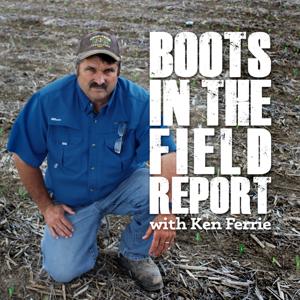


In this week’s Boots In The Field Report Ken covers how we are progressing compared to normal, what to look for now before the corn tassels, and reminds growers about staying on top of aphids, spider mites, and rootworm. He also warns about fields showing resistance, which areas need to be on higher alert for tar spot, and advises growers to take care of the waterhemp in beans before the seedbed gets out of control.
In this week’s Boots In The Field Report Ken touches on fields recovering from wind and hail damage, explains why L1 hybrids will take the biggest hit, and reminds growers to never walk away from a growing crop, especially this year. He also warns growers in the dry areas to stop mowing ditches and for pest scouts to be on the lookout for corn borer, western bean cutworm, rootworm, and Japanese beetles.
Ken Ferrie starts this week’s Boots In The Field Report with a fishing recap, followed by a crop report of how crops looked on the drive. He talks heat stress and what that means for these rolled up corn plants, and what pests to be on the lookout for. And despite a lot of farmers not getting into the fields to plant beans as early as they would like, he is still seeing pre-solstice flowering in several fields. Ken also puts out the call for those seeing tar spot to call the sightings into the office so we can keep tabs on it.
In this week’s Boots In The Field Report Ken covers nitrate levels, carbon penalty, cutworm, rootworm, and armyworm flights, and crop deficiencies showing up. He breaks down the difference in nitrogen, sulfur, and zinc deficiencies and how they present in the corn plant. Adding nitrogen to a sulfur deficiency can make the problem worse, so it is important to know which one you are facing. He also covers yellowing beans fighting the carbon penalty and why replant beans might be showing it more than older beans.
This year may go down in the books as some of the best corn stands Ken has seen, with the corn coming up in 4 days and even emergence. In this week’s Boots In The Field Report Ken covers the nitrate values coming back, indicating we are in the middle of the carbon penalty period. As the soils warm up, doubling the microbe population every 10 degrees, it creates a draw down on nitrogen supply. He warns that growers will possibly see yellow or pale green corn and even bean plants. This is a chance to evaluate your nitrogen plan for timing and see if it is working to not let your corn have a bad day. Cutting has started and with the price of corn Ken recommends moving the threshold from 3% to 1.5% on when to act. He also warns about bean leaf beetle feeding.
In this week’s Boots In The Field Report Ken Ferrie reports the ground that didn’t get hoed but is struggling to get make it out of the ground might have to be hoed twice and that still might not be enough to help the plants break through the crust. Replant decisions need to be made quickly with facts and not emotion. Ken reminds growers they will need to know both stand count and ear count when factoring in if they should replant. He also advises using their own knowledge from their hybrid fix/flex plots and the hybrid yearbook to help guide what number to use for bushels per ear when penciling out replant decisions. There is a replant calculator on our website to help guide these decisions. Ken also alerts pest scouts to be on the lookout for cutworm the end of this week.
Cold wet weather has brought planting progress to a crawl. In this week’s Boots In The Field Report Ken Ferrie warns growers about ground getting hard with recent rains causing planters to ride out of the ground and concern for crusting on crops already in the ground. He also covers how row fresheners can help with the less than desirable seed bed conditions and warns about running spring strip-till this late in the season with potential of drying out the soil and causing salt burn to the seed. Next week looks promising for planting and Ken advises growers to plant corn when they can plant corn. The loss to delaying corn planting at this late of a date far outweighs any advantage that can be gained by planting beans trying to gain an early planting advantage.
In this week’s Boots In The Field Report, Ken Ferrie discusses the closing window for achieving early planted beans. While there often isn’t a yield difference between strip-till and no-till beans, this year might prove to be the exception. Strip-tilling may create a 2-3 week earlier window for planting which may allow an opportunity for some pre-solstice flowering that the no-till couldn’t take advantage of because it was too wet to plant. Ken warns to switch from beans to corn when it is fit to plant corn, but not to jump the gun because replant decisions could be more costly this year than in normal years.
In this week’s Boots In The Field Report Ken warns growers getting antsy about getting in the field to make sure the calendar, coffee shop talk, nor neighbors are the deciding factor but rather your own investigation of fields to see if they are fit. A spring compaction layer can take the top yield potential out of field before you even get the seeds in the ground. He also reminds growers that are looking at calling an audible at the line and switching crops to make sure you have evaluated the whole process before making the change.
Ken starts this Boots In The Field Report with a recap of insects to be on the lookout for and then dives in with Matt Duesterhaus, breaking down how to evaluate bean maturities for different regions and planting dates when striving for pre-solstice flowering.
From the publisher's feed
One of the founding pillars of Crop-Tech Consulting is integrating a systems approach to farming. Crop-Tech is continually adding to their expertise and services. To aid in this process, CTC…

148 Listeners

128 Listeners

223 Listeners
19 Listeners

360 Listeners

124 Listeners

385 Listeners

51 Listeners

114 Listeners

354 Listeners

4 Listeners

26 Listeners
1,698 Listeners

24 Listeners