
Sign up to save your podcasts
Or

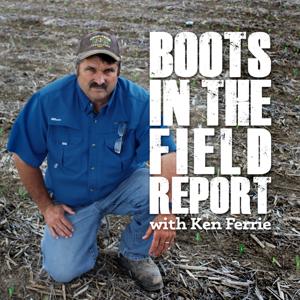


In this week’s Boots In The Field Report Ken talks bigger than expected swings in bean yields and attributes that to the maturity of the bean planted and the weather it received. He is getting a lot more reports of white mold showing up and recommends combine operators make a note for pest team for yield map review if they are seeing that show up in the grain tank. Ken also recaps yield results from the Corn College Campus teaching plots and discusses why L1 and L2 hybrids have seemed to stumble more with this year’s weather pattern.
Ken talks about the gift and the curse of the dry fall: easier harvesting without getting equipment stuck/wheel tracks, don’t have to go as deep with fall tillage to get full width shatter, and good conditions to build fall strips, but without moisture it may make fall anhydrous applications impossible to seal. He also reminds growers that they will need to have notes of weed escapes because it will take 3 years of staying on top of it to get them back under control. Ken advises harvest scouts to keep track of ear counts and locations so at yield mapping time, they can calculate bushels per ear and when finding ear mold issues moving them up the harvest list and not storing that grain at home.
In this week’s Boots In The Field Report Ken gives a harvest report of yields coming in across the state and comments that combine operators are saying the big swings in yield in a field are coming from the swings in stand throughout the field. Yields are expected to improve in corn fields as growers move to later planted corn that had less weather obstacles at the beginning of the season. The good September weather is helping gain depth of kernel which helps offset some of the tip abortion loss from earlier in the season. Ken calls combine operators to have two main things on their to-do list: calibrate their yield monitor and check for harvest loss.
In this week’s Boots In The Field Report Ken covers the harvest reports coming in and the highlights from his recent Iowa / Minnesota crop tour. He reports Northern Iowa and Southern Minnesota seem to be the heaviest of Tar Spot Alley this year. Several areas had a challenging July and August but a favorable September. If plants could stay healthy long enough to take advantage of September, growers might be presently surprised at harvest. Ken also encourages pest teams to watch how fields are drying down to help inform harvest order.
Ken Ferrie recaps 2,700 miles of crop touring over the last week on what he saw on the way up to Canada and coming back. He also reports April planted corn locally is hitting black layer and causing some growers to think about harvesting soon to cash in on premiums. Ken additionally comments on how corn that is stressed now, is hustling to black layer and that will come at the cost of grain fill.
In this week’s Boots In The Field Report Ken covers tip loss, spider mites, northern leaf blight and diseases increasing later in the season in corn fields. He also covers sightings of SDS and white mold in bean fields. Ken talks with Matt Duesterhaus to see what he has been seeing in Western Illinois.
In this week’s Boots In The Field Report Ken gives a crop report from his trip to Ohio and back and on conditions he is seeing locally. Due to the late planting and tight water margins a lot of final yield potential is riding on the last 30 days of fill and making it hard to make accurate yield estimates right now. Ken also warns about heavy spider mite pressure due to weather and spraying taking out all its natural predators and tipping the balance in the mite’s favor. As always Ken reminds growers not to walk away from a growing crop, especially this year
Most areas got at least a little rain last week, but some got too much and in some areas it came with heavy winds. While the fields that took heavy wind in June still had growing potential to lessen the effects of the goose-necking and neighboring plants in the green snap areas could adjust ear size or throw a second ear to account for additional sunlight, it is too late in the season for either of those things to do much good for the fields that got wind last week. As Ken was looking at crops that reached R3 and beyond, pollination is showing more uneven than first thought, mostly due to heat stress. In beans, he is seeing waterhemp escapes and both Japanese beetle and the stink bug invade. All this and more in this week’s Boots In The Field Report.
In this week’s Boots In The Field Report Ken Ferrie tells how water in the next 60 days will tell the rest of the story, how despite being able to pollinate in 5 days the heat wreaked some havoc on even pollination, and warns about checking for spider mites in the corn before spraying a fungicide.
In this week’s Boots In The Field Report Ken covers how quickly pollination is going, the increasing need to spray for silk clippings, why shorter corn might be a good thing come this fall, where tar spot has been reported and why even though it is later in the calendar year than last year, why it would be considered coming in earlier in plant maturity. He advises pest bosses to be scouting low on that plant as most will be home grown and warns that we may be looking at mid to late October for harvest.
From the publisher's feed
One of the founding pillars of Crop-Tech Consulting is integrating a systems approach to farming. Crop-Tech is continually adding to their expertise and services. To aid in this process, CTC…
148 Listeners

128 Listeners

223 Listeners
19 Listeners
360 Listeners

124 Listeners

385 Listeners

51 Listeners
114 Listeners

354 Listeners

4 Listeners

26 Listeners
1,698 Listeners

24 Listeners