
Sign up to save your podcasts
Or

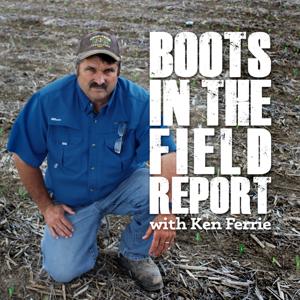


In this week’s Boots In The Field Report Ken covers some of the issues he is seeing in this dry weather including drought stress on crops, herbicide carryover from last June being dry, and lack of mass flow for potassium uptake. He continues to get reports of leaning corn issues due to lack of crown root development and warns that dicamba type product applications will probably make this problem worse. He has also spotted silvering on corn due to low temp / scalding on leaves, cutworm damage on beans planted into cover, and first flowers on early planted beans. He also advises growers to be on army worm watch this weekend and to make sure in these dry conditions to use a urease inhibitor with y-drop and surface sidedress applications.
This week’s Boots In The Field Report covers issues popping up in fields as this crop starts to take off. Ken Ferrie reports on heavy cutworm pressure causing growers to spray, dry conditions causing herbicide carryover and a number of conditions causing good but not great ratings for corn stands. Ken also reminds growers of the difference between the ugly corn phase and the carbon penalty. He recommends that now is the time to be in the fields documenting conditions, checking for rootless corn, insect presence/feeding, and diagnosing dead plants to help make improvements for next year.
High Ear Counts = High Yields
In this week's #BIFR, Ken reminds growers that high ear counts are the key to high yields. He also covers planting updates, replant decisions, the ugly corn phase, and insect activity. Cutworm feeding has started, so pest teams be on the lookout!
Ken Ferrie covers planting progress and emergence in this week’s Boots In The Field Report. Much-needed rain came for most of the Midwest and will help reduce a lot of service calls on all the seed that was sitting in dry soil. Bean stands are looking good and indicating a lot will make early flowering.
While corn stands look good from the road, Ken advises stretching a tape to see what your stand count and ear count are. While industry standard says growers should shoot for a 13% or less reduction from planted to ear count, Ken challenges growers to strive to keep it under 6% to take their yields to the next level. He also recommends recording and cataloging these early stand and ear counts so they can be reviewed during yield map meetings.
Ken also covers how seed chilling, seed quality, and seed orientation play into the emergence issues and advises if growers pushed away a lot of dry soil to plant into moisture and received a good shot of rain this week, to keep an eye out for crusting.
It is finally here! In this week’s Boots In The Field Report Ken Ferrie gives the green light locally for planting corn and encourages growers to get this planting season in the books. But he does caution growers to make sure they are planting into moisture. He gives the following advice if still needing to do tillage before plating:
Horizontal tillage: make sure the planter is on the tail of the tillage pass to make sure moisture doesn’t get away.
Vertical Tillage: If have to run, run shallow with little to no gang angle. If running on bean stubble to dry and warm up the soil, not needed with these conditions could go no-till. If running to incorporate surface nitrogen, better off buying a urease inhibitor and no-tilling to save moisture with current forecast.
High Speed Disks: this is putting in a shallow horizontal tillage layer creating a lot of issues. Gives up moisture needed for germination within hours, subject to blowing if it doesn’t rain and subject to crusting if it does rain.
Planting into moisture is crucial and Ken advises using technology like SmartFirmers and digging behind the planter multiple times to ground truth if you are staying in moisture. He reminds growers that the closing system has 2 jobs: 1. Close from the bottom up 2. Firm soil so moisture doesn’t get away. Farmers do NOT want to get dry soil down into the trench, that may mean switching from spike wheels to solid wheels, making sure depth wheels are snug against disk openers, and in tilled soil, increasing down pressure to keep a true V.
If having moisture to germinate is a concern Ken recommends shutting of the in-furrow starter to reduce risk of salt burn to seed and if have technology like FurrowJet, sending product to the wings and keeping it out of the furrow. If water is gone down to planting depth, two options remain: 1. Waiting for a rain and then chasing it with the planter. 2. Use row cleaners and push dry soil out of the way to get to moisture. Both come with several risks but have better odds than planting in dry conditions and hoping for a rain.
Ken also reminds growers about the problem brewing with cutworm and armyworm populations and advises growers to check if their seed treatment package covers cutworm or armyworm. If not may need to think about adding an insecticide to the planter or to burndown pass.
In this Boots In The Field Report Ken Ferrie covers the calls coming in on the crops planted April 3-10th that took the hardest hit from the freeze. The first step to evaluating replant decisions is to have accurate counts for what plants survived. For beans checking that the stem below the cotyledon is firm. If soft, it gets counted in the dead column. If firm, it gets counted in the maybe column and growers will have to watch for new growth to confirm (70-90 GDUs – so could be next Friday before you know). On corn Ken recommends checking plants that had spikes close to the surface, watching to see if those split and try to leaf out underground. Moisture, tillage practices, and field conditions can play a big role in how deep the freeze got. As the calendar days start to slip away, growers need to know how many days it will take their operation to get their corn crop in the ground. That will determine if they have the luxury to wait for conditions to be right to give them the best chance of achieving their ear count objectives or if they are going to have to push conditions at one end or the other of the planting window. He also reminds growers as they wait to get back in to finishing planting not to drop the ball on their planted acres, keeping an eye out for crusting and cutworm and armyworm issues.
In this week’s Boots in The Field Report Ken covers planting progress of last week and concerns as we look at the weather ahead. Beans that were planned to be planted early and have been treated for SGS, can be planted understanding that they will be in the ground for awhile before they come up and require growers to keep an eye on soil crusting to make sure it doesn’t become an issue. He also explains the difference in conditions that cause concern for losing spike down plants versus seed chilling concerns. Both seed chilling, and spike down loss have the possibility of at 7-10 percent stand reduction, so if fighting both could already be at a 14-20 percent reduction if everything else is perfect. Ken also speaks to some of the lower seed germination results rolling in and if growers have concerns with soybean germination score, they might want to bump population 10%.
In this week’s Boots In The Field Report Ken gives the green light locally to plant fully treated beans for early planting with the understanding that there is always a risk that you may have to replant if we get a heavy frost. If forecast locally is correct then also giving a yellow light to plant corn Wednesday through noon Saturday to get the first day willies out. Understanding that the corn will most likely be in the ground until May 1st if the forecasted weather between now and then holds true. Ken reminds growers that they will have trouble with spike down plants being late emergers and that this is NOT the time to use those seed samples that had poor seed test results coming back. He also reminders growers that if you can ribbon the soil 1 inch below your tillage pass than you are going to create a compaction layer by running in too wet conditions. Use your own field conditions (on a field-by-field basis) and the depth and type of tillage tool you are using to guide when it is fit to run in each of your fields.
This week on the Boots In The Field Report podcast Ken Ferrie advises that now is the time for the pest boss to lay down the first line of defense. He recommends cutworm and armyworm traps going out wherever you have green cover, setting up wireworm and grub bait stations, and putting out gopher and vole bait traps. Most problems are very manageable if caught early enough. When the population grows too big, then you start to run out of options to manage and avoid a reduction in yields. Scouting for the 2023 crop starts now.
The question to ask: “Is the soil dry enough?” In this week’s Boots In The Field Report Ken Ferrie covers why this questions is so important, with 80% of the service calls for compaction that he goes on can all be traced back to this first pass in the spring. If growers are doing vertical tillage, asking is the soil dry enough to handle the weight of the equipment without creating compaction? If doing tillage, what is the moisture like below the tillage layer, is it too moist and will create compaction? This also applies to when to run the burn down pass to make sure you won’t have wheel tracks to deal with all season long. Ken also cautions growers about using spring anhydrous in the strip, wanting either rain, using RTK to stay off strips when planting or at least 2 weeks between that and planting to help tame down the anhydrous core pH.
From the publisher's feed
One of the founding pillars of Crop-Tech Consulting is integrating a systems approach to farming. Crop-Tech is continually adding to their expertise and services. To aid in this process, CTC…
148 Listeners
128 Listeners

223 Listeners
19 Listeners
360 Listeners

124 Listeners
385 Listeners

51 Listeners
114 Listeners

354 Listeners

4 Listeners

26 Listeners
1,698 Listeners
24 Listeners