
Sign up to save your podcasts
Or

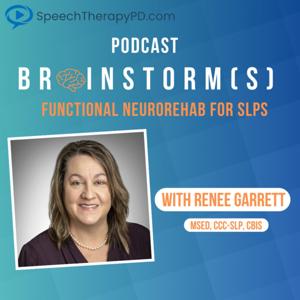


Surviving a brain tumor is only one part of the story.
Guest: Ana Hernandez, MS, CCC-SLP
Earn 0.10 ASHA CEUs for this episode with Speech Therapy PD
Watch on YouTube
In this episode of Brainstorms, host Renee Garrett, MSEd, CCC-SLP, CBIS, is joined by Ana Hernandez, MS, CCC-SLP, a speech-language pathologist and brain tumor survivor, to share Ana’s lived experience of recovery and rebuilding life after treatment.
Ana shares how recovery has affected communication, cognition, energy, relationships, identity, and participation in everyday life. Together, Renee and Ana discuss challenges that may be less visible to others, including cognitive fatigue, communication changes, adjusting to a new normal, and learning to advocate for the support you need.
About the Guest: Ana Hernandez, MS, CCC-SLP, founder of Adult Stuttering Services, focuses on stuttering care that prioritizes quality and dignity. A survivor of brain surgery, her clinical perspectives are shaped by her own recovery journey. This deep dive into neurodivergence has significantly shaped her clinical perspective.
Difficulty swallowing pills may point to a broader concern involving swallowing or functional communication.
Guest: Katie Decker, MA, CCC-SLP
Earn 0.10 ASHA CEUs for this episode with Speech Therapy PD
Watch on YouTube
In this episode of Brainstorms, host Renee Garrett, MSEd, CCC-SLP, CBIS, is joined by Katie Decker, MA, CCC-SLP, to discuss pill dysphagia, an often-overlooked challenge that can affect medication adherence, safety, and overall health.
Renee and Katie examine the factors that can make swallowing medication difficult, including pill size, shape, and texture, as well as swallowing physiology, cognition, and underlying neurologic conditions.
About the Guest: Katie Decker, MA, CCC-SLP, is a Clinical Specialist with PatCom Medical, where she focuses on providing clinicians nationwide with access to state-of-the-art swallowing and voice diagnostic equipment to enhance their practice and patient care. She has previously worked in a variety of medical settings, including owning and operating a Mobile FEES business in Iowa.
Communication disorders can have far-reaching consequences in healthcare.
Guest: Hilary Sample, MA, CCC-SLP
Earn 0.10 ASHA CEUs for this episode with Speech Therapy PD
Watch on YouTube
In this episode of Brainstorms, host Renee Garrett, MSEd, CCC-SLP, CBIS, is joined by Hilary Sample, MA, CCC-SLP, to examine how conditions such as aphasia, dysarthria, apraxia of speech, and cognitive-communication disorders can create barriers to receiving high-quality medical care. Together, they discuss why effective communication is critical to healthcare and what clinicians across settings need to know.
About the Guest: Hilary Sample, MA, CCC-SLP, is a medical speech-language pathologist and co-founder of MedConcerns. Drawing on her experience in acute care and inpatient rehabilitation, she partnered with a physician to develop practical tools that help healthcare teams communicate more effectively with patients who have aphasia and other communication disorders.
Show Notes:
Hilary Contact: @medconcerns @hilarysampleslp
MedConcerns: https://medconcerns.com/
References:
Clarification:
Bartlett et al. (2008) found that among patients who experienced preventable adverse events, 46% of those with communication problems experienced multiple events, compared with 20% of those without communication problems.
Developing expertise in voice disorders takes more than what is learned in graduate school.
Guest: Moriah Douglas, MS, CCC-SLP
Earn 0.10 ASHA CEUs for this episode with Speech Therapy PD
Watch on YouTube
Developing expertise in voice disorders takes more than what is learned in graduate school. In this episode of Brainstorms, host Renee Garrett, MSEd, CCC-SLP, CBIS, is joined by Moriah Douglas, MS, CCC-SLP, to discuss how mentorship, clinical experience, and lifelong learning help speech-language pathologists build confidence in the assessment and treatment of voice disorders.
About the Guest: Moriah Douglas, MS, CCC-SLP, is a speech-language pathologist specializing in acute and outpatient medical rehabilitation. She earned her master's degree in Speech-Language Pathology from the University of St. Augustine for Health Sciences in 2024 after completing undergraduate degrees in Speech and Hearing Sciences at the University of South Alabama and Athletic Training at the University of West Florida.
How can we incorporate brain health into everyday clinical practice?
Guest: Jennifer Ruckner, MS, CCC-SLP
Earn 0.10 ASHA CEUs for this episode with Speech Therapy PD
Watch on YouTube
Brainstorms podcast host Renee Garrett, MSED, CCC-SLP, CBIS, is joined by Jennifer Ruckner, MS, CCC-SLP, for a practical discussion on how speech-language pathologists can incorporate brain health into everyday clinical practice. Together, they break down the neuroscience behind neuroplasticity, cognitive reserve, and lifestyle factors that influence brain function, while exploring what brain health really means across the continuum of care.
About the Guest: Jennifer Ruckner, MS, CCC-SLP, is a seasoned speech-language pathologist with over three decades of experience across Early Intervention, school districts, and private practice. She earned her Bachelor of Science and Master’s degrees in Communication Disorders from Auburn University and has practiced since 1990. Jennifer specializes in Social/Pragmatic Language, Autism Spectrum Disorder, Expressive Language Disorder, and Feeding Disorders.
Show Notes and Resources:
Health-literate communication is essential to effective speech-language pathology practice.
Guest: Richard Zraick, PhD, CCC-SLP, CHSE
Earn 0.10 ASHA CEUs for this episode with Speech Therapy PD
Watch on YouTube
In this episode of Brainstorms, Richard Zraick, PhD, CCC-SLP, CHSE, joins host Renee Garrett, MSEd, CCC-SLP, CBIS, to discuss practical, evidence-informed strategies for making clinical communication clearer, more accessible, and more actionable. Together, they examine common barriers to patient understanding and share practical ways to organize information, reduce cognitive load, use plain language without sacrificing clinical accuracy, incorporate teach-back into everyday practice, and create patient education that better supports individuals with communication disorders, cognitive impairments, and varying literacy levels.
About the Guest: Richard Zraick, PhD, CCC-SLP, CHSE, is Professor and formerly the Founding Director of the School of Communication Sciences and Disorders at the University of Central Florida. He is a Fellow of the American Speech, Language, and Hearing Association. He is also a Certified Health Simulation Educator. He completed his Psychology B.A. (’84) and Speech and Hearing Science M.A. (’87) at the University of Arizona, followed by a Ph.D. from Arizona State University (’98).
Show Notes:
Examining Patient-Provider Language and Interactions in Healthcare (EXPLAIN) Lab
Why Do Intent, Intensity, and Neuroplasticity Matter?
Guest: Laura Langer, MS, CCC-SLP
Earn 0.10 ASHA CEUs for this episode with Speech Therapy PD
Watch on YouTube
In this episode of Brainstorms, host Renee Garrett, MSEd, CCC-SLP, CBIS, is joined by Laura Langer, MS, CCC-SLP, to examine the evidence behind the SPEAK OUT! program and why intentional speech production plays such an important role in treating individuals with Parkinson's disease. Together, they discuss the research supporting SPEAK OUT!, the principles of motor learning and neuroplasticity that guide the program, and how repetition, intensity, and salience work together to create meaningful improvements in communication.
About the Guest: Laura Langer, M.S., CCC-SLP, serves as the Chief Clinical & Research Officer at Parkinson Voice Project, where she is committed to advancing evidence-based care for individuals with Parkinson's disease. She has an extensive background in medical speech-language pathology and clinical education, with a strong focus on neurologic communication and swallowing disorders.
Guest: Valerie James Abbott
Earn 0.10 ASHA CEUs for this episode with Speech Therapy PD
Watch on YouTube
In this episode of Brainstorms, host Renee Garrett, MSEd, CCC-SLP, CBIS, welcomes Valerie James Abbott, parent-advocate and national leader in hearing health awareness, for an important discussion about late-onset hearing loss. Because many children with late-onset hearing loss pass their newborn hearing screening, later-developing hearing changes can be easily missed. Valerie shares both her personal experience as the parent of a child with late-onset hearing loss and her work advocating for improved hearing screening, family support, and better outcomes for deaf and hard-of-hearing children.
About the Guest: Valerie James Abbott is the parent of a child with late-onset hearing loss. As a parent-advocate and leader, she worked for the Center for Family Involvement at the Partnership for People with Disabilities at Virginia Commonwealth University, supporting families of children recently diagnosed with hearing loss. She served as the first parent ever elected chair of the Virginia Early Hearing Detection and Intervention Program Advisory Committee, and she led the nonprofit Hands & Voices' return to Virginia.
Follow Valerie IG: valerie.james.abbott
What happens when the clinician suddenly becomes the patient?
Guest: Laura Morgan, MS, CCC-SLP, CBIST
Earn 0.10 ASHA CEUs for this episode with Speech Therapy PD
Watch on YouTube
In this episode of Brainstorms: Functional Rehab for SLPs, Renee Garrett, MSEd, CCC-SLP, CBIS, is joined by Laura Morgan, MS, CCC-SLP, CBIST, for a deeply personal conversation about Laura’s experience navigating life after brain injury while also carrying the insight and perspective of a rehabilitation professional.
About the Guest: In 2012, after Laura Morgan earned her master’s in Speech-language Pathology, she started her clinical fellowship in Frederick, Maryland. Halfway through the fellowship, Laura was a buckled passenger in a serious motor vehicle accident. She sustained a moderate-to-severe brain injury in the accident, but as a result of the long rehab process, she gained a unique perspective on head injury in the field of Speech Pathology. Laura Morgan IG: 📍 SLP_TBI
Show Notes:
Contact Laura Morgan IG: 📍 SLP_TBI
Guest: Sarah Tucker, PT, NCS, AIT, BRM
Earn 0.10 ASHA CEUs for this episode with Speech Therapy PD
Watch on YouTube
This episode of Brainstorms: Functional Rehab for SLPs features Sarah Tucker, PT, NCS, AIT, BRM, discussing the vital role adaptive fitness can play in long-term neuro recovery after formal rehabilitation ends. For individuals living with stroke, traumatic brain injury, Parkinson’s disease, spinal cord injury, and other neurological conditions, recovery is often a lifelong process. This conversation explores how adaptive fitness programs can help rebuild strength, confidence, identity, and connection while supporting meaningful participation in everyday life. Renee and Sarah highlight the growing intersection between rehabilitation and inclusive fitness, emphasizing how movement impacts not only physical function, but also cognitive, emotional, and social well-being.
About the Guest:
Sarah Tucker, MPT, is a physical therapist with over 17 years of experience in inpatient rehabilitation and 8 years in outpatient neurological therapy. She earned her Master of Physical Therapy degree from Quinnipiac University in Hamden, Connecticut, in 2002 and has spent her entire clinical career in Newport News, Virginia.
Sarah Tucker IG: Uncharted_Adaptive_Fitness
From the publisher's feed

90,783 Listeners

43,814 Listeners
883 Listeners
369,412 Listeners
213 Listeners
47 Listeners

17,989 Listeners
27 Listeners
6 Listeners

5,831 Listeners
20 Listeners

13 Listeners
3 Listeners
7 Listeners
7 Listeners